





Last Updated 09-09-2026
Executive Summary
- Secondary Markets: Understand why buyers and investors are increasingly exploring smaller real estate markets.
- Affordability: See how secondary markets can offer more accessible property prices.
- Growth Potential: Explore the factors that can support long-term market growth.
- Niagara Opportunity: Learn why Niagara is attracting buyers, sellers, and real estate investors.
- Investment Strategy: Understand key factors to consider before investing in a secondary market.
Why This Shift Matters
A young professional couple earning a combined $150,000 per year walks through a downtown Toronto condo. The asking price: $850,000 for 650 square feet. Two weeks later, they’re touring a 2,000 square foot detached home in St. Catharines, Niagara Region. The price: $665,000. The home comes with a backyard, garage, and proximity to wineries. More importantly, the husband’s job in Toronto remains accessible via improved GO Transit service.
This is not a hypothetical scenario. This is the calculation thousands of Ontario buyers are making in 2025.
Following the COVID-era price surge that saw GTA home values climb by 40-50% in just two years, many first-time buyers and young families found themselves permanently priced out of the market they grew up in. While prices have moderated since 2023-declining 6-8% in many GTA submarkets-affordability remains historically strained. The average home in the GTA sits at $1,039,458 as of late 2025, with Toronto specifically averaging $1,036,362.
The question is no longer if buyers should look beyond the GTA, but where it makes strategic sense to relocate while maintaining connection to GTA employment and lifestyle. This blog examines Ontario’s emerging secondary markets-particularly the Niagara Region-alongside Kitchener-Waterloo-Cambridge, Hamilton, Guelph, Barrie, and Simcoe County, analyzing affordability, infrastructure, employment, and long-term growth potential.
Get comprehensive, data-driven real estate guidance on the rise of secondary markets with Quantum Team Realty. Serving buyers, sellers, and investors across Niagara Falls, St. Catharines, Welland, and the Greater Toronto Area.
The Affordability Crisis That Created This Opportunity
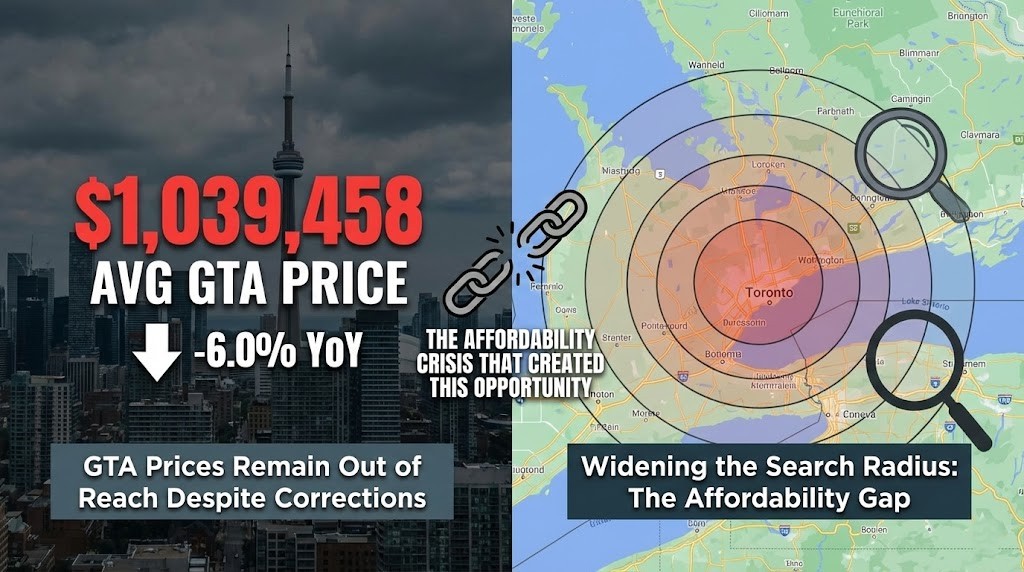
Monthly Expense Comparison Table
The Greater Toronto Area maintains an average home price of $1,039,458 as of November 2025, down 6.0% year-over-year. While this represents a correction from peak 2022 levels, it offers little relief to buyers who couldn’t afford homes when they were 30% higher.
Looking to purchase property? Explore how to buy a home in Niagara with our team.
GTA Price Performance by Municipality (November 2025):
- Source: WOWA.ca, Toronto Regional Real Estate Board, November 2025
| Municipality | Average Price | YoY Change | Typical Property Type |
|---|---|---|---|
| Toronto (City) | $1,036,362 | -4.1% | Condo / Townhouse |
| Mississauga | $968,036 | -2.8% | Condo / Semi-Detached |
| Brampton | $914,161 | -10.0% | Semi / Detached |
| Oakville | $1,672,000 | -10.8% | Detached |
| Richmond Hill | $1,280,000 | -16.0% | Detached |
| Markham | $1,350,000 | -8.5% | Detached |
Even with these declines, qualifying for an average home in the GTA requires household incomes approaching $195,000-$200,000 annually. For perspective, according to Statistics Canada, the median household income in Ontario is approximately $87,000.
This affordability gap isn’t closing-it’s widening the search radius.
Secondary Markets: The Strategic Alternative
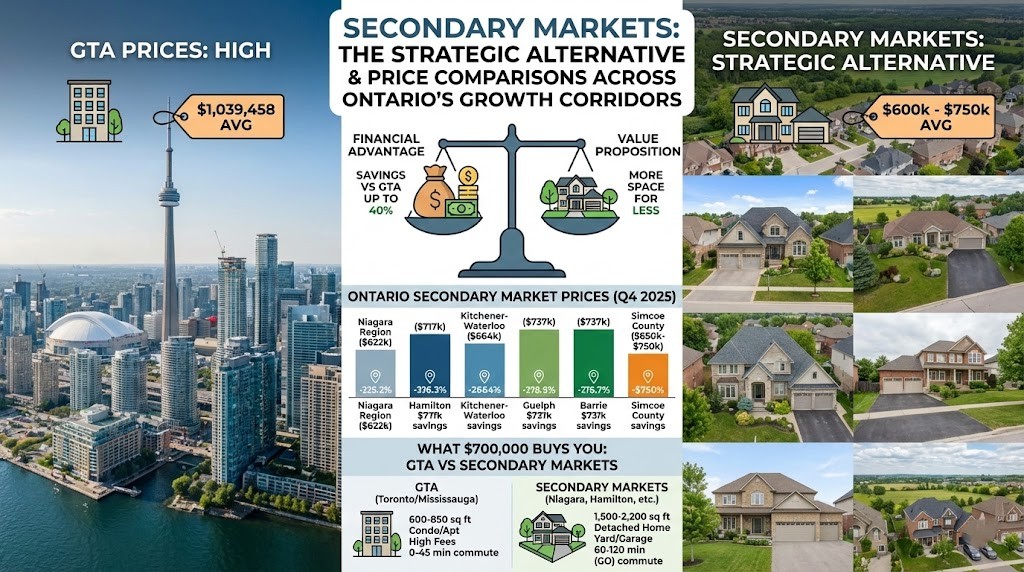
Living Expense Comparison Table
The financial advantage of secondary markets becomes clear when examining direct comparisons:
Ontario Secondary Market Prices (Q4 2025):
| Market | Average / Median Price | Distance from Toronto | Savings vs GTA | YoY Change |
|---|---|---|---|---|
| Niagara Region | $622,079 avg | 130 km (81 mi) | -$417,379 (40%) | -9.4% |
| St. Catharines | $665,000 | 135 km | -$374,458 | -4.2% |
| Niagara Falls | $610,000 | 130 km | -$429,458 | -6.5% |
| Kitchener-Waterloo | $664,300 benchmark | 110 km (68 mi) | -$375,158 (36%) | -6.9% |
| Cambridge | $690,000 | 100 km | -$349,458 | -6.5% |
| Hamilton | $717,344 avg | 70 km (43 mi) | -$322,114 (31%) | -6.4% |
| Guelph | $737,339 avg | 95 km (59 mi) | -$302,119 (29%) | -3.0% |
| Barrie | $736,988 median | 105 km (65 mi) | -$302,470 (29%) | -4.0% |
| Simcoe County | $650,000 – $750,000 | 100-140 km | -$289,458 – $389,458 | -5% to -8% |
- Sources: Niagara Association of REALTORS, WOWA.ca, Waterloo Region Association of REALTORS, CREA, HonestDoor, Durham Post, November-December 2025
The Niagara Region specifically showed an average sold price of $622,079 in December 2025, representing a 9.43% year-over-year decline-creating exceptional value for buyers with GTA incomes purchasing in secondary markets.
What $700,000 Buys You: GTA vs Secondary Markets
| Location | Property Type | Size | Features | Commute to Union Station |
|---|---|---|---|---|
| Toronto (City) | 1-bed condo | 600 sq ft | No parking, high fees | 0-30 min |
| Mississauga | 2-bed condo | 850 sq ft | 1 parking, amenities | 30-45 min |
| Niagara Region | 3-bed detached | 1,800-2,200 sq ft | Garage, yard, renovated | 90-120 min (GO) |
| Kitchener | 3-bed semi-detached | 1,600 sq ft | 2 parking, finished basement | 90-110 min (GO) |
| Hamilton | 3-bed detached | 1,700 sq ft | Driveway, yard | 60-75 min (GO) |
| Guelph | 3-bed townhouse | 1,500 sq ft | Garage, small yard | 75-90 min (drive) |
| Barrie | 3-bed detached | 1,900 sq ft | Double garage, yard | 75-90 min (GO) |
Based on November-December 2025 MLS data and typical property offerings
The value proposition is stark: for $700,000, Toronto buyers get 600 square feet. Niagara buyers get 1,800-2,200 square feet with outdoor space.
The Niagara Advantage: Deep Dive into Ontario's Emerging Market
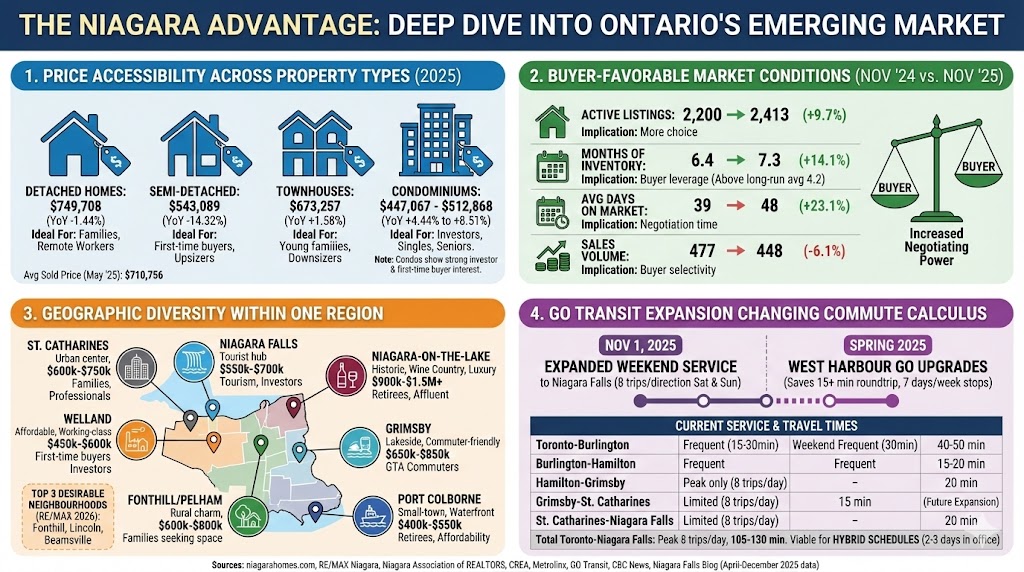
Why Niagara Is Leading Secondary Market Growth
The Niagara Region-encompassing St. Catharines, Niagara Falls, Welland, Fort Erie, Grimsby, Fonthill/Pelham, and Niagara-on-the-Lake-has emerged as the standout alternative to GTA living for several strategic reasons:
1. Price Accessibility Across Property Types
As of May 2025, Niagara’s average sold price was $710,756, with detached homes at $749,708, semi-detached at $543,089, townhouses at $673,257, and condominiums at $512,868.
Property Type Comparison Table
| Property Type | Average Price | YoY Change | Ideal For |
|---|---|---|---|
| Detached Homes | $749,708 | -1.44% | Families, remote workers |
| Semi-Detached | $543,089 | -14.32% | First-time buyers, upsizers |
| Townhouses | $673,257 | +1.58% | Young families, downsizers |
| Condominiums | $447,067 – $512,868 | +4.44% to +8.51% | Investors, singles, seniors |
- Sources: niagarahomes.com, RE/MAX Niagara, April-December 2025
Notably, condos emerged as the standout performer in December 2025, with an average price of $447,067 and an 8.51% year-over-year increase-signaling strong investor and first-time buyer interest.
2. Buyer-Favorable Market Conditions
As of November 2025, months of inventory in Niagara numbered 7.3 months, up from 6.4 months a year earlier and significantly above the long-run average of 4.2 months.
Quick Market Comparison Table
| Metric | Nov 2024 | Nov 2025 | Change | Market Implication |
|---|---|---|---|---|
| Active Listings | 2,200 | 2,413 | +9.7% | More choice |
| Months of Inventory | 6.4 | 7.3 | +14.1% | Buyer leverage |
| Average Days on Market | 39 | 48 | +23.1% | Negotiation time |
| Sales Volume | 477 | 448 | -6.1% | Buyer selectivity |
- Source: Niagara Association of REALTORS, CREA, niagarahomes.com, November 2025
This buyer’s market environment means purchasers have negotiating power absent from GTA markets for years. Average days on market reached 45 days in August 2025, up 12.50% from the previous year, giving buyers time for thorough inspections and strategic offers.
3. Geographic Diversity Within One Region
Niagara isn’t a monolithic market-it offers distinct communities catering to different buyer priorities:
Quick Market Comparison Table
| Community | Character | Average Price Range | Best For |
|---|---|---|---|
| St. Catharines | Urban center, full amenities | $600,000 – $750,000 | Families, professionals |
| Niagara Falls | Tourist hub, waterfront access | $550,000 – $700,000 | Tourism workers, investors |
| Niagara-on-the-Lake | Historic, wine country, luxury | $900,000 – $1,500,000+ | Retirees, affluent buyers |
| Welland | Affordable, working-class | $450,000 – $600,000 | First-time buyers, investors |
| Grimsby | Lakeside, commuter-friendly | $650,000 – $850,000 | GTA commuters |
| Fonthill / Pelham | Rural charm, growing | $600,000 – $800,000 | Families seeking space |
| Port Colborne | Small-town, waterfront | $400,000 – $550,000 | Retirees, affordability seekers |
Based on November-December 2025 MLS data and local market reports
According to RE/MAX’s 2026 outlook, the top three neighborhoods anticipated to be the most desirable in Niagara are Fonthill, Lincoln, and Beamsville, each offering a balance of small-town charm, growing amenities, and proximity to key employment hubs.
4. GO Transit Expansion Changing Commute Calculus
The single biggest factor transforming Niagara from “too far” to “feasible” is transportation infrastructure expansion.
Beginning November 1, 2025, GO Transit expanded weekend service to Niagara Falls, offering eight trips in each direction between Toronto and Niagara Falls every Saturday and Sunday.
West Harbour GO Station upgrades completed in spring 2025 now save Niagara commuters over 15 minutes per roundtrip, with every Niagara- and Toronto-bound train stopping at West Harbour GO Station seven days a week.
GO Transit Route Service Table
| Route Segment | Weekday Service | Weekend Service | Travel Time | Key Stops |
|---|---|---|---|---|
| Toronto – Burlington | Frequent (15-30 min) | Frequent (30 min) | 40-50 min | Multiple |
| Burlington – Hamilton | Frequent | Frequent | 15-20 min | West Harbour, Confederation GO (new) |
| Hamilton – Grimsby | Peak hours only | 8 trips/day | 20 min | Future expansion |
| Grimsby – St. Catharines | Limited | 8 trips/day | 15 min | Planned station |
| St. Catharines – Niagara Falls | Limited | 8 trips/day | 20 min | Niagara Falls GO |
| Total: Toronto – Niagara Falls | Peak service | 8 trips each way | 105-130 min | Full corridor |
- Sources: Metrolinx, GO Transit, Niagara Falls Blog, CBC News, October-November 2025
With the GO Transit service area-which includes the Greater Toronto and Hamilton Region, Kitchener-Waterloo, Barrie and Niagara-expected to grow to 15 million people by 2051, expanding GO service is necessary to help alleviate congestion.
For buyers working hybrid schedules (2-3 days in office), GO Transit makes Niagara viable. A 2-hour commute twice weekly is manageable. A 2-hour commute five days weekly is not.
What Makes KWC Attractive
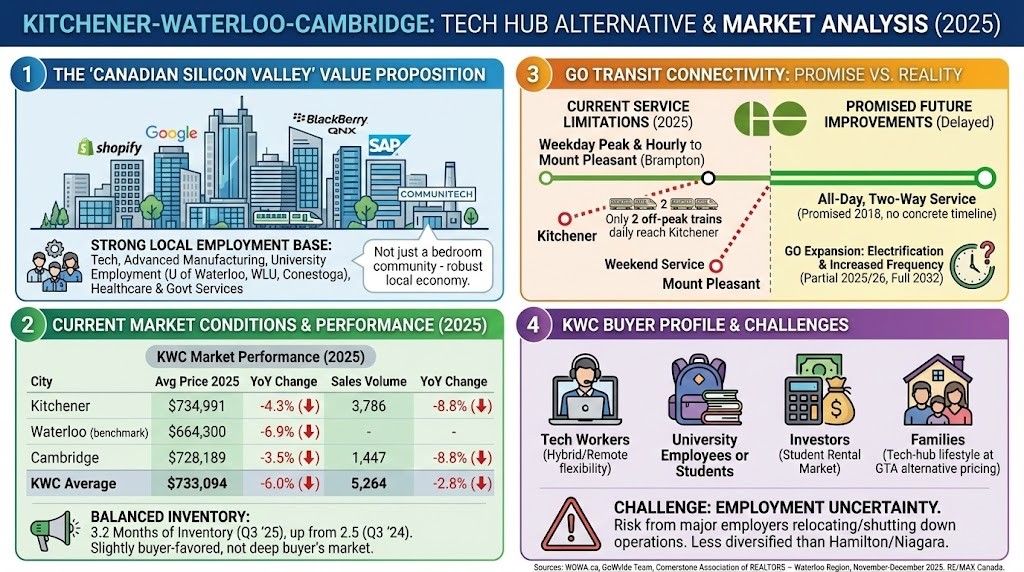
1. Strong Local Employment Base
Unlike pure bedroom communities, KWC has its own robust economy:
- Tech sector (Shopify, Google, BlackBerry QNX, SAP, Communitech)
- Advanced manufacturing
- University employment (University of Waterloo, Wilfrid Laurier, Conestoga College)
- Healthcare and government services
This means buyers aren’t solely reliant on GTA employment-local job opportunities exist.
2. Balanced Inventory Conditions
Months of inventory for single detached homes numbered 3.2 at the end of Q3 2025, up from 2.5 months in Q3 2024.
In August 2025, 536 homes sold through the MLS System, down 1.3% compared to last year and 23.1% below the 10-year average for the month.
The market is balanced to slightly buyer-favored, but not as deeply buyer-friendly as Niagara’s 7.3 months of inventory.
3. GO Transit Connectivity-With Caveats
The Kitchener line provides hourly, two-way midday and late evening service as far as Mount Pleasant station in Brampton on weekdays only, with two off-peak weekday trains going all the way to Kitchener. On weekends, two-way hourly service is provided as far as Mount Pleasant only.
Current Kitchener GO Service Limitations:
- Limited all-day service (not yet 15-minute frequency)
- Most trains terminate at Brampton (Mount Pleasant)
- Only 2 off-peak trains daily reach Kitchener
- Weekend service stops at Mount Pleasant (Brampton)
Promised Future Improvements: Premier Doug Ford promised in 2018 that all-day, two-way GO service between Toronto and Kitchener would happen “as quickly as possible,” though as of early 2025, the region is still awaiting a concrete timeline.
GO Expansion plans call for electrification and increased frequency, but full implementation continues to be delayed. Construction for electrification of lines began in 2023, with partial implementation projected for 2025 and 2026 and full completion in 2032.
4. Challenge: Employment Uncertainty
RE/MAX notes that there are major employers in the Kitchener-Waterloo region shutting down and relocating their operations, putting some strain on the region as residents move to seek employment elsewhere.
This employment volatility creates risk not present in markets like Hamilton or Niagara with more diversified economies.
KWC Buyer Profile:
- Tech workers with hybrid/remote flexibility
- University employees or students
- Investors targeting student rental market
- Families seeking tech-hub lifestyle at GTA alternative pricing
Get an accurate property valuation to sell your home in Niagara.
Hamilton: The Comeback City
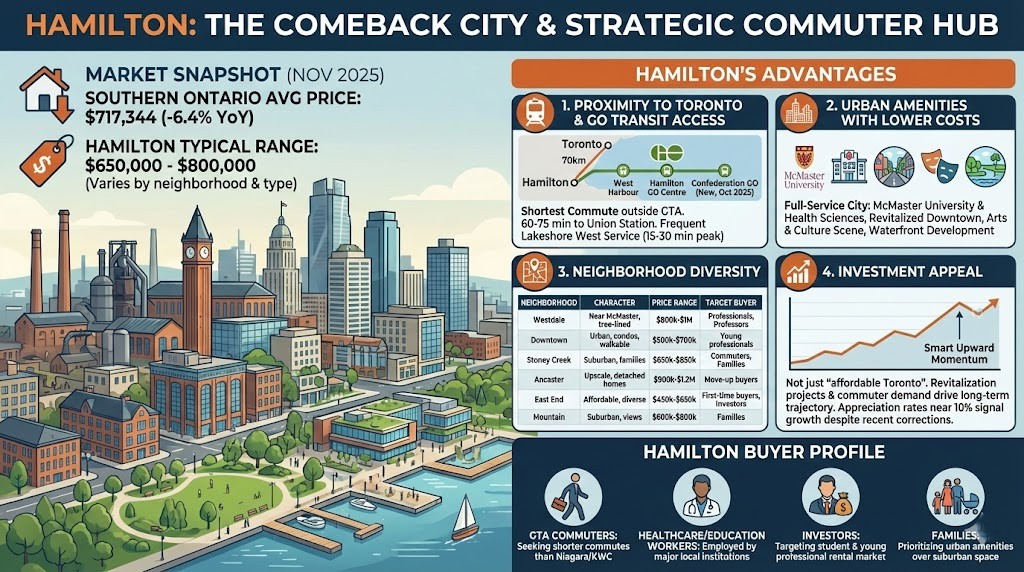
From "Steeltown" to Strategic Commuter Hub
Hamilton has shed its rust-belt image to become one of Ontario’s most appealing secondary markets, combining relative affordability with excellent GTA connectivity.
Market Snapshot
Southern Ontario, which includes Hamilton and Niagara, recorded an average price of $717,344 in November 2025, down 6.4% year-over-year.
Hamilton specifically sits near this regional average, with homes typically ranging $650,000-$800,000 depending on neighborhood and property type.
Hamilton's Advantages
1. Proximity to Toronto
At just 70 kilometers from Toronto-closer than any other major secondary market-Hamilton offers the shortest commute times outside the GTA.
Hamilton GO Transit Access:
- Multiple GO stations (West Harbour, Hamilton GO Centre, Confederation GO [new])
- Confederation GO Station opened October 27, 2025, in Stoney Creek, providing 13 weekday and 15 weekend train trips
- Frequent Lakeshore West service (15-30 minute frequency during peak)
- Commute time to Union Station: 60-75 minutes
2. Urban Amenities with Lower Costs
Hamilton is a full-service city offering:
- McMaster University (employment and student rental demand)
- Hamilton Health Sciences (major employer)
- Revitalized downtown core
- Arts and culture scene
- Waterfront development
3. Neighborhood Diversity
At just 70 kilometers from Toronto-closer than any other major secondary market-Hamilton offers the shortest commute times outside the GTA.
Hamilton GO Transit Access:
- Multiple GO stations (West Harbour, Hamilton GO Centre, Confederation GO [new])
- Confederation GO Station opened October 27, 2025, in Stoney Creek, providing 13 weekday and 15 weekend train trips
- Frequent Lakeshore West service (15-30 minute frequency during peak)
- Commute time to Union Station: 60-75 minutes
4. Investment Appeal
Hamilton is no longer just “affordable Toronto.” With revitalization projects and steady demand from commuters, appreciation rates near 10% signal smart upward momentum.
While recent data shows 6.4% year-over-year declines matching broader Southern Ontario trends, Hamilton’s long-term trajectory remains positive given infrastructure investment and GTA spillover demand.
Hamilton Buyer Profile:
- GTA workers seeking shorter commutes than Niagara/KWC
- Healthcare/education sector employees
- Investors targeting student and young professional rental market
- Families prioritizing urban amenities over suburban space
Other Strategic Secondary Markets
Guelph: The University Town
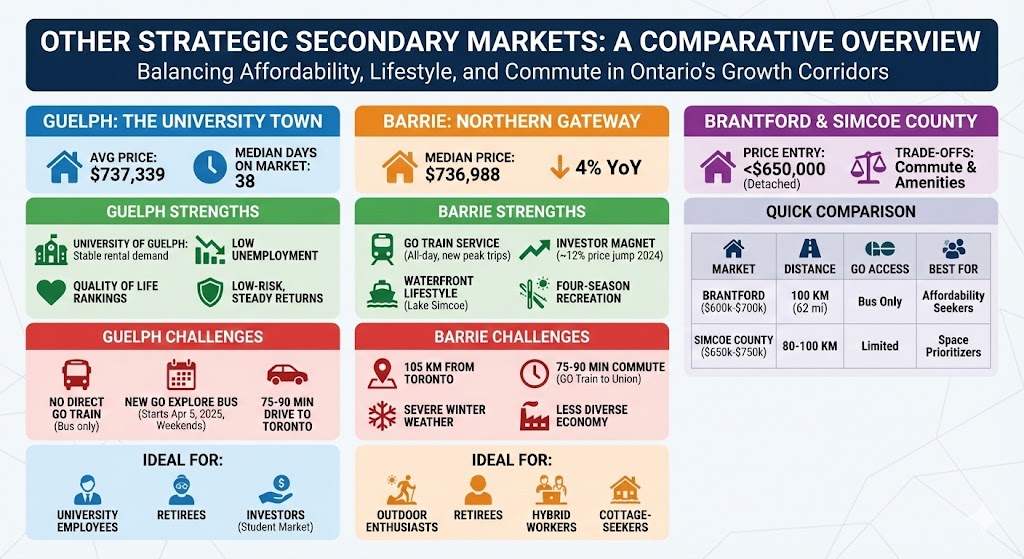
Current Guelph MLS stats indicate an average house price of $737,339 with median days on market of 38 days.
Guelph Strengths:
- University of Guelph (stable rental demand)
- Low unemployment
- Quality of life rankings
- Guelph balances affordability, low unemployment, and institutional rental demand, making it a smart pick for low-risk, steady returns
Guelph Challenges:
- No direct GO Transit service (bus connections only)
- New GO Explore bus service starting weekends April 5, 2025, will connect University of Waterloo to Burlington GO station, stopping at Wilfrid Laurier University and Kitchener GO station, improving regional connectivity
- 75-90 minute drive to Toronto (highway dependent)
Barrie: Northern Gateway
Barrie had a median price of $736,988, down 4% year-over-year.
Barrie Strengths:
- GO Train service on Barrie line
- The Barrie line added a trip departing from Aurora GO at 7:20 a.m. arriving at Union Station at 8:14 a.m., and another departing Union Station at 4:53 p.m. arriving at Aurora GO at 5:46 p.m.
- The Barrie line has all-day weekday and weekend train services along the entire line, although most trains only go as far as Aurora
- In 2024, Barrie home prices jumped roughly 12%, making it a magnet for investors seeking appreciation and rental yield
- Waterfront lifestyle (Lake Simcoe)
- Four-season recreation (skiing, boating)
Barrie Challenges:
- 105 km from Toronto
- 75-90 minute commute (GO Train to Aurora, then to Union)
- Winter weather more severe than southern markets
- Less diverse economy than Hamilton/KWC
For the first time since 2019, buyers could pause, compare options, and make calculated decisions rather than submitting blind offers with waived conditions.
Brantford and Simcoe County
Both markets offer entry points below $650,000 for detached homes but with trade-offs in commute times and amenities compared to the primary secondary markets discussed above.
| Market | Median Price | Distance from Toronto | GO Transit Access | Best For |
|---|---|---|---|---|
| Brantford | $600,000 – $700,000 | 100 km (62 mi) | Bus connections only | Affordability seekers |
| Simcoe County (Innisfil, Bradford) | $650,000 – $750,000 | 80-100 km | Limited | Space prioritizers |
Critical Factors for Successful Secondary Market Buying
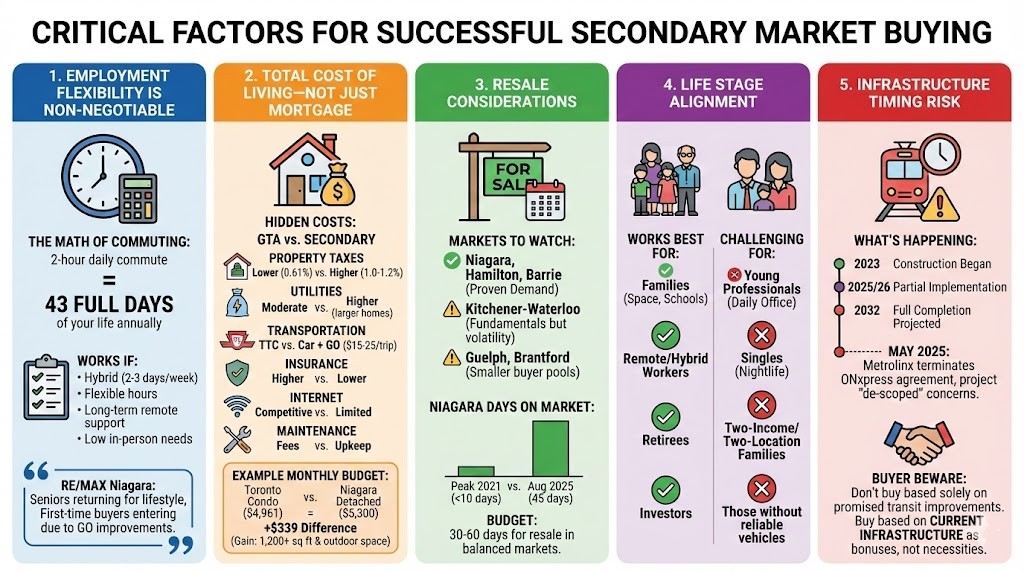
1. Employment Flexibility Is Non-Negotiable
The Math of Commuting:
A 2-hour daily commute equals:
- 4 hours per day
- 20 hours per week (5-day schedule)
- 1,040 hours per year
- 43 full days of your life spent commuting annually
This only works if:
- You work hybrid (2-3 days in office maximum)
- You have flexible start/end times (avoid peak GO trains)
- Your employer supports remote work long-term
- Your role doesn’t require frequent in-person collaboration
According to RE/MAX Niagara, seniors are returning to Niagara drawn by its lifestyle and amenities, while more first-time buyers are entering the market thanks to the upcoming GO transit service improvements.
2. Total Cost of Living-Not Just Mortgage
Market Comparison Table
| Expense Category | GTA Living | Secondary Market Living |
|---|---|---|
| Property Taxes | Higher (Toronto ~0.61%) | Lower (Niagara ~1.0-1.2%) |
| Utilities | Moderate | Higher (larger homes, electric heat) |
| Transportation | TTC / local transit | Car essential, GO fare ($15-25 / trip), parking |
| Insurance | Higher (urban premiums) | Lower (suburban / rural) |
| Internet / Services | Competitive options | Limited rural options |
| Maintenance | Condo fees or less space | More space = more upkeep |
Example Monthly Budget Comparison:
| Expense | Toronto Condo | Niagara Detached | Difference |
|---|---|---|---|
| Mortgage (@ 4.5%, $700K) | $3,850 | $3,850 | $0 |
| Property Tax | $355 (0.61%) | $700 (1.2%) | +$345 |
| Condo Fees | $450 | $0 | -$450 |
| Utilities | $150 | $350 | +$200 |
| Transportation | $156 (TTC) | $400 (car + GO) | +$244 |
| Total Monthly | $4,961 | $5,300 | +$339 |
While the Niagara home costs $339 more monthly, buyers gain 1,200+ additional square feet and outdoor space-often a worthwhile trade-off for families.
3. Resale Considerations
Will you be able to sell when life circumstances change?
Markets to watch:
- ✅ Niagara, Hamilton, Barrie: Established secondary markets with proven resale demand
- ⚠️ Kitchener-Waterloo: Strong fundamentals but employment volatility risk
- ⚠️ Guelph, Brantford: Smaller buyer pools, longer selling times
In Niagara, average days on market reached 45 days in August 2025, compared to peak 2021 when homes sold in under 10 days. Budget 30-60 days for resale in balanced secondary markets.
4. Life Stage Alignment
Secondary markets work best for:
- ✅ Families with children (space, yards, better schools per dollar)
- ✅ Remote workers (no commute penalty)
- ✅ Hybrid workers (2-3 days in office maximum)
- ✅ Retirees (downsizing from GTA, seeking lifestyle)
- ✅ Investors (rental demand from local employment/universities)
Secondary markets are challenging for:
- ❌ Young professionals requiring daily office presence
- ❌ Singles prioritizing urban nightlife and dating pools
- ❌ Families reliant on two-income, two-location employment
- ❌ Those without reliable vehicles
5. Infrastructure Timing Risk
GO Transit expansion promises are politically popular but operationally complex.
What’s actually happening:
- Construction for electrification of GO lines began in 2023, with partial implementation in 2025 and 2026 and full completion projected in 2032
- However, in May 2025, Metrolinx announced the termination of the agreement with ONxpress Operations, with concerns growing that the project is being “de-scoped”
Buyer Beware: Don’t purchase in secondary markets based solely on promised future transit improvements. Buy based on current infrastructure, treating future improvements as bonuses rather than necessities.
Actionable Steps for GTA Buyers Considering Secondary Markets
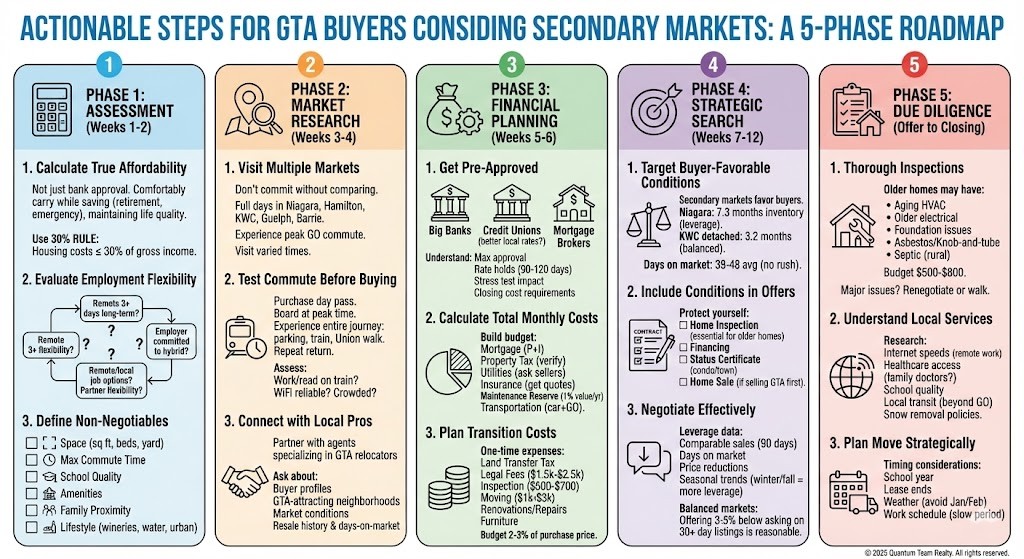
Phase 1: Assessment (Weeks 1-2)
1. Calculate Your True Affordability
Not what the bank will lend you, but what you can comfortably carry while:
- Saving for retirement
- Building emergency fund
- Maintaining quality of life
Use the 30% rule: Housing costs should not exceed 30% of gross household income.
2. Evaluate Employment Flexibility
Questions to ask:
- Can I work remotely 3+ days per week long-term?
- Is my employer committed to hybrid work, or is it temporary?
- If I need to find new employment, can I do so remotely or in the secondary market?
- Does my partner’s employment allow location flexibility?
3. Define Your Non-Negotiables
Prioritize what matters:
- Space (square footage, bedrooms, yard)
- Commute time maximum
- School quality (if relevant)
- Community amenities
- Proximity to family
- Lifestyle factors (wineries, waterfront, urban core)
Phase 2: Market Research (Weeks 3-4)
1. Visit Multiple Secondary Markets
Don’t commit to one location without comparing:
- Spend full days in Niagara, Hamilton, KWC, Guelph, Barrie
- Experience GO Transit commute during peak hours (both ways)
- Visit neighborhoods at different times (weekday morning, weekend evening)
- Assess local amenities (groceries, healthcare, recreation)
2. Test the Commute Before Buying
Actually take GO Transit:
- Purchase day pass
- Board during your typical work commute time
- Experience the entire journey: parking, platform waiting, train ride, Union Station navigation, office walk
- Repeat for return journey during rush hour
Can you read/work on the train? Is WiFi reliable? Are trains crowded?
3. Connect with Local Real Estate Professionals
Partner with agents who specialize in serving GTA relocators:
- Ask about typical buyer profiles
- Understand which neighborhoods attract GTA buyers
- Learn about local market conditions and negotiation leverage
- Get insights on resale history and days-on-market trends
Phase 3: Financial Planning (Weeks 5-6)
1. Get Pre-Approved with Multiple Lenders
Shop around:
- Big banks
- Credit unions (often better rates for smaller markets)
- Mortgage brokers
Understand:
- Your maximum approval amount
- Rate holds (90-120 days)
- Stress test impact (qualifying at higher rate)
- Closing cost requirements
2. Calculate Total Monthly Costs
Build a complete budget:
- Mortgage (principal + interest)
- Property taxes (verify actual rates for specific properties)
- Utilities (ask sellers for previous 12 months of bills)
- Insurance (get quotes for specific properties)
- Maintenance reserve (1% of home value annually)
- Transportation (car payment/lease, insurance, gas, GO fare, parking)
3. Plan for Transition Costs
One-time expenses:
- Land transfer tax (varies by municipality)
- Legal fees ($1,500-$2,500)
- Home inspection ($500-$700)
- Moving costs ($1,000-$3,000)
- Immediate renovations or repairs
- Furniture (if upsizing significantly)
Budget 2-3% of purchase price for closing costs plus moving expenses.
Phase 4: Strategic Search (Weeks 7-12)
1. Target Buyer-Favorable Conditions
Current market conditions favor buyers in secondary markets:
- Niagara’s 7.3 months of inventory provides leverage
- KWC’s 3.2 months of inventory for detached homes is balanced
- Days on market averaging 38-48 days means no rush
2. Include Conditions in Offers
Unlike 2021-2022, you can now protect yourself:
- Home inspection condition: Essential for older homes
- Financing condition: Protect against appraisal issues or lender changes
- Status certificate condition: For condos/townhouses
- Home sale condition: If selling GTA property first
3. Negotiate Effectively
Leverage data:
- Comparable sales in last 90 days
- Days on market for the specific property
- Price reductions (if any)
- Seasonal trends (winter/fall = more leverage)
In balanced secondary markets, offering 3-5% below asking on properties listed over 30 days is reasonable.
Phase 5: Due Diligence (Offer to Closing)
1. Thorough Inspections
Older homes in secondary markets may have:
- Aging HVAC systems
- Older electrical panels
- Foundation issues
- Asbestos or knob-and-tube wiring
- Septic systems (rural properties)
Budget $500-$800 for comprehensive inspection. If major issues surface, renegotiate or walk away.
2. Understand Local Services
Research:
- Internet providers and speeds (essential for remote work)
- Healthcare access (family doctors accepting patients?)
- School quality (if relevant)
- Public transit beyond GO (local bus systems)
- Snow removal policies (some municipalities don’t plow side streets quickly)
3. Plan Your Move Strategically
Timing considerations:
- School year (if children involved)
- Lease end dates
- Weather (avoid January/February moves if possible)
- Work schedule (move during slow period)
The Rise Of Secondary Markets | Quantum Team Realty Niagara
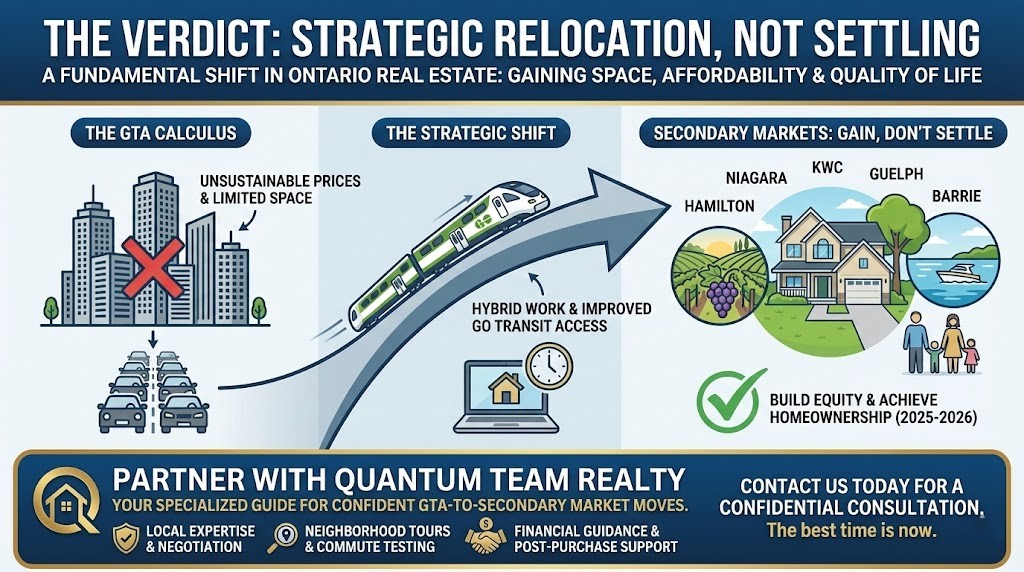
The rise of secondary markets represents a fundamental shift in Ontario real estate. For decades, the GTA was the only option for career-oriented buyers seeking employment access and lifestyle amenities. The combination of unsustainable GTA prices and improved regional transit is changing this calculus.
Niagara, Kitchener-Waterloo, Hamilton, Guelph, and Barrie are not “second-best” options-they’re strategic alternatives offering different value propositions. A family buying a $650,000 detached home in St. Catharines isn’t settling. They’re gaining space, affordability, and quality of life while maintaining GTA employment access through hybrid work and GO Transit.
The question isn’t whether secondary markets are a good idea. The question is whether your specific employment, lifestyle, and life stage align with what these markets offer.
For the right buyers-particularly first-time purchasers, young families, hybrid workers, and retirees-secondary markets represent the best opportunity to build equity and achieve homeownership in 2025-2026 Ontario.
Partner With Quantum Team Realty for Your Secondary Market Search
At Quantum Team Realty, we specialize in helping GTA buyers make confident, strategic moves to secondary markets across Ontario. Our two locations-serving Toronto and the broader Ontario market-position us uniquely to guide clients through the transition from GTA resident to secondary market homeowner.
We understand:
- The financial trade-offs between GTA and secondary market living
- GO Transit logistics and commute realities
- Which neighborhoods attract successful GTA relocators
- How to negotiate in buyer-favorable secondary markets
- Resale considerations and long-term market fundamentals
Our services for secondary market buyers:
- Comparative market analysis across multiple secondary markets
- Neighborhood tours and commute testing coordination
- Local market expertise through our network of partner agents
- Financial planning guidance and lender connections
- Post-purchase support and community integration resources
Whether you’re exploring Niagara for affordability, Hamilton for proximity, or KWC for tech employment, Quantum Team Realty provides the expertise and local knowledge to make your relocation successful.
Contact Quantum Team Realty today for a confidential consultation about your secondary market options. The best time to explore alternatives to the GTA was yesterday. The second-best time is now.
Frequently Asked Questions
Is buying in a secondary market a good investment long-term?
Secondary markets like Niagara, Hamilton, KWC, and Barrie have demonstrated long-term appreciation in line with Ontario averages. While short-term volatility exists, despite recent corrections, the benchmark price of homes in Cambridge has risen by a remarkable 113% over the past ten years and 173% over the past fifteen years. The key is buying based on fundamentals-employment access, infrastructure, and lifestyle fit-rather than speculation.
How often will I realistically use GO Transit?
Honest assessment is critical. While Niagara now offers eight trips each direction on weekends, weekday service remains limited. If you work in Toronto 5 days per week, GO Transit likely won’t meet your needs. For 2-3 days per week, it’s viable. For fully remote workers, GO provides flexibility for occasional office visits, medical appointments, or social activities.
What happens if GO Transit service gets cut back?
This is a real risk. Metrolinx announced the termination of the agreement with ONxpress Operations in May 2025, with concerns growing that the GO Expansion project is being “de-scoped”. Never buy in a secondary market assuming transit improvements that haven’t yet been built. Buy based on current infrastructure and your ability to drive or adapt to service changes.
Are secondary market homes harder to sell?
Niagara homes averaged 48 days on market in November 2025, compared to 20-25 days in peak GTA markets. Selling takes longer but isn’t prohibitively difficult if priced correctly. The risk is higher in niche communities (very small towns, rural areas) than in established cities like Hamilton, St. Catharines, or Kitchener. Plan to hold 7-10 years to ride out market cycles.
Should I wait for prices to drop further?
RE/MAX forecasts average residential sale prices in Niagara will increase by two per cent going into 2026, with sales anticipated to rise by four per cent. Prices have already corrected 6-10% from peaks. Waiting for further drops means competing against other buyers when prices stabilize or rise. If a property meets your needs and budget, current conditions favor buyers with negotiating power and reasonable days-on-market.
How do I know which secondary market is right for me?
Choose based on your priorities:
- Shortest commute: Hamilton (60-75 min)
- Most affordable: Niagara (Welland, Fort Erie, Port Colborne under $550,000)
- Best local employment: KWC (tech sector), Hamilton (healthcare/education)
- Lifestyle/recreation: Niagara (wineries), Barrie (waterfront)
- Urban amenities: Hamilton, Kitchener
- Best resale liquidity: Hamilton, Niagara (St. Catharines), Barrie
Visit multiple markets, experience the commute, and assess where you’d genuinely enjoy living-not just where the numbers work.
What's the biggest mistake buyers make when relocating to secondary markets?
Underestimating the commute impact. A 90-minute journey sounds manageable in theory. In practice, it means:
- Waking at 5:30 AM for 8 AM office arrival
- Leaving work at 4 PM to be home by 6 PM
- Missing evening activities, gym sessions, social events
- Limited flexibility for late meetings or early appointments
The second biggest mistake: buying in the wrong neighborhood within the secondary market. Not all Niagara neighborhoods are equal. Research micro-markets, visit multiple times, and talk to locals before committing.

Sunny Chadha
Sunny Chadha is the Co-Founder of Quantum Team Realty and brings over 15 years of experience in Niagara real estate. He is passionate about helping clients make informed decisions and sharing his deep knowledge of the local market.
References
- niagarahomes.com. (December 2025). “Niagara Real Estate Market Update | Monthly Trends & Prices.” Retrieved from niagarahomes.com/blog
- niagarahomes.com. (April 3, 2025). “Niagara Real Estate Market Update – March 2025 [Prices, Sales & Trends].” Retrieved from niagarahomes.com
- niagarahomes.com. (June 6, 2025). “May 2025 Niagara Region Real Estate Market Update: Prices, Sales, and Trends.” Retrieved from niagarahomes.com
- niagarahomes.com. (May 2, 2025). “April 2025 Niagara Region Real Estate Market Update: Prices, Sales, and Trends.” Retrieved from niagarahomes.com
- Blythwood Homes. (July 31, 2025). “Why the Niagara Real Estate Market Is Booming in 2025.” Retrieved from blythwoodhomes.ca
- RE/MAX Canada. (December 2025). “Niagara Housing Market Outlook (2026).” Retrieved from blog.remax.ca/niagara-housing-market-outlook
- niagarahomes.com. (September 2, 2025). “Niagara Region Real Estate – August 2025 Market Report.” Retrieved from niagarahomes.com
- Canadian Real Estate Association (CREA). (November 2025). “Niagara Association of REALTORS® | CREA Statistics.” Retrieved from creastats.crea.ca/board/stca
- WOWA.ca. (November 19, 2025). “Kitchener-Waterloo-Cambridge Housing Market Update.” Retrieved from wowa.ca/kitchener-waterloo-cambridge-housing-market
- The GoWylde Team. (December 11, 2025). “Guelph, Kitchener-Waterloo & Cambridge Real Estate Market Update 2025.” Retrieved from gowylde.ca
- RE/MAX Canada. (December 2025). “Kitchener-Waterloo Housing Market Outlook (2026).” Retrieved from blog.remax.ca/kitchener-waterloo-housing-market-outlook
- Canadian Real Estate Association (CREA). (Q3 2025). “Kitchener-Waterloo-Cambridge Market Conditions.” Retrieved from stats.crea.ca/mls/wrar-market-conditions
- The Deutschmann Team. (September 10, 2025). “Waterloo Region Housing Market Update – September 2025.” Retrieved from elitere.ca
- WOWA.ca. (December 29, 2025). “Ontario Housing Market: Interactive Map.” Retrieved from wowa.ca/ontario-housing-market
- Durham Post. (August 15, 2025). “Homebuyers can save big just beyond GTA borders.” Retrieved from durhampost.ca
- nesto.ca. (October 16, 2025). “Ontario Housing Market | 2025 Home Prices.” Retrieved from nesto.ca/real-estate/ontario-housing-market-outlook
- GTA Landlord. (2025). “Neighborhoods Delivering the Highest ROI Right Now.” Retrieved from gtalandlord.ca
- Zolo.ca. (December 2025). “Guelph Housing Market Report | December 2025.” Retrieved from zolo.ca/guelph-real-estate/trends
- Metrolinx. (2025). “GO Expansion.” Retrieved from metrolinx.com/en/projects-and-programs/go-expansion
- Wikipedia. (November 16, 2025). “GO Expansion.” Retrieved from en.wikipedia.org/wiki/GO_Expansion
- Niagara At Large. (April 11, 2025). “Ontario’s Ford Government Completes Construction on GO Station, Saving Time for Niagara Commuters.” Retrieved from niagaraatlarge.com
- Wikipedia. (January 2026). “GO Transit.” Retrieved from en.wikipedia.org/wiki/GO_Transit
- CBC News. (October 26, 2025). “Metrolinx expanding its GO Transit service Monday, adding new rush hour train trips.” Retrieved from cbc.ca/news/canada/toronto
- CBC News. (February 8, 2025). “PCs promise ambitious GO Transit expansion. But experts question its feasibility.” Retrieved from cbc.ca/news/canada/toronto
- Niagara Falls Blog. (November 4, 2025). “Weekend GO Train Service Expanding in Niagara.” Retrieved from cliftonhill.com/falls_blog
- CBC News. (March 27, 2025). “GO Transit set to add service across southern Ontario for summer season.” Retrieved from cbc.ca/news/canada/toronto


