




Last Updated 09-09-2026
Executive Summary
- GTA vs Niagara: Compare property tax costs between major GTA municipalities and the Niagara Region.
- 2026 Rates: Understand how residential property tax rates differ across Ontario municipalities.
- Annual Costs: See how property values can affect the total taxes homeowners pay each year.
- Tax Calculator: Use comparative figures to estimate ongoing property ownership costs.
- Niagara Savings: Understand how lower property values may influence overall annual carrying costs.
Why This Shift Matters
When Sarah purchased her first home in Toronto for $750,000, she was shocked to receive her first property tax bill: $5,220 annually. Her cousin Mark bought a similar-priced home in St. Catharines, Niagara Region, and pays $8,100 per year. Same purchase price, nearly $3,000 difference in annual taxes. How is this possible?
Property tax in Ontario operates on a deceptively simple formula, but the real-world variations between municipalities create vastly different financial obligations for homeowners. In 2025, these differences became even more pronounced as cities across the province implemented significant tax increases to offset rising infrastructure costs, despite flat or declining property values. Understanding how property taxes work-and how they differ between the GTA and secondary markets like Niagara-is essential for every Ontario homeowner and prospective buyer.
While the City of Toronto boasts a lower percentage property tax rate on paper, higher property valuations mean GTA homeowners often pay significantly more in total annual taxes compared to the Niagara Region. Explore our 2026 comparative property tax table to calculate your ongoing carrying costs.
Stay informed on upcoming MPAC assessment updates with Ontario property tax changes in 2026.
How Property Tax Works in Ontario
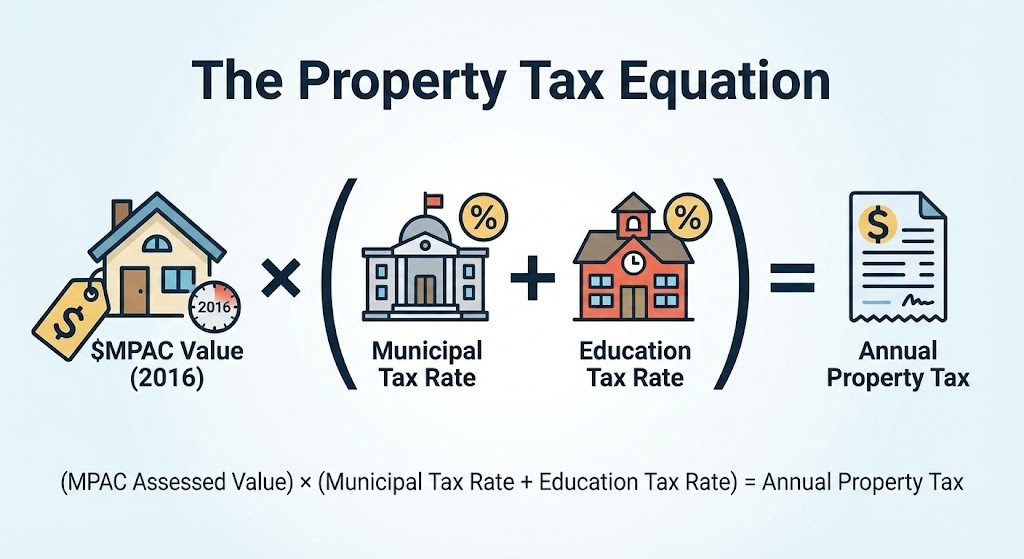
Property tax is calculated using a straightforward formula, but the components behind it are complex:
Formula: (MPAC Assessed Value) × (Municipal Tax Rate + Education Tax Rate) = Annual Property Tax
The MPAC Assessment: Frozen in Time
The Municipal Property Assessment Corporation (MPAC) determines the assessed value of every Ontario property. Here’s the critical detail most homeowners miss: all property assessments in Ontario remain based on January 1, 2016 values through at least 2026.
Originally, MPAC conducted province-wide reassessments every four years. The last update occurred in 2016. Due to COVID-19, the Ontario government postponed the 2020 reassessment. They’ve continued postponing it through 2023, 2024, 2025, and now 2026. Your property’s assessed value for tax purposes is what it would have sold for on January 1, 2016-in its current condition.
What This Means:
- If you bought a $1 million home in 2025, your MPAC assessment might show $650,000 (2016 market value)
- Newer homes built after 2016 are assessed at what they would have been worth in 2016
- Major renovations are added at 2016 construction costs
This creates significant distortions. Suburban properties that doubled in value between 2016-2022 are taxed on pre-surge valuations, while downtown Toronto condos that saw moderate appreciation face relatively higher effective tax rates.
Municipal Tax Rates: The Variable Component
Each municipality sets its own tax rate based on budget requirements. This rate varies dramatically across Ontario:
2025 Ontario Municipal Property Tax Rates (Residential):
| Municipality | Tax Rate | Sample Tax on $700,000 Home* | YoY Rate Increase |
|---|---|---|---|
| GTA | |||
| Toronto | 0.688% | $4,816 | +6.9% |
| Mississauga | 0.830% | $5,810 | +3.5% |
| Brampton | 0.990% | $6,930 | +4.2% |
| Markham | 0.700% | $4,900 | +3.8% |
| Vaughan | 0.744% | $5,208 | +4.1% |
| Niagara Region | |||
| St. Catharines | 1.150% | $8,050 | +4.5% |
| Niagara Falls | 1.200% | $8,400 | +5.2% |
| Welland | 1.280% | $8,960 | +5.8% |
| Niagara-on-the-Lake | 1.050% | $7,350 | +3.9% |
| Other | |||
| Hamilton | 1.170% | $8,190 | +4.8% |
| Ottawa | 1.118% | $7,826 | +2.9% |
*Based on MPAC assessed value (typically lower than purchase price). Includes municipal + education tax (0.153%).
- Sources: johnowen.realtor, WOWA.ca, municipal websites, December 2025
The pattern is clear: GTA municipalities have lower rates but higher property values. Secondary markets like Niagara have higher rates but lower assessed values.
Education Tax: The Provincial Constant
The province sets a uniform education tax rate of 0.153% across all of Ontario. This funds the public education system and doesn’t vary by municipality.
2025: The Year of Aggressive Tax Increases
Despite property values declining or remaining flat in most Ontario markets, 2025 brought substantial property tax increases as municipalities faced budget pressures from infrastructure costs, emergency services, and social programs.
Toronto's Historic Increases
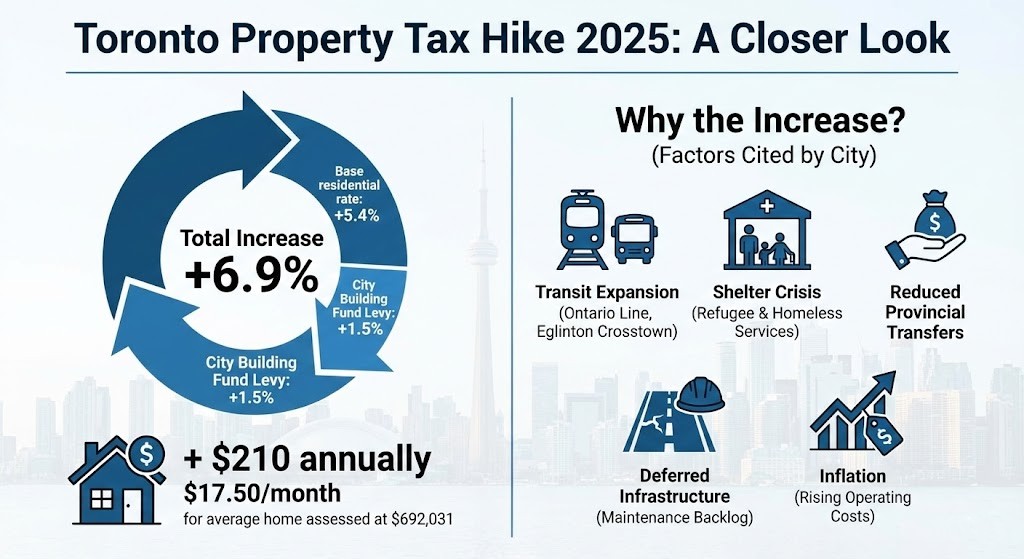
Toronto implemented a 6.9% residential property tax increase in 2025, following a shocking 9.5% increase in 2024-the largest single-year hike since amalgamation in 1998. Combined, these represent over 16% cumulative increases in just two years.
Toronto's 2025 Increase Breakdown:
- Base residential rate: +5.4%
- City Building Fund Levy: +1.5% (dedicated to transit and housing infrastructure)
- Total: +6.9%
For a home with a $692,031 MPAC assessment (average Toronto residential property), this translates to an additional $210 annually, or $17.50 per month.
Why Such Aggressive Increases?
Toronto cited several factors:
- Transit Expansion: Ontario Line, Eglinton Crosstown, TTC service enhancements
- Shelter Crisis: Refugee settlement and homeless services costs ballooning
- Reduced Provincial Transfers: Less funding from upper governments
- Deferred Infrastructure: Years of below-inflation increases left a maintenance backlog
- Inflation: Operating costs (salaries, materials, fuel) rising faster than revenues
Niagara Region Increases
Niagara municipalities implemented more moderate but still significant increases averaging 4-6% across the region. St. Catharines increased rates by 4.5%, Niagara Falls by 5.2%, and Welland by 5.8%.
Unlike Toronto, Niagara’s increases primarily addressed infrastructure renewal (aging water systems, road repairs) and emergency services expansion rather than large transit projects.
The Paradox: Lower Rates, Higher Bills vs. Higher Rates, Lower Bills
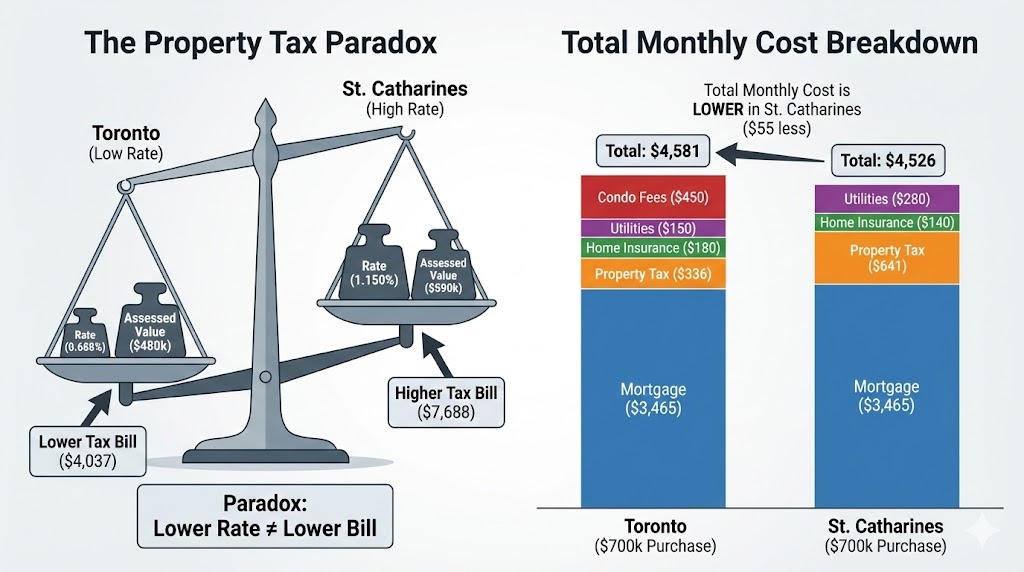
Here’s where property tax in Ontario becomes counterintuitive. The municipality with the lowest rate doesn’t necessarily deliver the lowest tax bill.
Scenario: Comparing Two $700,000 Purchases
| Factor | Toronto Home | St. Catharines Home |
|---|---|---|
| Purchase Price | $700,000 | $700,000 |
| MPAC Assessment | $480,000 (2016 value) | $590,000 (2016 value) |
| Municipal Rate | 0.688% | 1.150% |
| Education Rate | 0.153% | 0.153% |
| Combined Rate | 0.841% | 1.303% |
| Annual Property Tax | $4,037 | $7,688 |
| Monthly Cost | $336 | $641 |
| Difference | – | +$3,651 / year |
- The St. Catharines buyer pays 90% more in property taxes despite identical purchase prices. However, context matters:
What St. Catharines Provides:
- Lower home prices overall (average $665,000 vs Toronto’s $1,036,362)
- More space per dollar (detached vs condo)
- Local services (roads, police, fire) comparable to GTA
- No Land Transfer Tax (Toronto charges both provincial + municipal)
What Toronto Provides:
- Extensive TTC transit network
- More infrastructure density
- Cultural institutions and amenities
- Employment accessibility
Breaking Down Total Housing Costs
When evaluating affordability, smart buyers look beyond just property tax:
Monthly Cost Comparison ($700,000 Purchase):
| Expense | Toronto | St. Catharines | Difference |
|---|---|---|---|
| Mortgage (4.5%, $630K) | $3,465 | $3,465 | $0 |
| Property Tax | $336 | $641 | +$305 |
| Home Insurance | $180 | $140 | – $40 |
| Utilities (condo vs house) | $150 | $280 | +$130 |
| Condo Fees | $450 | $0 | – $450 |
| Total Monthly | $4,581 | $4,526 | – $55 |
Despite higher property taxes, the St. Catharines detached home costs less per month than the Toronto condo once all expenses factor in-and provides significantly more space.
Looking Ahead: 2026 Property Tax Outlook
Election Year Dynamics
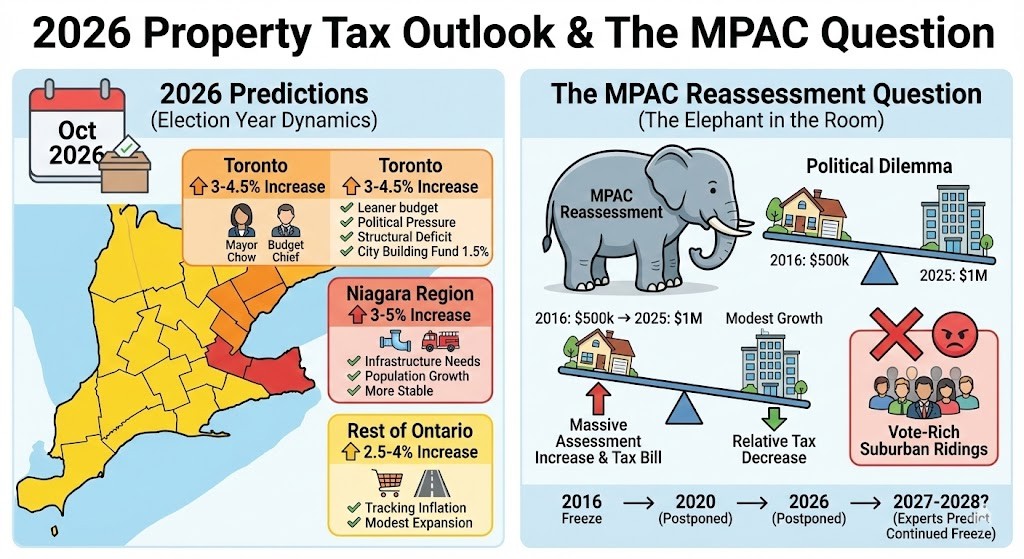
2026 is a municipal election year across Ontario, with voters heading to polls in October. Historically, election years see more moderate tax increases as incumbents avoid voter backlash.
2026 Predictions:
Toronto: Expected 3-4.5% increase
- Mayor Olivia Chow and Budget Chief Shelley Carroll signaled a “leaner” 2026 budget
- Political pressure to moderate after two years of aggressive hikes
- Structural deficit remains, limiting how low increases can go
- City Building Fund Levy (1.5%) likely continues
Niagara Region: Expected 3-5% increases across municipalities
- Infrastructure needs ongoing
- Population growth (GTA relocators) straining services
- More stable than Toronto due to less transit/shelter spending
Rest of Ontario: Most municipalities targeting 2.5-4% increases, roughly tracking inflation plus modest service expansion.
The MPAC Reassessment Question
The elephant in the room: what happens when MPAC finally conducts a province-wide reassessment updating from 2016 values to current market conditions?
The Political Dilemma:
Suburban homes that doubled in value (2016: $500,000 → 2025: $1,000,000) would see massive assessment increases, triggering higher tax bills even without rate increases. Downtown Toronto condos that appreciated modestly might see relative tax decreases.
This would cause significant taxpayer anger in vote-rich suburban ridings. No provincial government wants to trigger this before an election. Experts predict the 2016 freeze continues through at least 2027-2028.
Regional Tax Burden: What You're Actually Paying
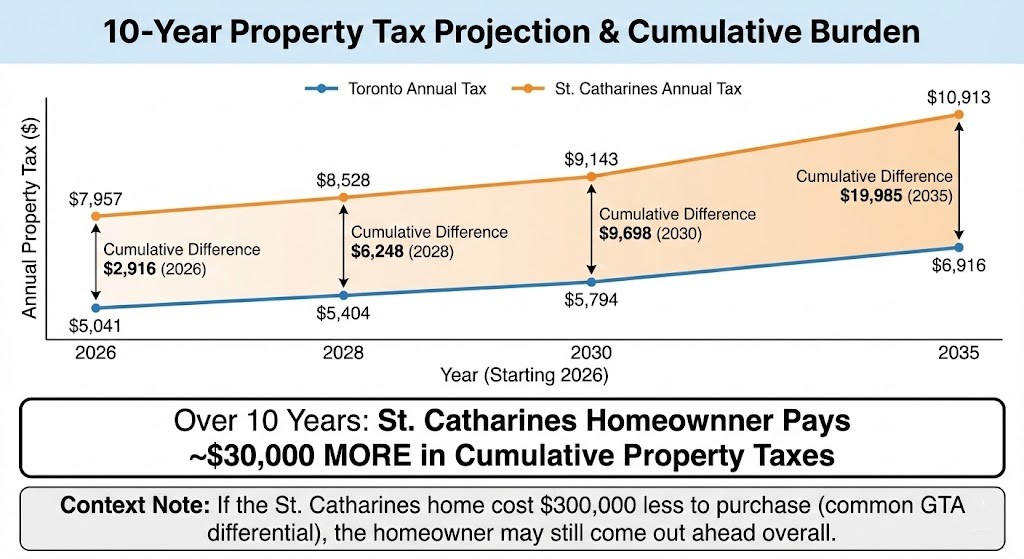
Understanding the total tax burden requires looking at cumulative costs over time:
10-Year Property Tax Projection (Starting 2026):
Assumptions: $700,000 MPAC assessment (Toronto), $700,000 assessment (St. Catharines), 3.5% annual increases
| Year | Toronto Annual Tax | St. Catharines Annual Tax | Cumulative Difference |
|---|---|---|---|
| 2026 | $5,041 | $7,957 | $2,916 |
| 2028 | $5,404 | $8,528 | $6,248 |
| 2030 | $5,794 | $9,143 | $9,698 |
| 2035 | $6,916 | $10,913 | $19,985 |
Over 10 years, the St. Catharines homeowner pays approximately $30,000 more in property taxes. However, if their home cost $300,000 less to purchase (common GTA vs Niagara differential), they still come out ahead.
See how lower purchase prices balance taxes in our report on what $700K buys in Niagara.
Strategic Considerations for Buyers
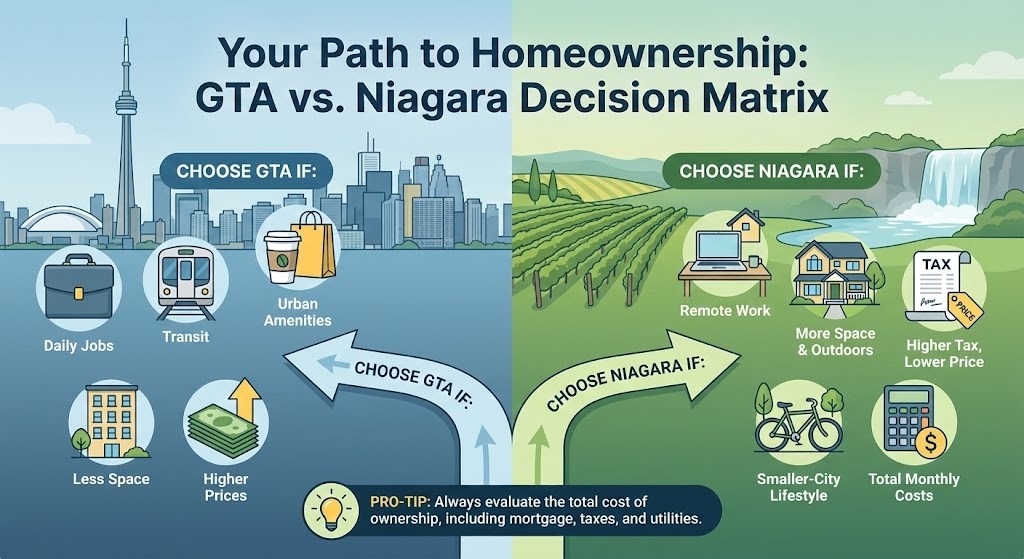
When comparing properties across Ontario municipalities, evaluate total cost of ownership:
- Compare apples to apples: A $700,000 Toronto condo is fundamentally different from a $700,000 Niagara detached home
- Factor in all housing costs: Mortgage, property tax, insurance, utilities, condo fees, maintenance
- Consider long-term increases: Property taxes typically rise 3-5% annually
- Understand assessment discrepancies: Your purchase price ≠ MPAC assessed value
- Research municipal services: Higher taxes may deliver better services (or not-do your homework)
Making the GTA vs Niagara Decision
Choose GTA if:
- You require daily access to Toronto employment
- Transit access is essential
- You prefer urban density and amenities
- Space is less important than location
- You can afford higher purchase prices
Choose Niagara if:
- You work remotely or hybrid (2-3 days/week maximum in GTA)
- You prioritize space and outdoor living
- Higher property taxes are acceptable given lower purchase prices
- You value small-city lifestyle
- Total monthly housing costs matter more than tax rates alone
Partner with Quantum Team Realty
At Quantum Team Realty, we help Ontario buyers understand the true costs of homeownership across the GTA and secondary markets like Niagara. Property taxes are just one piece of the affordability puzzle-our experienced agents provide comprehensive cost analysis to ensure you make informed decisions.
Whether you’re evaluating a Toronto condo against a Niagara detached home, or simply trying to understand your current property tax obligations, our team has the local expertise to guide you through Ontario’s complex real estate tax landscape.
Contact Quantum Team Realty today for personalized guidance on property taxes, home affordability, and strategic buying decisions across Ontario. Our two locations ensure local market knowledge wherever your search takes you.
Frequently Asked Questions
Why are Niagara property taxes so much higher than Toronto?
Toronto has exceptionally high property values, allowing the city to charge lower rates while generating sufficient revenue. Niagara municipalities have lower property values, requiring higher rates to fund comparable services. It’s a function of the tax base size, not inefficiency.
Will property taxes go down if home prices decline?
No. Property taxes are set to meet municipal budget needs, not property values. Even as GTA prices declined 6-8% in 2025, tax rates increased. Municipalities adjust rates to generate required revenue regardless of market conditions.
Can I appeal my property tax assessment?
Yes. You can file a Request for Reconsideration with MPAC if you believe your assessment is inaccurate or inequitable compared to similar properties. The deadline for 2026 taxes is March 31, 2026. Use MPAC’s AboutMyProperty tool to compare your assessment to neighbors.
What happens if I don't pay property taxes?
Unpaid property taxes accumulate penalties (typically 1.25% monthly) and can result in tax sale proceedings where the municipality can eventually seize and sell your property. Property taxes take priority over mortgages in Ontario.
Are there property tax breaks for seniors or low-income homeowners?
Yes. Programs vary by municipality but often include:
- Tax deferrals for seniors (payment postponed until property sale/death)
- Low-income property tax grants
- Disabled persons property tax relief
- Check with your specific municipality for eligibility
Is property tax deductible for homeowners?
No. Personal residence property taxes are not tax-deductible in Canada (unlike the US). However, if you own rental property, property taxes are deductible as a rental expense.
Should I factor property taxes into my home-buying budget?
Absolutely, Lenders consider property taxes when calculating debt service ratios for mortgage qualification. Budget 0.8-1.3% of your home’s purchase price annually for Ontario property taxes, with higher percentages outside the GTA.

Sunny Chadha
Sunny Chadha is the Co-Founder of Quantum Team Realty and brings over 15 years of experience in Niagara real estate. He is passionate about helping clients make informed decisions and sharing his deep knowledge of the local market.
References
- johnowen.realtor. (December 23, 2025). “Ontario Property Taxes by City 2025 – Compare your location.” Retrieved from johnowen.realtor
- WOWA.ca. (2025). “Ontario Property Tax – Rates & Calculator.” Retrieved from wowa.ca/taxes/ontario-property-tax
- Justo. (2025). “Toronto Property Tax 2025: Why It’s Increasing and What Homeowners Need to Know.” Retrieved from justo.ca
- CBC News. (February 12, 2025). “Toronto city council finalizes new budget, with 6.9% property tax hike.” Retrieved from cbc.ca
- City of Toronto. (2025). “Property Tax Rates & Fees.” Retrieved from toronto.ca
- Aird & Berlis LLP. (February 18, 2025). “City of Toronto Proposed Property Tax Increases and Key 2025 Deadlines for Property Owners.” Retrieved from airdberlis.com
- Fraser Institute. (2025). “Toronto property tax hikes-a brief history.” Retrieved from fraserinstitute.org
- Municipal Property Assessment Corporation (MPAC). (2025). “The Assessment Cycle.” Retrieved from mpac.ca
- MPAC. (2025). “MPAC Sends Property Assessment Notices to Ontario Owners.” Retrieved from mpac.ca
- Ryan Tax. (2025). “Take Control of Your Property Taxes: Five Tips for 2025.” Retrieved from ryan.com/canada
- Global News. (December 10, 2024). “Why property taxes are skyrocketing in some Ontario cities.” Retrieved from globalnews.ca
- Toronto Taxpayer. (December 2025). “Toronto Tax Increase 2025-2026: rates, hikes, budget forecast.” Retrieved from torontotaxpayer.ca


