





Last Updated 10-09-2026
Executive Summary
- Tax Comparison: Compare land transfer tax costs when buying property in Toronto versus Niagara.
- Ontario Tax: Understand how Ontario’s provincial land transfer tax applies to property purchases.
- Toronto Difference: Learn why Toronto buyers may face an additional municipal land transfer tax.
- Buyer Costs: See how land transfer tax can affect your total home-buying budget.
When Michael and Sarah purchased their first home in Toronto for $850,000, they budgeted carefully for their down payment, moving costs, and lawyer fees. What they didn’t fully anticipate was the $17,900 land transfer tax bill due on closing day. Their friends who bought a similar-priced home in St. Catharines, Niagara Region, paid $12,950-nearly $5,000 less for the exact same purchase price.
The difference? Toronto is the only major city in Ontario that charges both provincial and municipal land transfer taxes, creating the highest transfer tax burden in the province. And as of December 17, 2025, Toronto City Council approved even higher rates for luxury properties effective April 1, 2026, making the gap even wider.
Understanding land transfer tax in Ontario-and specifically how Toronto compares to the rest of the province including Niagara-is essential for every homebuyer. This isn’t just about budgeting; it’s about understanding one of the largest closing costs you’ll face when purchasing property.
Get comprehensive, data-driven real estate guidance on land transfer tax toronto vs niagara with Quantum Team Realty. Serving buyers, sellers, and investors across Niagara Falls, St. Catharines, Welland, and the Greater Toronto Area.
What Is Land Transfer Tax in Ontario?

Land transfer tax (LTT) is a mandatory provincial tax applied whenever property ownership changes hands in Ontario. This tax is paid by the buyer-not the seller-and is due on the closing date of the transaction. Your real estate lawyer typically handles payment as part of the closing process.
Key Facts:
- Calculated as a percentage of the property’s purchase price
- Paid by the buyer on closing day
- Uses a graduated (marginal) tax system-different portions of the purchase price are taxed at different rates
- Cannot be rolled into your mortgage-must be paid upfront from available funds
- First-time homebuyer rebates are available (up to $4,000 provincial, up to $4,475 municipal in Toronto)
Ontario Provincial Land Transfer Tax Rates (2026)
The Ontario government uses a graduated tax system. Here are the current provincial rates, which remain unchanged for 2026:
Ontario Provincial LTT Rates:
| Purchase Price Bracket | Tax Rate |
|---|---|
| First $55,000 | 0.5% |
| $55,001 to $250,000 | 1.0% |
| $250,001 to $400,000 | 1.5% |
| $400,001 to $2,000,000 | 2.0% |
| Over $2,000,000 | 2.5% |
- Source: Ontario Ministry of Finance, Ratehub.ca, 2026
These rates apply across all of Ontario, from Thunder Bay to Ottawa to Windsor to Niagara. Every buyer in the province pays these rates to the provincial government.
The Toronto Exception: Double Taxation
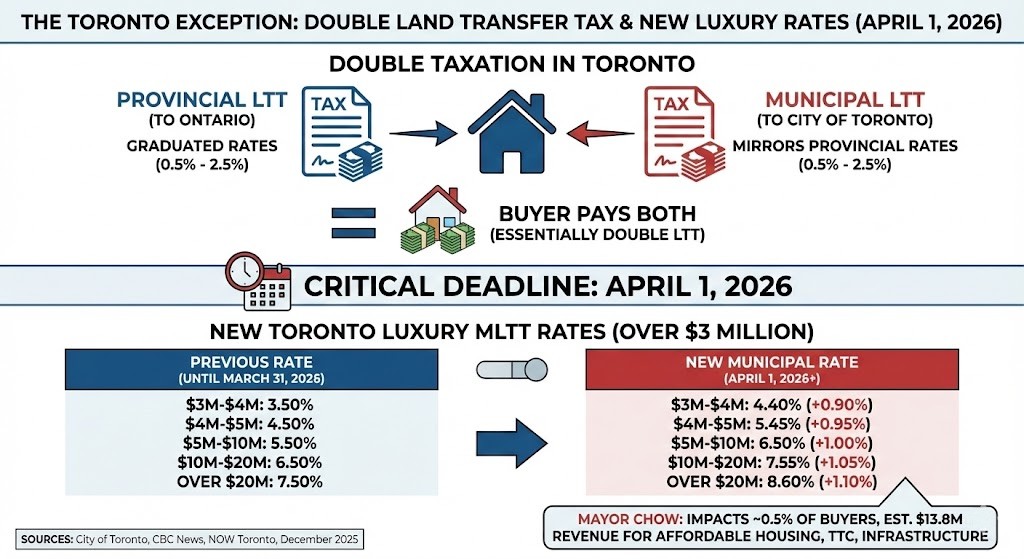
Here’s where Toronto becomes dramatically different from everywhere else in Ontario.
On February 1, 2008, Toronto introduced a Municipal Land Transfer Tax (MLTT) on top of the provincial LTT. This means Toronto buyers pay two separate land transfer taxes on the same transaction:
- Provincial Land Transfer Tax (to Ontario)
- Municipal Land Transfer Tax (to City of Toronto)
Current Toronto Municipal LTT Rates (Until March 31, 2026)
For most properties, Toronto’s municipal rates mirror the provincial rates:
| Purchase Price Bracket | Municipal Rate |
|---|---|
| First $55,000 | 0.5% |
| $55,001 to $250,000 | 1.0% |
| $250,001 to $400,000 | 1.5% |
| $400,001 to $2,000,000 | 2.0% |
| Over $2,000,000 | 2.5% |
This means for a typical home purchase in Toronto, you essentially double the land transfer tax compared to the rest of Ontario.
Looking to purchase property? Explore how to buy a home in Niagara with our team.
BREAKING: New Toronto Luxury MLTT Rates (Effective April 1, 2026)
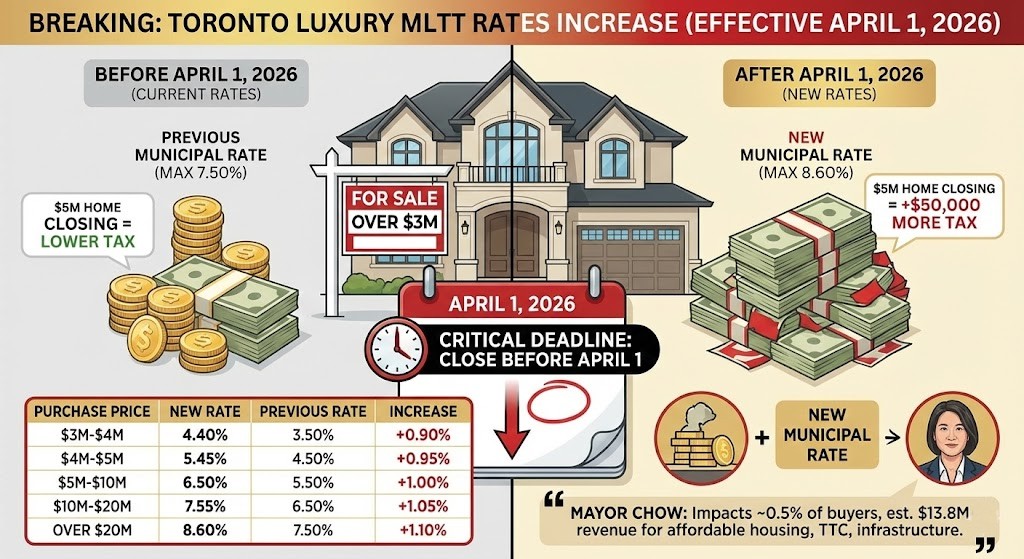
On December 17, 2025, Toronto City Council approved increased Municipal Land Transfer Tax rates for high-value residential properties containing one or two single-family residences. These changes take effect April 1, 2026.
New Toronto Municipal LTT Rates for Properties Over $3 Million (April 1, 2026+):
| Purchase Price Bracket | New Municipal Rate | Previous Rate | Increase |
|---|---|---|---|
| $3 million to $4 million | 4.40% | 3.50% | +0.90% |
| $4 million to $5 million | 5.45% | 4.50% | +0.95% |
| $5 million to $10 million | 6.50% | 5.50% | +1.00% |
| $10 million to $20 million | 7.55% | 6.50% | +1.05% |
| Over $20 million | 8.60% | 7.50% | +1.10% |
- Sources: City of Toronto, CBC News, NOW Toronto, December 2025
Mayor Olivia Chow stated the increase will impact approximately 0.5% of buyers (roughly 1,100 transactions per year) and generate an estimated $13.8 million in additional annual revenue for the city. The funds will be directed toward affordable housing, TTC fare subsidies, and infrastructure.
Critical Deadline: Buyers purchasing luxury properties should aim to close before April 1, 2026, to avoid the increased rates. A $5 million home closing March 31 vs. April 1 could see a difference of over $50,000 in municipal LTT alone.
Land Transfer Tax Comparison: Toronto vs. Niagara
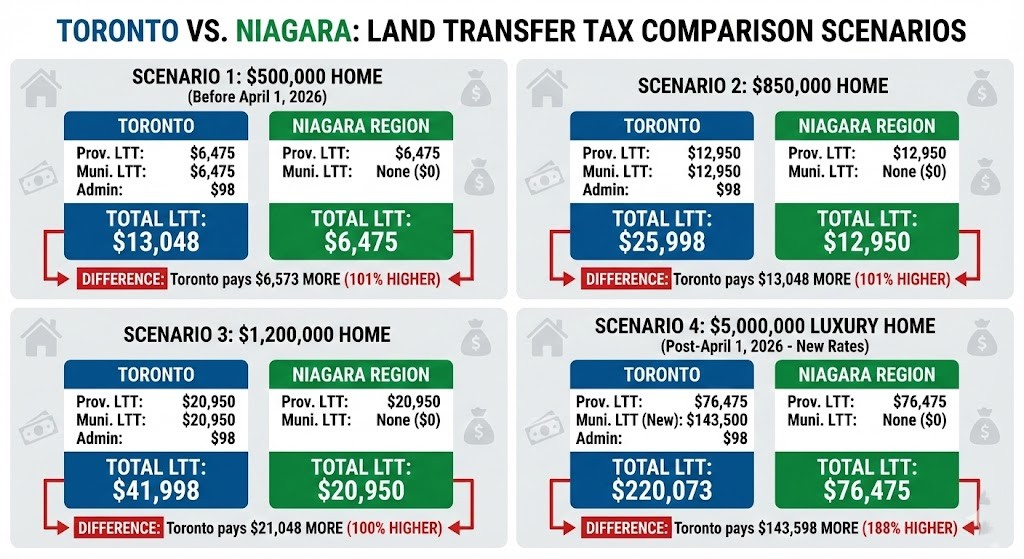
Let’s examine real-world scenarios comparing what buyers pay in Toronto versus Niagara Region.
Scenario 1: $500,000 Home Purchase
Ontario Provincial LTT Rates:
| Tax Component | Calculation | Amount |
|---|---|---|
| Provincial LTT | Graduated calculation | $6,475 |
| Municipal LTT | Mirrors provincial | $6,475 |
| Administration Fee | Toronto processing | $98 |
| Total LTT | – | $13,048 |
Niagara Region (St. Catharines, Niagara Falls, Welland, etc.):
| Tax Component | Calculation | Amount |
|---|---|---|
| Provincial LTT | Graduated calculation | $6,475 |
| Municipal LTT | None | $0 |
| Total LTT | – | $6,475 |
Difference: Toronto buyers pay $6,573 more (101% higher) than Niagara buyers for the exact same purchase price.
Scenario 2: $850,000 Home Purchase
Toronto:
- Provincial LTT: $12,950
- Municipal LTT: $12,950
- Administration: $98
- Total: $25,998
Niagara:
- Provincial LTT: $12,950
- Municipal LTT: $0
- Total: $12,950
Difference: Toronto buyers pay $13,048 more (101% higher).
Scenario 3: $1,200,000 Home Purchase
Toronto:
- Provincial LTT: $20,950
- Municipal LTT: $20,950
- Administration: $98
- Total: $41,998
Niagara:
- Provincial LTT: $20,950
- Municipal LTT: $0
- Total: $20,950
Difference: Toronto buyers pay $21,048 more (100% higher).
Scenario 4: $5,000,000 Luxury Home (Post-April 1, 2026)
Toronto (After April 1, 2026 with new luxury rates):
- Provincial LTT: $76,475
- Municipal LTT (New Rates): $143,500 (up from $91,475 under old rates)
- Administration: $98
- Total: $220,073
Niagara:
- Provincial LTT: $76,475
- Municipal LTT: $0
- Total: $76,475
Difference: Toronto buyers pay $143,598 more (188% higher) than Niagara buyers. This represents an additional $52,025 compared to the old Toronto rates.
First-Time Home Buyer Rebates: The Silver Lining
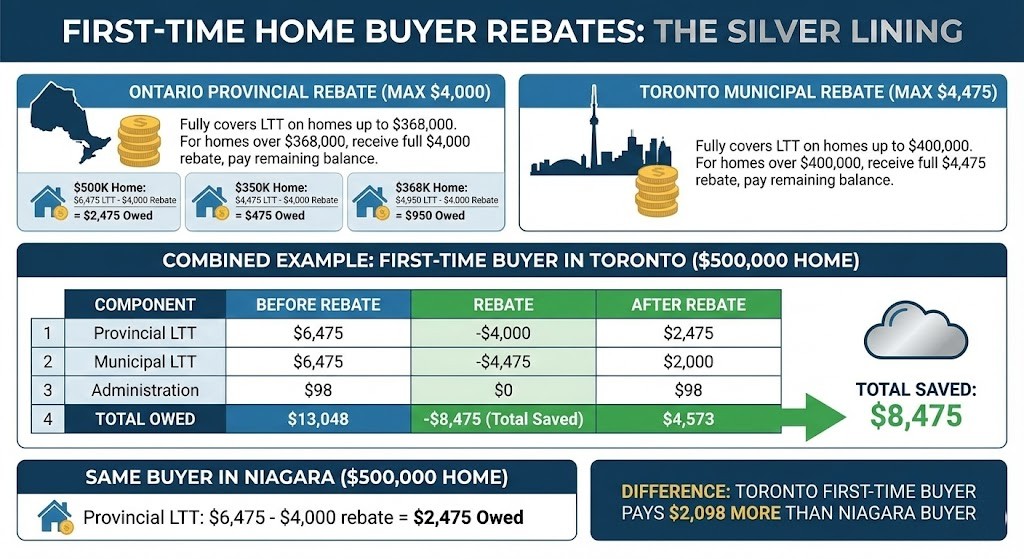
Both Ontario and Toronto offer land transfer tax rebates for first-time homebuyers, significantly reducing the tax burden for eligible buyers.
Ontario Provincial Rebate
Maximum Rebate: Up to $4,000
How It Works:
- Fully covers the provincial LTT on homes priced up to $368,000
- For homes over $368,000, you receive the full $4,000 rebate and pay the remaining balance
Example:
- $500,000 home: Provincial LTT = $6,475 – $4,000 rebate = $2,475 owed
- $350,000 home: Provincial LTT = $4,475 – $4,000 rebate = $475 owed
- $368,000 home: Provincial LTT = $4,950 – $4,000 rebate = $950 owed
Toronto Municipal Rebate
Maximum Rebate: Up to $4,475
How It Works:
- Fully covers the municipal LTT on homes priced up to $400,000
- For homes over $400,000, you receive the full $4,475 rebate and pay the remaining balance
Get an accurate property valuation to sell your home in Niagara.
Combined Example: First-Time Buyer in Toronto ($500,000 Home)
| Component | Before Rebate | Rebate | After Rebate |
|---|---|---|---|
| Provincial LTT | $6,475 | – $4,000 | $2,475 |
| Municipal LTT | $6,475 | – $4,475 | $2,000 |
| Administration | $98 | $0 | $98 |
| Total Owed | $13,048 | – $8,475 | $4,573 |
The first-time buyer in Toronto saves $8,475 through the combined rebates, reducing their LTT from $13,048 to $4,573.
Same buyer in Niagara:
- Provincial LTT: $6,475 – $4,000 rebate = $2,475 owed
Even with rebates, the Toronto first-time buyer pays $2,098 more than the Niagara first-time buyer.
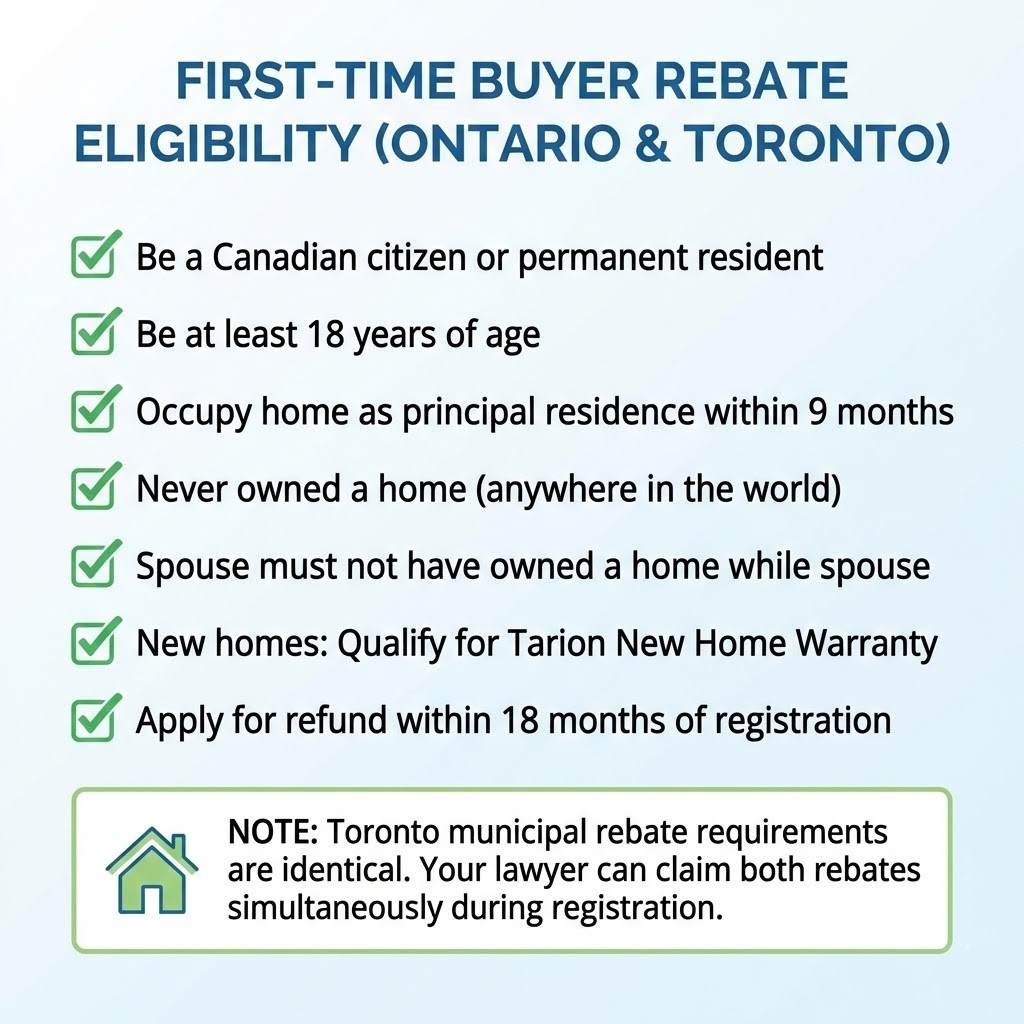
First-Time Buyer Eligibility Requirements
To qualify for the Ontario provincial rebate, you must meet all of these criteria:
- Be a Canadian citizen or permanent resident
- Be at least 18 years of age
- Occupy the home as your principal residence within 9 months of purchase
- Have never owned a home (or any interest in a home) anywhere in the world
- Your spouse must not have owned a home while being your spouse
- For newly built homes, the property must qualify for Tarion New Home Warranty
- Apply for the refund within 18 months of registration
Toronto municipal rebate requirements are identical. Your lawyer can claim both rebates simultaneously during the registration process.
Closing Cost Reality: Beyond Land Transfer Tax
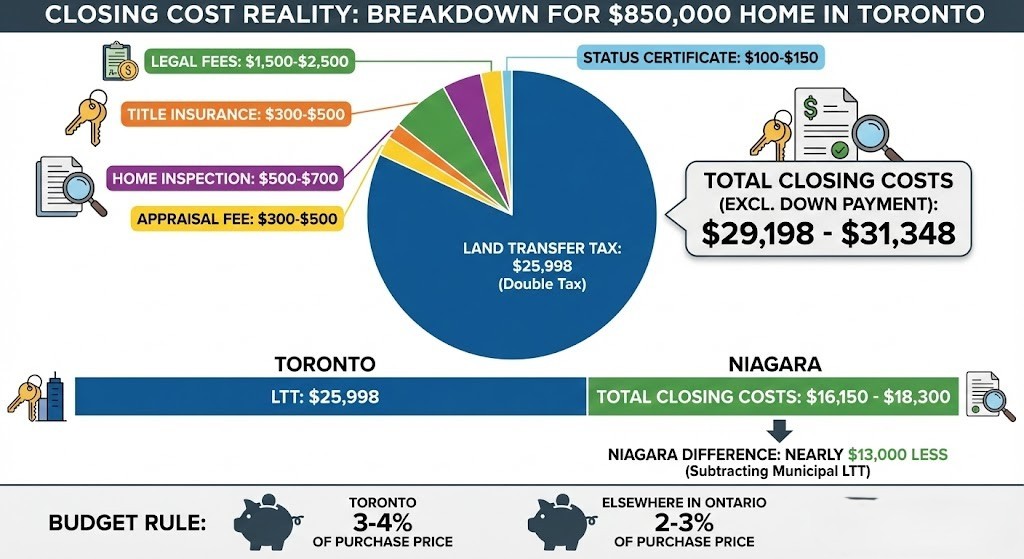
While land transfer tax is the largest single closing cost for most buyers, it’s not the only expense. Here’s what a typical closing looks like:
Total Closing Costs Breakdown ($850,000 Home in Toronto):
| Expense | Typical Cost | Notes |
|---|---|---|
| Land Transfer Tax | $25,998 | Double tax in Toronto |
| Legal Fees | $1,500-$2,500 | Real estate lawyer |
| Title Insurance | $300-$500 | Protects against title defects |
| Home Inspection | $500-$700 | Recommended but optional |
| Appraisal Fee | $300-$500 | If required by lender |
| HST on New Homes | $110,500 | 13% on new construction (rebates available) |
| Status Certificate Fee | $100-$150 | For condos |
| Total Closing Costs | $29,198-$31,348 | Excluding down payment |
For Niagara buyers, subtract the $13,048 municipal LTT, bringing total closing costs to $16,150-$18,300-nearly $13,000 less.
Budget Rule: Plan for 3-4% of your purchase price in closing costs in Toronto, 2-3% elsewhere in Ontario.
Impact on Affordability: The Hidden Down Payment
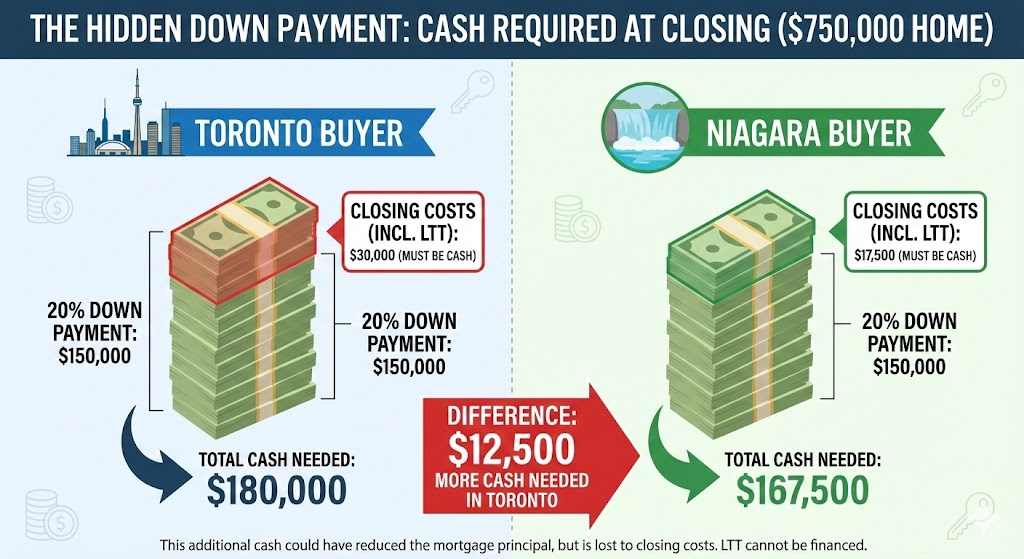
Land transfer tax represents a hidden barrier to homeownership because it must be paid in cash on closing-it cannot be financed through your mortgage.
Example: $750,000 Home Purchase
Toronto Buyer:
- 20% down payment: $150,000
- Closing costs (including LTT): $30,000
- Total cash needed: $180,000
Niagara Buyer:
- 20% down payment: $150,000
- Closing costs (including LTT): $17,500
- Total cash needed: $167,500
Difference: The Toronto buyer needs an additional $12,500 in cash beyond their down payment-money that could have gone toward the down payment itself, reducing monthly mortgage payments.
This disproportionately affects first-time buyers and young families who have scraped together a down payment but have limited liquid savings for closing costs.
Why Does Toronto Have Double Land Transfer Tax?
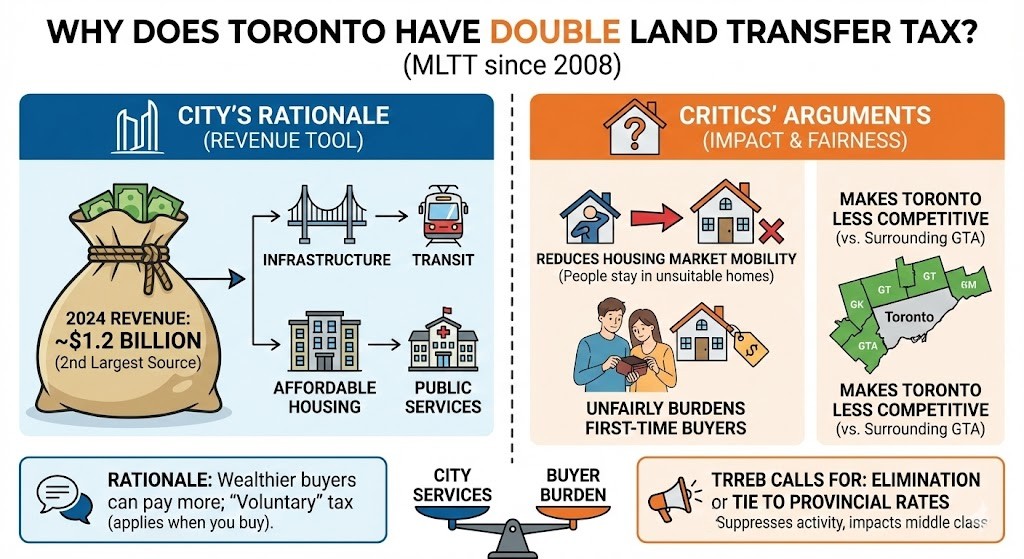
Toronto introduced the Municipal Land Transfer Tax in 2008 as a revenue tool to fund city services without raising property taxes. The rationale:
- Real estate transactions in Toronto involve wealthier buyers who can afford to pay more
- The tax is “voluntary” in that it only applies when you choose to buy
- Revenue funds infrastructure, transit, affordable housing, and public services
2024 Revenue: Toronto’s MLTT generated approximately $1.2 billion in revenue, making it the city’s second-largest revenue source after property taxes.
Critics argue the tax:
- Reduces housing market mobility (people stay in unsuitable homes to avoid the tax)
- Unfairly burdens first-time buyers trying to enter the market
- Makes Toronto less competitive compared to surrounding GTA municipalities
The Toronto Regional Real Estate Board (TRREB) has repeatedly called for the MLTT to be tied to provincial rates or eliminated entirely, arguing it suppresses market activity and disproportionately impacts middle-class buyers.
2026 Outlook: What's Changing and What's Not
Confirmed for 2026
✅ Toronto Luxury MLTT Increases (April 1, 2026): Homes over $3 million face significantly higher municipal rates, with the top bracket reaching 8.6% for properties exceeding $20 million.
✅ Provincial Rates Unchanged: Ontario’s provincial land transfer tax rates remain the same as 2025, with no announced changes.
✅ First-Time Buyer Rebates Maintained: Both provincial ($4,000) and Toronto municipal ($4,475) rebates continue unchanged.
Unlikely for 2026
❌ Provincial Rate Changes: There is no indication Ontario will adjust provincial LTT rates in 2026.
❌ Toronto MLTT Elimination: Despite political pressure and upcoming municipal elections (October 2026), the MLTT is unlikely to be eliminated or reduced given Toronto’s reliance on this revenue stream.
❌ Expansion to Other GTA Municipalities: Mississauga, Brampton, Markham, and other GTA cities continue to have no municipal LTT and show no signs of implementing one.
Strategic Considerations for Buyers
Toronto Buyers
1. First-Time Buyers: Always claim your rebates-the combined $8,475 savings is significant. Work with your lawyer to ensure proper application at registration.
2. Luxury Buyers: If purchasing a home over $3 million and able to close before April 1, 2026, accelerating your timeline could save tens of thousands of dollars.
3. Budget Accurately: Don’t underestimate closing costs. For a $1 million Toronto purchase, budget approximately $42,000 for land transfer tax alone (assuming no rebates).
4. Consider Surrounding Municipalities: Buyers on the Toronto border (near Mississauga, Vaughan, North York city limits) should evaluate whether locating just outside Toronto’s boundaries saves enough to justify the location change.
Niagara Buyers
1. Capitalize on Single-Tax Advantage: While Niagara’s land transfer tax is lower than Toronto’s, you’re still paying provincial LTT. First-time buyers should absolutely claim their $4,000 rebate.
2. Lower Closing Costs Enable Larger Down Payments: Money saved on closing costs (vs. Toronto) can be redirected toward a larger down payment, reducing mortgage insurance premiums and monthly payments.
3. Budget Conservatively: Even though Niagara buyers pay roughly half Toronto’s LTT, you should still budget 2-3% of purchase price for total closing costs.
Planning Your Purchase: Action Steps
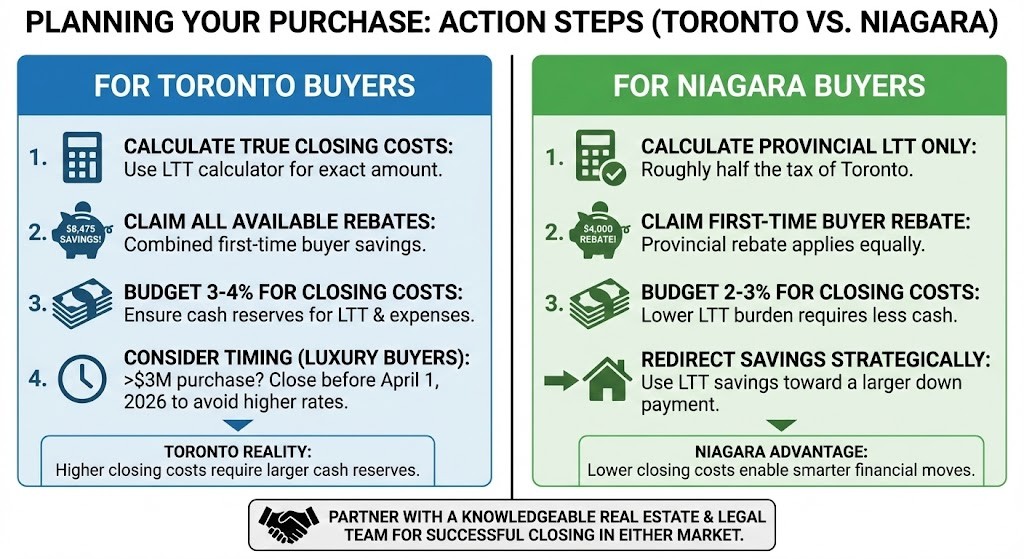
For Toronto Buyers:
- Calculate Your True Closing Costs: Use a land transfer tax calculator to determine exact LTT based on your purchase price
- Claim All Available Rebates: If you’re a first-time buyer, the combined $8,475 savings is substantial
- Budget 3-4% for Closing Costs: Don’t just focus on down payment-ensure you have cash reserves for LTT and other closing expenses
- Consider Timing (Luxury Buyers): If purchasing above $3 million, closing before April 1, 2026 avoids higher rates
For Niagara Buyers:
- Calculate Provincial LTT Only: You’re paying roughly half what Toronto buyers pay-significant savings
- Claim First-Time Buyer Rebate: The $4,000 provincial rebate applies equally in Niagara
- Budget 2-3% for Closing Costs: Niagara’s lower LTT burden means less cash required at closing
- Redirect Savings Strategically: Consider using the LTT savings vs. Toronto toward a larger down payment
The Bottom Line
Land transfer tax represents one of the largest closing costs Ontario homebuyers face, with Toronto buyers paying double what the rest of the province pays due to the city’s unique municipal LTT. For a typical $850,000 home, this translates to over $13,000 in additional costs-money that could otherwise strengthen your down payment or provide financial cushion post-purchase.
The December 2025 approval of increased luxury MLTT rates effective April 2026 further widens the gap for high-end buyers, with properties over $20 million facing a combined provincial and municipal LTT exceeding 11% of purchase price.
Whether you’re buying in Toronto’s competitive market or exploring more affordable secondary markets like Niagara, understanding land transfer tax-and planning for it properly-is essential for successful homeownership.
Partner With Quantum Team Realty
At Quantum Team Realty, we help Ontario buyers understand the complete cost picture of homeownership, including land transfer tax implications. Our experienced team has guided hundreds of clients through successful purchases across the GTA and Niagara Region, ensuring they budget accurately and claim all available rebates.
Whether you’re a first-time buyer navigating Toronto’s double-tax environment or exploring Niagara’s more affordable markets, our expertise ensures you’re prepared for every aspect of closing day.
Contact Quantum Team Realty today for a personalized closing cost analysis and market consultation. Our two locations serving Toronto and broader Ontario provide the local knowledge you need to make confident real estate decisions.
Ready to calculate your land transfer tax? Visit our homepage for instant access to LTT calculators, market reports, and buyer resources.
Frequently Asked Questions
Can I avoid land transfer tax if I'm a first-time buyer?
No, but you can significantly reduce it. Ontario’s $4,000 rebate fully covers LTT on homes up to $368,000. Toronto’s additional $4,475 municipal rebate covers municipal LTT on homes up to $400,000. For homes above these thresholds, you receive the full rebate amount but still owe LTT on the portion above.
Do I pay land transfer tax on my mortgage amount or purchase price?
Land transfer tax is calculated on the purchase price, not your mortgage amount. If you buy a $700,000 home with a $560,000 mortgage (80% loan-to-value), LTT is calculated on the full $700,000 purchase price.
What if I'm buying a property with someone else-can we both claim the first-time buyer rebate?
If both buyers are first-time buyers, you can both claim the rebate. If only one buyer is a first-time buyer, that person can claim 50% of the maximum rebate amount based on their ownership share. The other buyer (not first-time) receives no rebate on their portion.
Are there any exemptions to land transfer tax in Ontario?
Yes, certain transfers are exempt including:
- Transfers between spouses
- Transfers to lineal descendants (parent to child)
- Transfers involving certain farming properties between family members
- Transfers to establish a family business Each exemption has specific requirements-consult your real estate lawyer for eligibility.
How does land transfer tax work for newly built homes?
Land transfer tax applies the same way to new construction as resale homes, calculated on the purchase price. However, new homes have additional costs including 13% HST (with rebates available for primary residences). Budget for both LTT and HST when purchasing new construction.
Can land transfer tax be added to my mortgage?
No. Canadian lenders do not allow land transfer tax to be financed through your mortgage. This tax must be paid from your available cash on the closing date. This is why proper budgeting for closing costs is critical-many first-time buyers focus solely on down payment requirements and are surprised by the additional cash needed.
Will other GTA cities implement municipal land transfer taxes like Toronto?
While several GTA municipalities have considered municipal LTT, none have implemented it to date. Mississauga, Brampton, Vaughan, Markham, and Oakville continue to rely on property taxes as their primary revenue source. Given voter sensitivity to new taxes, municipal LTT expansion appears unlikely in the near term.

Sunny Chadha
Sunny Chadha is the Co-Founder of Quantum Team Realty and brings over 15 years of experience in Niagara real estate. He is passionate about helping clients make informed decisions and sharing his deep knowledge of the local market.
References
- Ratehub.ca. (May 16, 2025). “Ontario Land Transfer Tax Rates 2026 | Calculator.” Retrieved from ratehub.ca/land-transfer-tax-ontario
- WOWA.ca. (2026). “Ontario Land Transfer Tax 2026 | Calculator, Rates & Rebates.” Retrieved from wowa.ca/calculators/ontario-toronto-land-transfer-tax
- NerdWallet Canada. (2025). “Canada Land Transfer Tax Calculator.” Retrieved from nerdwallet.com/ca/p/calculators/mortgages/land-transfer-tax
- City of Toronto. (December 17, 2025). “Municipal Land Transfer Tax & Municipal Non-Resident Speculation Tax Rates & Fees.” Retrieved from toronto.ca
- CBC News. (December 18, 2025). “Toronto city council approves hike in land transfer tax for luxury homebuyers.” Retrieved from cbc.ca/news/canada/toronto
- CBC News. (December 10, 2025). “Toronto one step closer to making luxury homebuyers pay more in land transfer taxes.” Retrieved from cbc.ca/news/canada/toronto
- Toronto Livings. (December 18, 2025). “Toronto Luxury Land Transfer Tax Increase Coming in 2026.” Retrieved from torontolivings.com
- NOW Toronto. (December 18, 2025). “‘They are the wealthiest of the wealthiest,’ Toronto approves higher land transfer taxes for luxury homebuyers.” Retrieved from nowtoronto.com
- Toronto Taxpayer. (2025). “Toronto Taxes 2026: City Fees, Rates and New Budget Hikes.” Retrieved from torontotaxpayer.ca
- Toronto Taxpayer. (December 2025). “Toronto Tax Increase 2025-2026: rates, hikes, budget forecast.” Retrieved from torontotaxpayer.ca/blog/toronto-tax-increase
- Ratehub.ca. (January 12, 2026). “Toronto Land Transfer Tax 2025.” Retrieved from ratehub.ca/land-transfer-tax-toronto
- nesto.ca. (October 28, 2025). “Ontario Land Transfer Tax Calculator.” Retrieved from nesto.ca/calculators/land-transfer-tax/ontario
- Perch. (May 25, 2023). “Ontario Land Transfer Tax Calculator 2026.” Retrieved from myperch.io/tools/ontario-land-transfer-tax-calculator
- WOWA.ca. (2025). “Land Transfer Tax Calculator for Canadian Provinces 2025.” Retrieved from wowa.ca/calculators/land-transfer-tax
- Hale Tale. (January 2026). “Toronto Property Tax 2025 Guide: Rates & 2026 Updates.” Retrieved from haletale.com/toronto-property-tax-guide-to-2026


