



When David opened his 2025 Toronto property tax bill in February, he was shocked to discover an additional $420 annually—a 6.9% increase over 2024. His $692,031 MPAC-assessed home now cost $5,718 in property taxes instead of $5,298. Worse, his friend in Mississauga faced an even steeper 9% combined increase from regional and municipal hikes.
Neither anticipated these increases. After all, Toronto home prices declined 4.1% year-over-year in 2025, and the broader Ontario market showed similar corrections. How could property taxes rise dramatically while property values fell?
The answer reveals a complex dynamic affecting every Ontario homeowner: municipal budget pressures, frozen MPAC assessments dating back to 2016, and structural funding gaps forcing cities to extract more revenue from existing tax bases. For homeowners budgeting monthly expenses, the uncertainty around 2026 property tax changes creates planning challenges—especially as many municipalities signal continued increases ahead.
Who This Guide Serves
This analysis is specifically for current Ontario homeowners (across GTA, Niagara Region, Hamilton, and surrounding municipalities) facing property tax increases, as well as prospective buyers evaluating total cost of ownership when comparing markets. Whether you own a detached home in Toronto, a condo in Mississauga, or investment property in Niagara Falls, understanding the forces driving property tax changes helps you budget accurately and make informed decisions about your real estate holdings.
Understanding Ontario's Property Tax System: The 2016 Freeze
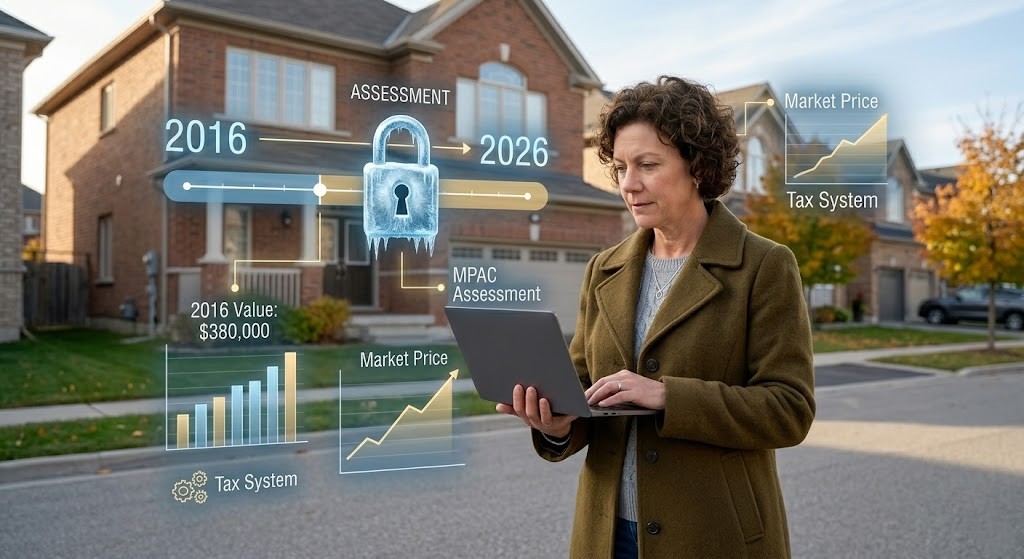
To understand why your property taxes keep rising despite market corrections, you need to grasp how Ontario calculates property taxes and why assessments remain frozen nearly a decade old.
How Property Tax Is Calculated
Property tax in Ontario follows a straightforward formula:
(MPAC Assessed Value) × (Municipal Tax Rate + Education Tax Rate) = Annual Property Tax
The Municipal Property Assessment Corporation (MPAC), a provincial agency, determines assessed values for every Ontario property. Municipalities then set tax rates based on budget requirements, applying these rates to assessed values to generate revenue.
The provincial government sets a uniform education tax rate (0.153%) province-wide, funding public education. Municipal rates vary dramatically based on local budget needs, infrastructure requirements, and tax base size.
The Critical 2016 Assessment Freeze
Here’s the complication creating distortions across Ontario: all property assessments remain based on January 1, 2016 market values through at least 2026.
MPAC typically conducts province-wide reassessments every four years. The last update occurred in 2016. Due to COVID-19, Ontario postponed the scheduled 2020 reassessment. They’ve continued postponing through 2022, 2023, 2024, 2025, and now 2026.
What This Means:
Your $1 million home purchased in 2024 might show a $650,000 MPAC assessment (its estimated 2016 market value). A suburban property that doubled in value since 2016 is taxed on pre-surge valuations. Downtown Toronto condos with modest appreciation face relatively higher effective tax rates.
This freeze creates winners and losers. Properties in markets that appreciated dramatically since 2016 (many suburban areas) enjoy artificially low assessments relative to current values. Properties in stable or declining markets face proportionally higher tax burdens.
Why Hasn't Ontario Updated Assessments?
Politically, a 2026 reassessment would trigger massive tax shifts. Suburban homes that doubled in value would see assessment increases of 50-100%, dramatically raising tax bills even without rate increases. Downtown condos with modest appreciation might see relative decreases. This redistribution would create voter backlash in suburban ridings—a politically unpalatable outcome heading into election cycles.
2025 Property Tax Increases: What Actually Happened
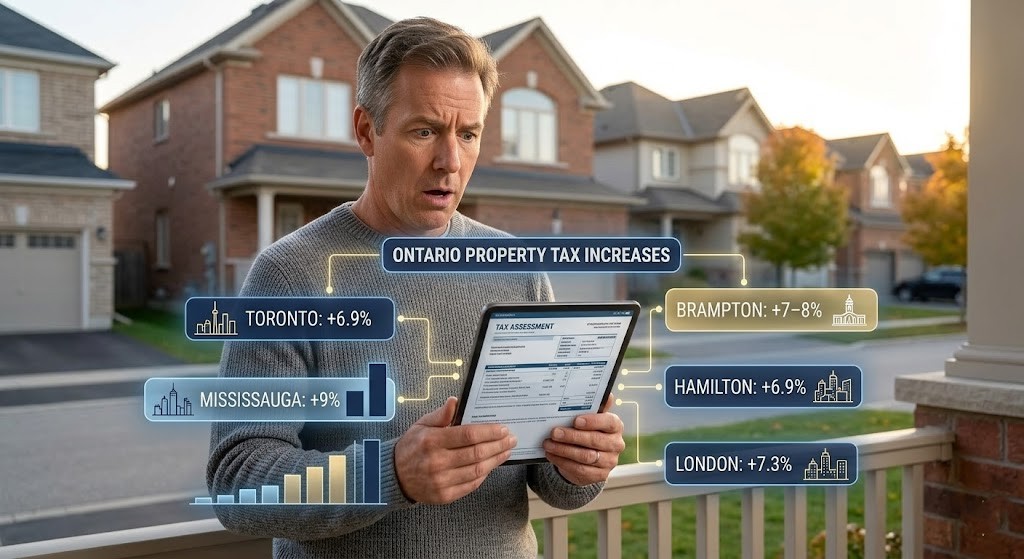
Ontario municipalities implemented some of the steepest property tax increases in decades during 2025, driven by budget pressures municipalities can no longer ignore.
Major Ontario Municipalities - 2025 Increases
| Municipality | 2025 Tax Rate | Increase vs 2024 | Average Home Assessment | Annual Tax (Avg Home) |
|---|---|---|---|---|
| Toronto | 0.754% | +6.9% | $692,031 | $5,718 |
| Mississauga | 0.830% | +9%+ (combined) | $580,000 | $4,814 |
| Brampton | 0.990% | +7–8% (combined) | $550,000 | $5,445 |
| Hamilton | 1.170% | +6.9% | $420,000 | $4,914 |
| Burlington | 1.150% | +5.97% | $460,000 | $5,290 |
| London | 1.280% | +7.3% | $385,000 | $4,928 |
Sources: Municipal budgets, johnowen.realtor, torontotaxpayer.ca, INsauga, Global News, January 2026
Note: Rates shown include municipal and education portions. Some municipalities (Mississauga, Brampton) face additional regional tax increases beyond municipal rates.
Why Such Aggressive Increases?
Municipal budget pressures stem from multiple factors:
1. Provincial Cost-Shifting
Municipalities increasingly fund services historically covered by provincial or federal governments: refugee settlement costs, social housing, public health infrastructure, transit expansion.
2. Infrastructure Deficit
Years of below-inflation tax increases created deferred maintenance backlogs. Roads, water systems, transit, and public facilities require billions in overdue investment.
3. Inflation Pressures
Operating costs (salaries, materials, fuel, contracts) rose faster than municipal revenue growth, forcing catch-up increases.
4. Limited Revenue Tools
Unlike the province or federal government, municipalities are unable to carry a deficit, requiring balanced budgets annually. Property taxes represent their primary revenue source, making rate increases inevitable when expenses rise.
5. Refugee and Shelter Costs
Toronto specifically cited hundreds of millions in refugee settlement and homeless shelter costs—expenses Mayor Olivia Chow argues should be federally funded but currently burden municipal budgets.
Toronto's Record-Breaking Increases
Toronto implemented extraordinary increases: 9.5% in 2024 (largest since amalgamation in 1998), followed by 6.9% in 2025. Combined, these represent over 16% cumulative increases in just two years.
For homeowners, this translated to meaningful monthly cost increases. A home with a $692,031 assessment saw annual taxes jump from approximately $4,960 (2023) to $5,508 (2024) to $5,718 (2025)—an increase of $758 over two years.
In our experience serving both Toronto and Niagara Region homeowners, these increases caught many by surprise. Homeowners budgeting based on historical 2-3% annual increases suddenly faced budget gaps requiring difficult choices: reduce savings, cut expenses elsewhere, or refinance to manage cash flow.
What to Expect in 2026: Election Year Dynamics
Predicting 2026 property tax changes requires understanding both fiscal realities and political pressures unique to municipal election years.
Why 2026 Is Different
October 2026 brings municipal elections across Ontario. Incumbents face voters after implementing steep increases in 2024-2025. Politically, proposing another aggressive hike immediately before elections risks backlash.
Mayor Olivia Chow and Toronto Budget Chief Councillor Shelley Carroll have signaled a “leaner” 2026 budget approach. They know that Torontonians are tapped out. The cost of living crisis hasn’t gone away; groceries are still expensive, mortgage renewals are hurting, and proposing another 9% increase would be politically damaging.
Likely 2026 Scenarios by Municipality
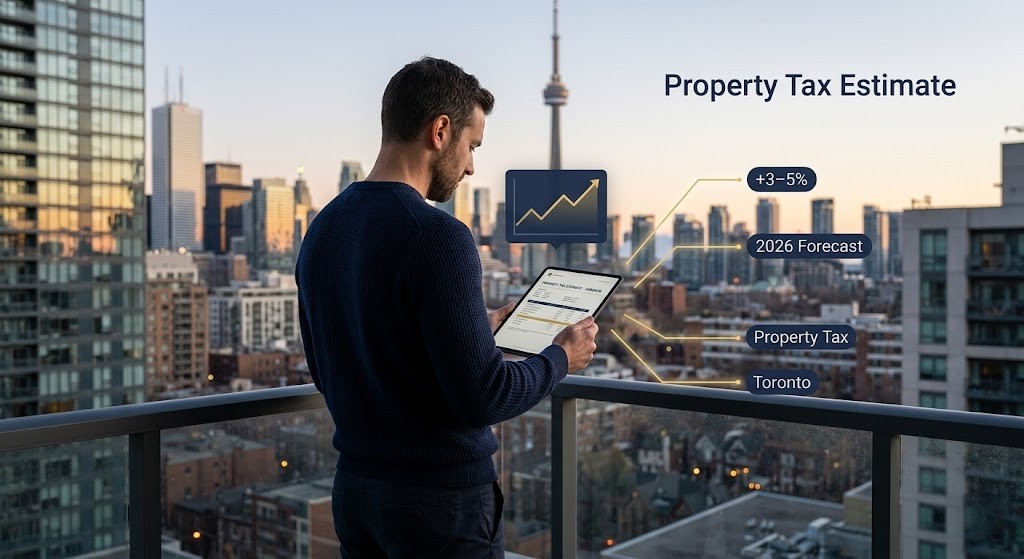
Toronto:
Expected increase: 3-5% (more moderate than 2024-2025)
Rationale:
- Election year political pressure
- Partial relief from provincial “New Deal” (taking back Gardiner Expressway and DVP)
- Continued structural deficit requiring some increase
- City Building Fund levy (1.5%) likely continues
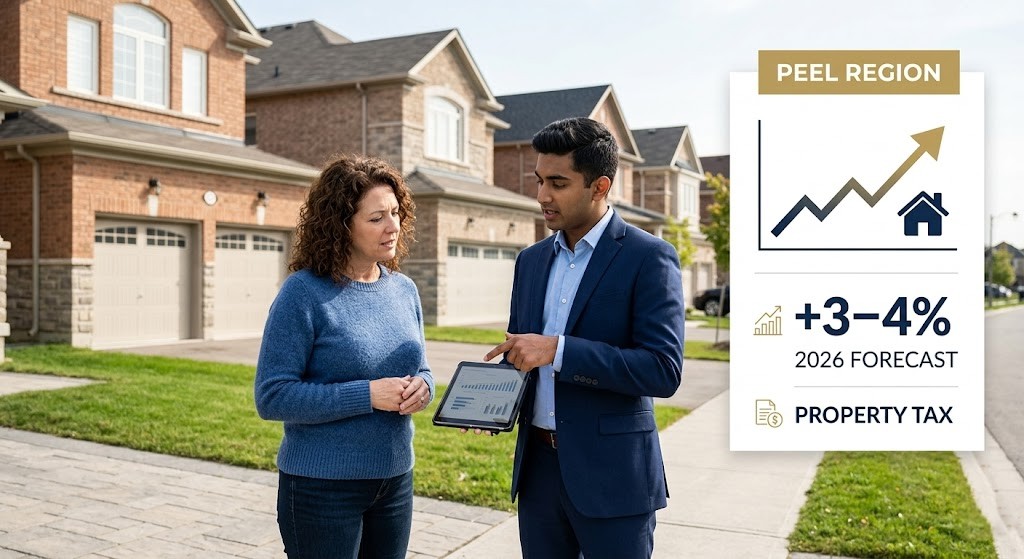
Peel Region (Mississauga/Brampton):
Expected increase: 3-4% combined regional and municipal
Rationale:
- Peel Regional Council approved its 2026 capital and operating budgets with a total average property tax increase of 3.36 per cent
- Additional municipal increases from Mississauga and Brampton city budgets
- Infrastructure investment for population growth
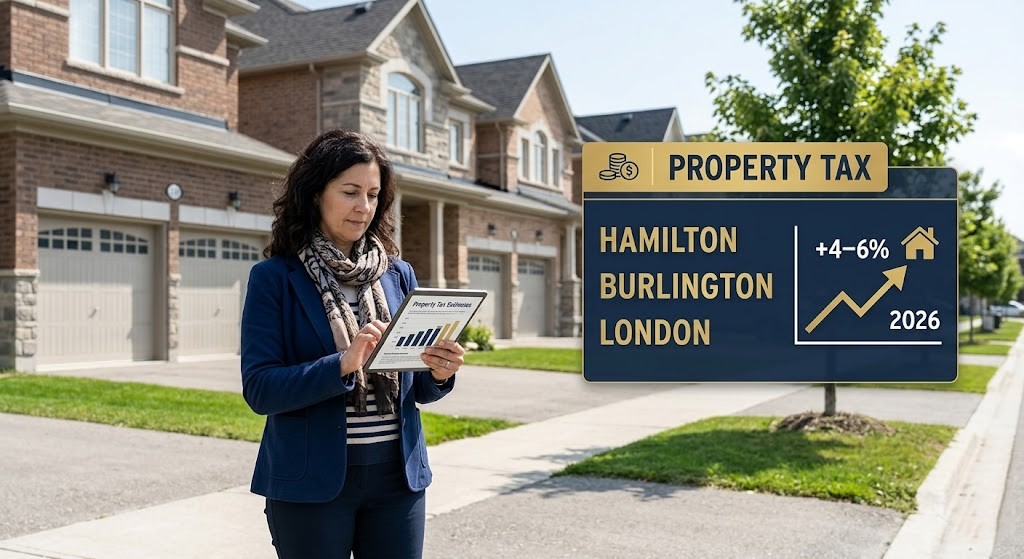
Hamilton, Burlington, London:
Expected increase: 4-6%
Rationale:
- Infrastructure needs ongoing
- Less extreme pressure than Toronto
- Balancing budget requirements with voter tolerance
The Ongoing Structural Challenge
Toronto faces a projected 2026 funding gap of approximately $1.072 billion. To put this in perspective, each 1% property tax increase generates roughly $49 million in revenue. Closing this gap entirely through property taxes would require a 22% increase—politically and economically impossible.
This means even “moderate” 2026 increases only partially address structural deficits. Future years will likely see continued above-inflation increases until provincial/federal funding formulas change or municipalities find alternative revenue sources.
How Property Tax Changes Impact Different Homeowner Types

Property tax increases affect homeowners differently based on their specific circumstances and financial situations.
First-Time Homeowners and Budget-Stretched Buyers
Challenge: Property tax increases consume larger portions of fixed income, forcing difficult spending choices.
Retirees on fixed pensions see property taxes rise while income remains static. A $600 annual increase represents 5% of a $12,000 annual pension increase—or an entire month’s grocery budget.
Strategic Consideration: Some municipalities offer property tax deferral programs for seniors, allowing taxes to be paid when the property eventually sells. Research local programs if cash flow is constrained.
Real Estate Investors and Landlords
Challenge: Increasing property taxes compress rental yields and cash flow.
Investors typically cannot pass full property tax increases to tenants mid-lease. A 7% tax increase on a rental property assessed at $600,000 equals $504 annually ($42/month)—directly reducing net operating income and overall return on investment.
Strategic Consideration: When evaluating investment properties across Ontario markets, total operating expenses (including realistic property tax escalation) matter more than purchase price alone. A property showing 5% rental yield today might deliver only 3.5% yield after three years of 6% annual tax increases.
For detailed analysis of investment property returns across Ontario markets, see our Condo vs Detached Homes: 5-Year Investment Comparison which factors property tax variations into total return calculations.
Homeowners Planning to Sell
Challenge: Rising property taxes affect buyer affordability and resale competitiveness.
When buyers evaluate total monthly costs, property taxes represent 15-25% of housing expenses. A home with $8,000 annual property taxes costs $667/month before mortgage, insurance, and utilities. This reduces buyers’ purchasing power and potentially impacts your selling price.
Strategic Consideration: If selling in a high-tax municipality, emphasize other value factors (location, schools, amenities) that justify total ownership costs. Consider timing sales before additional tax increases take effect.
Regional Variations: Why Location Matters

Property tax burdens vary dramatically across Ontario, creating meaningful differences in total cost of ownership.
Tax Rate vs. Total Tax: The Paradox
Toronto maintains one of Ontario’s lowest tax rates (0.754%) yet delivers significant total tax bills due to high property values. Niagara Falls has a much higher rate (1.2%) but lower assessed values often result in comparable or lower total taxes.
Example Comparison:
| Market | Purchase Price | MPAC Assessment (Est.) | Tax Rate | Annual Property Tax |
|---|---|---|---|---|
| Toronto | $1,000,000 | $650,000 (2016) | 0.754% | $4,901 |
| Mississauga | $950,000 | $580,000 (2016) | 0.830% | $4,814 |
| Niagara Falls | $650,000 | $550,000 (2016) | 1.200% | $6,600 |
| Hamilton | $750,000 | $480,000 (2016) | 1.170% | $5,616 |
Note: Actual taxes vary based on specific property assessments and municipal rates. Examples illustrative only.
This illustrates why comparing markets requires examining total monthly costs (mortgage + tax + insurance + utilities) rather than focusing solely on purchase price or tax rate.
Working with brokerages familiar with both GTA and regional Ontario markets provides perspective on these variations. At Quantum Team Realty, our presence in both Niagara Falls and Brampton enables us to provide comparative analysis helping buyers understand true cost differences across markets rather than focusing on purchase price alone.
For detailed market comparisons including property tax impacts, reference our Toronto vs GTA Suburbs: Where Your Money Goes Furthest analysis with comprehensive cost breakdowns.
Strategic Planning for Homeowners

Budgeting for Future Increases
Conservative Approach: Assume 4-5% annual property tax increases when budgeting long-term (mortgage renewals, retirement planning, investment analysis).
While municipalities may deliver lower increases in specific years (election years, extraordinary provincial funding), structural pressures suggest above-inflation increases continue until funding models change.
Property Tax Relief and Deferral Options
Municipal Tax Relief Programs:
Most municipalities offer relief for:
- Significant property damage preventing normal use
- Charitable organizations
- Assessment errors or over-classification
Long-Term Real Estate Strategy
Property tax trends should inform:
Purchase Decisions: Factor 5-year projected tax increases into affordability calculations.
Hold vs. Sell Analysis: If investment property taxes rise faster than rental income, exit strategy timing becomes critical.
Renovation Planning: Major renovations triggering MPAC reassessments can increase assessed values and future taxes—factor this into ROI calculations.
Market Selection: When expanding investment portfolios, compare not just current yields but projected net yields after realistic tax escalation.
What Homeowners Should Do Now

Whether you’re a current homeowner managing budgets or a prospective buyer evaluating markets, several immediate actions help navigate Ontario’s property tax environment:
Review Your Current Assessment:
Access your MPAC assessment online through AboutMyProperty portal. Compare your assessment to similar properties in your neighborhood. If your assessment appears disproportionately high, consider filing an appeal before the March 31, 2026 deadline.
Budget for 2026 Increases:
Don’t assume 2026 taxes remain flat. Even “moderate” 3-5% increases translate to $150-$400 annually for many homeowners. Adjust monthly budgets now rather than facing shortfalls when tax bills arrive.
Evaluate Total Costs When Comparing Markets:
If considering purchases across different Ontario municipalities, use comprehensive cost calculators factoring property taxes, not just mortgage payments. A $100,000 price difference may disappear when accounting for tax rate variations over 5-10 years.
Explore Property Tax Relief Options:
If you’re a senior on fixed income or facing financial hardship, research municipal deferral and relief programs. Many homeowners miss available assistance simply because they don’t know programs exist.
Monitor Municipal Budgets:
Most Ontario municipalities finalize budgets January-March annually. Following local budget processes provides advance notice of coming increases, enabling better planning.
For strategic guidance on evaluating Ontario markets with comprehensive cost analysis including property taxes, contact experienced brokerages serving multiple markets. Access our comprehensive Ontario real estate resources including market comparison tools, cost calculators, and detailed municipal tax data to make informed decisions.
Conclusion
Ontario’s property tax landscape presents challenges for every homeowner: aggressive 2025 increases (5-9% across major municipalities), continued MPAC assessment freezes creating distortions, structural municipal deficits forcing ongoing rate growth, and uncertainty around 2026 changes as election-year politics compete with fiscal realities.
For current homeowners, understanding these dynamics enables better budgeting and strategic planning. For prospective buyers comparing Ontario markets, recognizing that property taxes vary dramatically by municipality—and that future increases are likely—ensures realistic evaluation of total ownership costs.
While individual homeowners cannot control municipal tax policies, informed decision-making, strategic market selection, and proactive budget management help navigate these ongoing changes successfully. Whether you’re managing current properties, evaluating new purchases, or planning long-term real estate strategy, factoring realistic property tax projections into your analysis protects against unexpected budget pressures.
The municipalities delivering the most predictable, stable tax environments—combined with other cost factors like land transfer taxes, insurance, and utilities—represent the strongest foundations for sustainable homeownership.
For personalized analysis of property tax implications across Ontario markets you’re considering, explore our comprehensive buyer and homeowner resources, or schedule a consultation to discuss your specific circumstances with market experts familiar with both GTA and regional Ontario conditions.
Frequently Asked Questions
Why are my property taxes increasing when my home value decreased?
Property taxes fund municipal budgets and are largely independent of individual property value changes. Even when your home’s market value declines, municipalities still require revenue to fund services (police, fire, roads, transit, social services). Rising operating costs, infrastructure needs, and provincial cost-downloading force municipalities to increase tax rates despite declining property values.
When will MPAC update property assessments from 2016 values?
Ontario has not announced a timeline for province-wide reassessment. The 2016 freeze continues through at least 2026. Politically, updating assessments would trigger massive tax shifts—suburban homes that doubled in value would face steep tax increases, creating voter backlash. Most observers expect the freeze to continue through 2027-2028 or longer.
Can I appeal my 2026 property tax assessment?
Yes. The deadline to file a request for reconsideration or an appeal for 2026 is March 31, 2026. You can request MPAC reconsider your assessment if you believe it’s inaccurate or inequitable compared to similar properties. Use MPAC’s AboutMyProperty tool to compare your assessment to neighbors’ assessments before filing
Are there property tax breaks for seniors or low-income homeowners?
Programs vary by municipality but often include tax deferrals for seniors (payment postponed until property sale), low-income grants, disabled persons relief, and charitable rebates. Contact your municipal tax office to inquire about available programs. Many homeowners miss benefits simply because they don’t ask.
How do Toronto property taxes compare to surrounding municipalities?
Toronto has one of Ontario’s lowest tax rates (0.754% in 2025) but high property values result in substantial total taxes. Mississauga (0.830%), Brampton (0.990%), and Hamilton (1.170%) have higher rates but often lower assessed values. Total annual taxes depend on both rate and assessment—a $600,000 assessed Toronto home pays less than a $600,000 assessed Hamilton home despite Toronto’s lower rate.
Will 2026 property tax increases be lower because it's an election year?
Historically, municipal election years see more moderate tax increases as incumbents avoid voter backlash. Toronto’s Mayor Chow and Budget Chief Carroll have signaled a “leaner” 2026 budget targeting 3-5% increases rather than the 7-9% seen in 2024-2025. However, structural deficits mean some increase is likely despite political pressure.
Should I factor property taxes into my home-buying budget?
Absolutely. Lenders include property taxes in debt service ratio calculations when qualifying you for mortgages. Beyond qualification, property taxes represent 15-25% of total housing costs. Budget 0.75-1.3% of your home’s purchase price annually for Ontario property taxes, with higher percentages in secondary markets outside Toronto.
What happens if I can't afford to pay my property taxes?
Unpaid property taxes accumulate penalties (typically 1.25% monthly) and interest. Municipalities can eventually register tax liens against your property and initiate tax sale proceedings. Municipalities have the legal authority to register tax liens against properties. Contact your municipal tax office immediately if facing payment difficulties—many offer payment plans or hardship programs to avoid collection action.

Sunny Chadha
Sunny Chadha is the Co-Founder of Quantum Team Realty and brings over 15 years of experience in Niagara real estate. He is passionate about helping clients make informed decisions and sharing his deep knowledge of the local market.
References
- iFinance Canada. (January 2026). “The Average 2026 Property Taxes in Ontario and Toronto.” Retrieved from ifinancecanada.com
- Toronto Taxpayer. (January 18, 2026). “Toronto Tax Increase 2025-2026: rates, hikes, budget forecast.” Retrieved from torontotaxpayer.ca
- Hale Tale. (January 2026). “Toronto Property Tax 2025 Guide: Rates & 2026 Updates.” Retrieved from haletale.com
- John Owen, RE/MAX. (2025). “Ontario Property Taxes by City 2025 – Compare your location.” Retrieved from johnowen.realtor
- INsauga. (December 17, 2025). “Property tax hike coming to Mississauga and Brampton.” Retrieved from insauga.com
- Toronto Taxpayer. (January 2026). “Toronto Property Tax 2025-2026: The Definitive Guide.” Retrieved from torontotaxpayer.ca
- Global News. (December 10, 2024). “Why property taxes are skyrocketing in some Ontario cities.” Retrieved from globalnews.ca
- Lexology – Aird & Berlis. (January 2026). “Toronto Tax Increases, Provincial Deadlines and Tax Relief Options.” Retrieved from lexology.com
- Toronto Taxpayer. (January 2026). “Toronto Property Tax Calculator.” Retrieved from torontotaxpayer.ca
- Aird & Berlis LLP. (February 18, 2025). “City of Toronto Proposed Property Tax Increases and Key 2025 Deadlines for Property Owners.” Retrieved from airdberlis.com
This analysis is based on publicly available municipal budget data and property tax information as of January 2026. Individual circumstances vary. Consult with qualified real estate and financial professionals regarding your specific situation.


