





Last Updated 09-09-2026
Executive Summary
- 2026 Tax Changes: Understand key Ontario property tax changes affecting homeowners.
- Tax Calculation: Learn how property taxes are determined and updated.
- Homeowner Impact: See how tax changes can affect your annual housing costs.
- Niagara Focus: Understand what property tax changes may mean for Niagara homeowners.
- Planning Ahead: Learn how to factor property taxes into your home-buying budget.
If you own a home in Ontario right now, your property tax bill is almost certainly going up in 2026 – and in several cities, the increase is larger than anything seen in recent years. Between rising municipal budgets, infrastructure backlogs, a shift in how MPAC assesses property values, and new federal tax rules on capital gains, Ontario homeowners are navigating a more complex property tax landscape than they have in over a decade.propertytaxpayer.beehiiv+1
This guide breaks down exactly what is changing, which cities are seeing the largest increases, how the MPAC reassessment shift affects your assessed value, and what practical steps you can take to protect your budget – whether you are a first-time homeowner, a long-time resident or an investor with multiple properties across the region.
At Quantum Team Realty, we work with buyers, sellers and investors across Niagara Falls, St. Catharines, Thorold and Greater Toronto every day – and the property tax question is one of the most common conversations we are having with clients right now. Here is everything you need to know.
Get comprehensive, data-driven real estate guidance on ontario property tax changes 2026 with Quantum Team Realty. Serving buyers, sellers, and investors across Niagara Falls, St. Catharines, Welland, and the Greater Toronto Area.
What Is Actually Changing With Ontario Property Taxes in 2026?
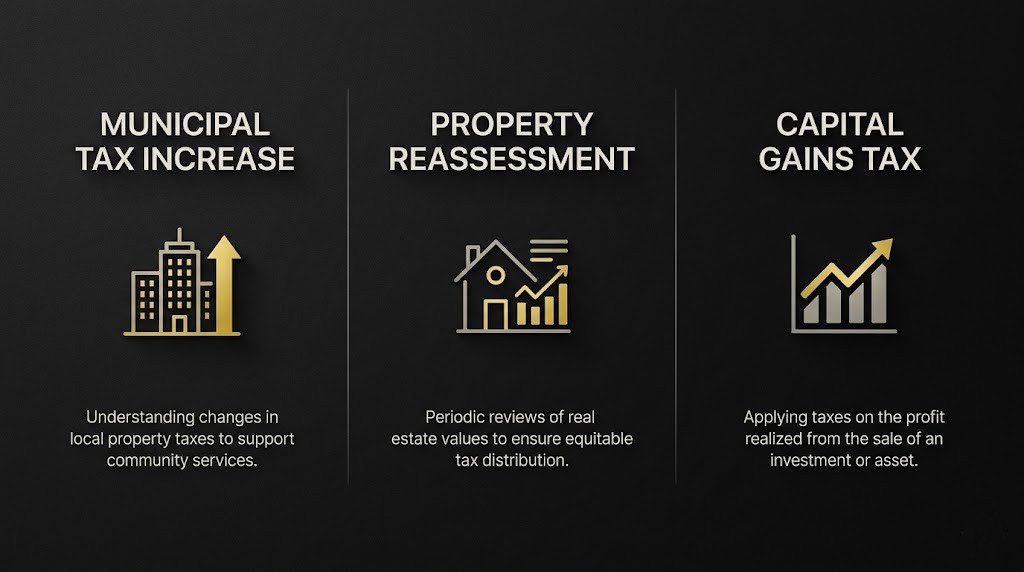
The 2026 property tax picture in Ontario is shaped by three distinct forces happening at the same time – and understanding each one separately is important because they affect different groups of homeowners differently.gtarealstar+1
- Municipal property tax increases: Virtually every major Ontario municipality has approved or proposed a property tax rate increase for 2026, driven by inflation, rising service costs, infrastructure backlogs and population growth pressures.
- MPAC reassessment cycle change: Ontario is transitioning from a four-year property reassessment cycle to a three-year cycle starting in 2026 – meaning your assessed value will be updated more frequently, which can change your bill even if the rate itself stays flat.
- Federal capital gains tax changes: As of January 1, 2026, the federal government has changed how capital gains are taxed on investment properties – a significant development for landlords and real estate investors, even if it does not affect primary residence owners directly.
⚠️ Important Clarification: Some online content has dramatically overstated the 2026 property tax changes as being capable of “doubling or tripling” costs for Ontario homeowners. This is not accurate for primary residences. The real impact is significant but manageable – and largely predictable if you understand what is driving it.
How Much Are Property Taxes Increasing in Ontario Cities in 2026?
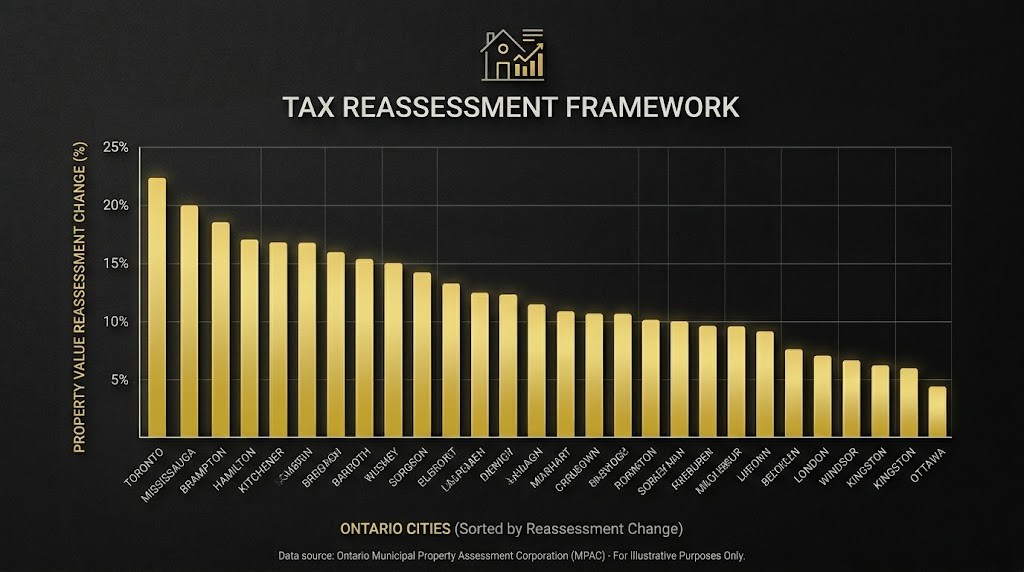
The increases vary significantly by municipality. Here is a current breakdown of what major Ontario cities have approved or proposed for 2026, alongside their current effective tax rates:cbc+3
| Municipality | 2026 Tax Increase | Residential Rate | Annual Tax ($700K) |
|---|---|---|---|
| Toronto | +2.2% | 0.76% | $5,320 |
| Mississauga | +5.21% | 1.04% | $7,280 |
| Hamilton | +4.25% | 1.43% | $10,010 |
| London | +3.6% | 1.68% | $11,760 |
| Ottawa | +3.9% | 1.23% | $8,610 |
| Niagara Falls | Ongoing | 1.647% | $11,530 |
| Halton Region | +4.75% | 0.95% | $6,650 |
Sources: Ontario Housing Market, CBC News, WOWA.ca, Global News, CTV News – March 2026. Figures are estimates. Actual bills vary by property.ontariohousingmarket+2
Looking to purchase property? Explore how to buy a home in Niagara with our team.
Why Is Toronto's Increase Smaller Than Other Ontario Cities?
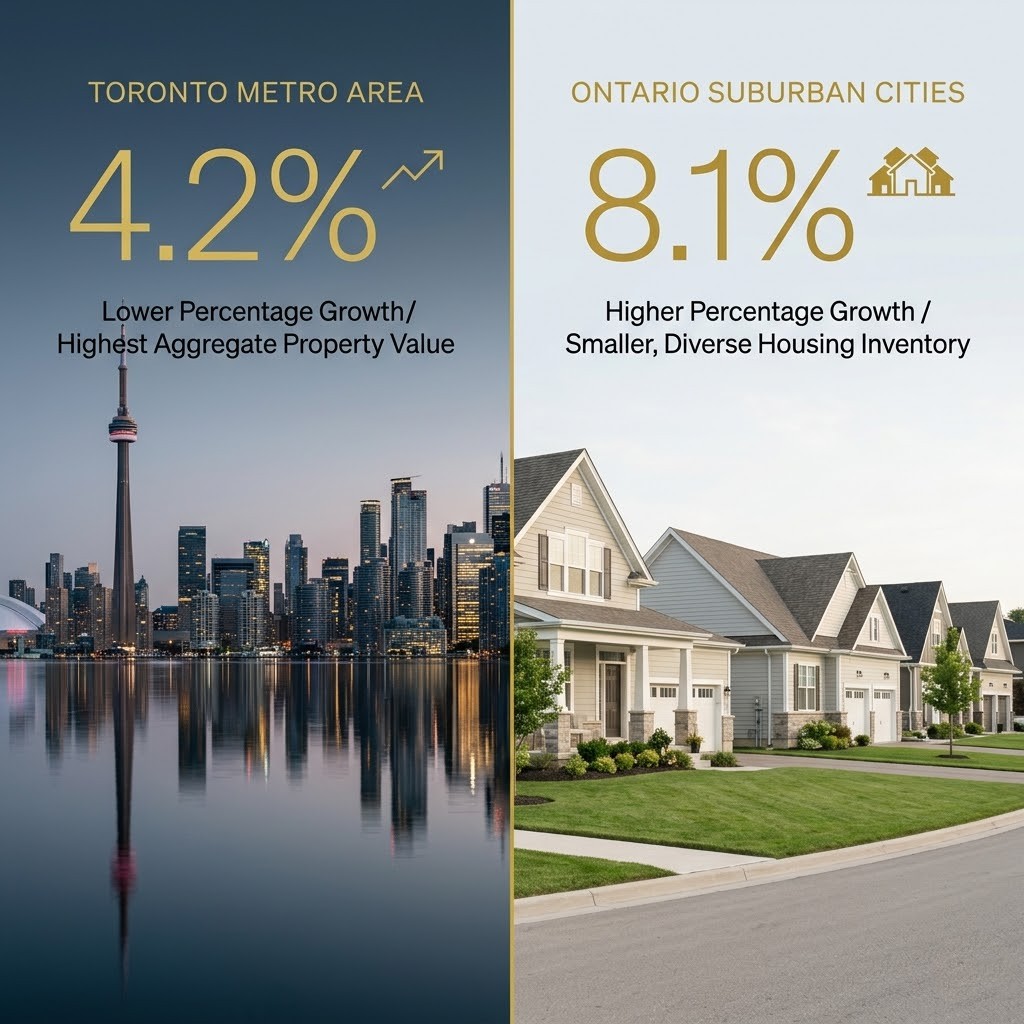
Toronto’s 2.2% increase for 2026 looks modest compared to Mississauga’s 5.21% – but that comparison is somewhat misleading. Toronto’s 2026 increase is the smallest under Mayor Chow’s tenure specifically because the previous two years were dramatically higher: a 9.5% increase in 2024 (the highest in 25 years) and a 6.9% increase in 2025. The city is stabilising after a significant deficit-driven shock.[cbc]
Toronto’s base residential tax rate (~0.76%) is also still among the lowest in Ontario, which means even after cumulative increases, Toronto homeowners pay significantly less per dollar of assessed value than homeowners in Hamilton (~1.43%), London (~1.68%) or Niagara Falls (~1.647%).wowa+1
This is one of the counterintuitive realities of Ontario real estate: buying a higher-priced Toronto home does not necessarily mean paying the highest property tax bill, while buying an “affordable” home in Niagara or London can come with a proportionally higher tax rate. For investors comparing GTA to Niagara, this math matters significantly.
What Is the MPAC Reassessment Change and How Does It Affect You?
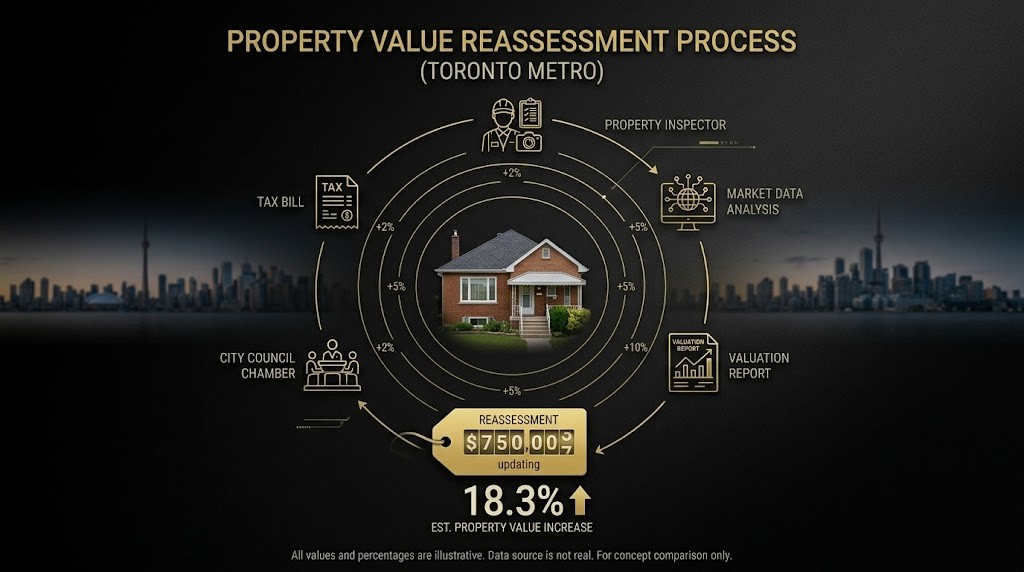
MPAC – the Municipal Property Assessment Corporation – is the provincial body responsible for assessing the value of every property in Ontario. Your property tax bill is calculated by multiplying your MPAC-assessed value by your municipality’s tax rate.[gtarealstar]
Ontario is transitioning from a four-year reassessment cycle to a three-year cycle beginning in 2026. This means your property’s assessed value will be updated more frequently – reflecting market changes faster than before. What this means practically:
- If your home’s value has risen significantly since its last assessment, you may see your assessed value increase – which raises your tax bill even if your municipality’s rate stays flat.
- If your local market has softened (as parts of GTA and Niagara have in 2025-2026), your reassessment could actually lower your assessed value – and therefore reduce your tax bill or limit increases.
- You have the right to appeal your MPAC assessment if you believe it does not accurately reflect your property’s current market value – this is a free process through the Assessment Review Board.
- More progressive brackets are being introduced for higher-valued properties, meaning homes assessed above certain thresholds will face higher effective tax rates than lower-valued homes in the same municipality.
💡 Quantum Team Realty Tip: Always review your MPAC assessment notice when it arrives. Many Ontario homeowners overpay property taxes simply because they do not know they can request a free review of their assessed value. If you have made significant renovations, this can work both ways – notify MPAC of improvements, as failing to do so and later having them discovered during a reassessment can result in back taxes.
What Is the MPAC Reassessment Change and How Does It Affect You?
If you own an investment property, rental unit or second property in Ontario – this section is critical.[propertytaxpayer.beehiiv]
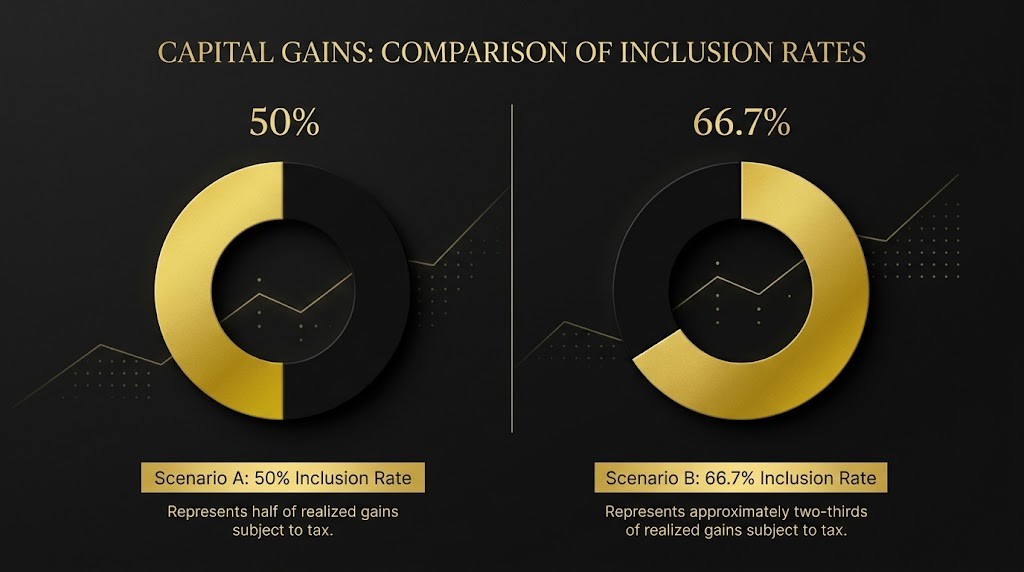
Effective January 1, 2026, the federal government has changed how capital gains are taxed when you sell a property that is not your primary residence:
- The first $250,000 in capital gains in a given tax year continues to be taxed at the existing 50% inclusion rate
- Any capital gains above $250,000 will now be included in taxable income at a higher 66.7% inclusion rate
- Primary residences are not affected – the principal residence exemption is unchanged
- This primarily affects investors selling properties with significant appreciation, particularly in markets like Toronto and Niagara Falls where values have grown substantially over the past decade
For a Niagara investor who bought a property in 2015 for $350,000 and is selling today for $700,000, the $350,000 capital gain now splits into two tiers – the first $250,000 at 50% inclusion, the remaining $100,000 at 66.7% inclusion. This is a meaningful difference in the tax owing, and timing your sale relative to this threshold requires careful planning with your accountant before listing.[propertytaxpayer.beehiiv]
Vacant Home Taxes Are Expanding Across Ontario
A third layer of property tax change in 2026 is the expansion of Vacant Home Taxes (VHT) across Ontario municipalities. Toronto was the first to implement this in 2022, and other cities have followed or are planning to in 2026.[propertytaxpayer.beehiiv]
- Toronto: VHT is active and actively enforced – homeowners must declare occupancy status annually
- Ottawa: Introduced VHT with annual declaration requirements for all property owners
- Niagara Region municipalities: Monitoring implementation – not yet active but being discussed at regional council level
- Exemptions exist for properties undergoing renovation, those owned by estates, and properties that are primary residences
The key takeaway: make sure you file your occupancy declaration on time every year in municipalities that require it. Failing to declare – even for a property you actively occupy – can result in the VHT being automatically applied to your bill.
What Does This Mean Specifically for Niagara Homeowners?
Niagara Falls has one of the highest residential property tax rates in Ontario at approximately 1.647% for 2025 – and that rate has been increasing steadily year-over-year since 2022. For context, a $600,000 home in Niagara Falls carries an estimated annual property tax bill of approximately $9,882, compared to roughly $4,560 for the same assessed value in Toronto.[wowa]
For buyers considering the Niagara region – often attracted by lower purchase prices relative to the GTA – factoring in property tax is essential to the total cost of ownership calculation. The lower sticker price does not always translate to lower ongoing costs
What Can Ontario Homeowners Do to Manage Property Tax Costs?
You cannot control your municipality’s budget decisions – but there are several concrete actions that give Ontario homeowners genuine leverage:cbc+1
- Review your MPAC assessment notice carefully – if the assessed value is higher than recent comparable sales, file a Request for Reconsideration (RfR) within the deadline. Free to do, and can reduce your bill for multiple years forward.
- Apply for the Ontario Senior Homeowners’ Property Tax Grant if you or a spouse are 64 or older – eligible homeowners can receive up to $500 annually.
- Check Low-Income Credit Programs in your municipality – many Ontario cities offer deferred payment programs or rebates for homeowners below certain income thresholds.
- For investment properties: Work with a real estate accountant to model the timing of any planned sale relative to the new capital gains inclusion rate thresholds.
- Pre-budget your monthly cost: Divide your annual property tax bill by 12 and set aside that amount monthly – property tax surprises are manageable when planned for in advance.
- Consult a realtor before buying – understanding the effective property tax rate of every property you consider, not just the list price, is critical to an accurate ownership cost comparison.
Get an accurate property valuation to sell your home in Niagara.
Have questions about property taxes in the Niagara Region or GTA? Book a free consultation with Quantum Team Realty – we help buyers, sellers and investors understand the full cost of ownership before making any decision.
Frequently Asked Questions
How much will property tax increase in Ontario in 2026?
Most Ontario cities are increasing property taxes between 2% and 5.5% in 2026, depending on municipal budgets, infrastructure needs, and population growth.
Will property taxes increase in Ontario in 2026?
Yes, most Ontario municipalities are increasing property taxes in 2026 due to rising costs, infrastructure needs, and inflation.
How does MPAC reassessment affect property taxes?
MPAC reassessment updates your home’s value. If your property value increases, your tax bill may increase even if tax rates stay the same.
Which Ontario city has the highest property tax rate?
Cities like Niagara Falls and London have higher tax rates compared to Toronto, even though home prices are lower.
Are primary residences affected by capital gains tax changes?
No, primary residences remain exempt. The 2026 capital gains changes mainly affect investment properties.
Can I reduce my property tax in Ontario?
Yes. You can:
Appeal your MPAC assessment
Apply for tax grants (seniors/low-income)
Plan property investments strategically
What is the Vacant Home Tax in Ontario?
Vacant Home Tax applies to properties left unoccupied. Owners must declare occupancy annually to avoid penalties.
Is Toronto property tax cheaper than other cities?
Yes. Despite higher home prices, Toronto has one of the lowest property tax rates in Ontario.

Sunny Chadha
Sunny Chadha is the Co-Founder of Quantum Team Realty and brings over 15 years of experience in Niagara real estate. He is passionate about helping clients make informed decisions and sharing his deep knowledge of the local market.


