




Last Updated 09-09-2026
Executive Summary
- Market Overview: Understand the key trends shaping Ontario’s housing market in 2026.
- Home Prices: Explore pricing trends and market conditions across Ontario.
- Buyer Opportunities: Learn how current conditions may affect home buyers.
- Seller Strategy: Understand important factors for sellers in the 2026 market.
- Niagara Outlook: See how Ontario-wide trends may influence Niagara Falls, St. Catharines, and Welland.
If you have been watching the Ontario housing market and wondering whether now is the right time to buy, sell, or wait – you are not alone. Prices are down. Inventory is up. Interest rates are slowly easing. And yet buyers are hesitating, sellers are pulling listings, and the market seems stuck in a standoff. What is really going on?
This is not a crash. It is a correction – and for the right buyer, it may be one of the most strategic entry points Ontario has offered in years. This guide breaks down exactly what is happening in the Ontario housing market in 2026, what the data from TRREB, CREA, CMHC, and OREA is telling us, and – most importantly – what it all means if you are thinking about buying or selling this spring.
Get comprehensive, data-driven real estate guidance on ontario housing market 2026 with Quantum Team Realty. Serving buyers, sellers, and investors across Niagara Falls, St. Catharines, Welland, and the Greater Toronto Area.
Ontario Housing Market Snapshot: Key Data Points (February 2026)

Here is where the Ontario market stands right now, based on the latest data from OREA, TRREB, WOWA, and CREA:
Ontario Regional Market Outlook 2026
| Metric | February 2026 Figure | Year-Over-Year Change |
|---|---|---|
| Ontario Average Home Price | $746,900 | -6.7% |
| Ontario Average Home Price (WOWA) | $802,601 | -5.2% |
| GTA Benchmark Home Price | $938,800 | -7.9% |
| GTA Average Home Price | $1,008,968 | -7.14% |
| GTA Homes Available for Sale | 19,314 | +7.4% (MoM) |
| GTA Sales vs January 2026 | Up 25.5% | Market Recovery Signal |
| GTA Sales-to-New-Listings Ratio | 36.1% | Below Balanced (40%+) |
| Central Ontario (Toronto) Avg Price | $1,019,988 | -7.1% |
| Southern Ontario (Hamilton) Avg Price | $733,144 | -2.5% |
| Northern Ontario Avg Price | $406,353 | +1.9% |
| Western Ontario Avg Price | $564,131 | -6.2% |
| Ontario Average Rent | $2,243/month | -5% |
| Lowest 5-Year Fixed Mortgage Rate | 4.04% | Declining Trend |
Sources: OREA, TRREB 2026 Market Outlook, WOWA.ca Ontario Housing Market (March 2026), CREA Quarterly Forecast January 2026, Nesto.ca Ontario Housing Market March 2026
Looking to purchase property? Explore how to buy a home in Niagara with our team.
Why Are Ontario Home Prices Shifting in 2026?

Ontario home prices are not falling because of a sudden shock or a crash. They are correcting after years of pandemic-era overheating – and several interrelated forces are driving that correction at once.
1. Elevated Inventory Is Giving Buyers the Upper Hand
The GTA had 19,314 homes available for sale in February 2026 – a significant supply increase compared to the inventory-starved markets of 2021 and 2022. More supply means more choices for buyers, longer days on market for sellers, and downward pressure on prices. Days on market are up more than 30% year-over-year across the GTA, which tells you that homes are sitting longer before selling.
2. Buyers Are Cautious - But Coming Back
GTA home sales dropped 11.2% in 2025 compared to 2024, according to TRREB. Buyers pulled back as they waited for prices to stabilise and interest rates to come down further. But February 2026 showed a 25.5% increase in sales compared to January – a meaningful sign that buyers are beginning to re-engage as affordability improves.
3. Interest Rates Are Declining - Slowly
The Bank of Canada’s rate-cutting cycle has brought the lowest 5-year fixed mortgage rate in Ontario to 4.04% as of April 1, 2026 – a meaningful improvement from the highs of 5.5%+ seen in 2023. Lower rates improve purchasing power and bring more buyers back to the table. CMHC projects that Ontario prices will likely continue softening in 2026 before stabilising.
4. Sellers Are Holding Back - Reducing New Supply
New listings fell almost 18% year-over-year in February 2026, and 11.3% from a year earlier in the GTA. Sellers are not rushing to list because they do not want to accept lower prices. This is creating a buyer-seller standoff: buyers want more price drops; sellers are waiting for conditions to improve. The result is a slower market – not a collapsing one.
5. Condo Market Is Feeling the Most Pressure
Royal LePage forecasts condominiums will decrease 2.5% to $563,918 year-over-year by Q4 2026. Condo investors who purchased pre-construction units at peak 2021-2022 prices are facing the harshest adjustments, particularly in downtown Toronto. The detached home segment is holding up comparatively better. Read our full condo vs detached comparison: https://quantumteamrealty.com/condo-vs-detached-homes-ontario-5-year-investment-comparison/
6. Tariff Uncertainty and Economic Caution
US tariff pressures and broader economic uncertainty are adding a layer of consumer caution to the market. CREA notes that these macro headwinds are contributing to buyer hesitation even as rates improve. That said, CREA forecasts a 5.1% national increase in home sales in 2026 – led by Ontario and BC – as pent-up demand eventually enters the market.
How Does the Market Differ Across Ontario Regions?

Not all of Ontario is experiencing the same conditions. The correction is deepest in high-cost urban centres and shallowest – or even reversed – in more affordable regions.
Ontario Housing Market 2026 – Data Table
| Region | Avg Price (Feb 2026) | YoY Change | Market Outlook |
|---|---|---|---|
| Central Ontario (Toronto / GTA) | $1,019,988 | -7.1% | Buyer’s market; high inventory, strong negotiating power |
| Southern Ontario (Hamilton) | $733,144 | -2.5% | Moderate correction; still attracting GTA relocators |
| Northeastern Ontario (Barrie area) | $674,024 | -8.2% | Deepest correction; buyers have significant leverage |
| Eastern Ontario (Ottawa area) | $608,756 | -1.1% | Most stable; supported by government employment base |
| Western Ontario (London area) | $564,131 | -6.2% | Affordable but softening; value opportunity emerging |
| Northern Ontario (Sudbury area) | $406,353 | +1.9% | Only region with price growth; limited supply dynamics |
| Niagara Region | More affordable than GTA avg | Favourable | Growing demand from GTA relocators; strong long-term fundamentals |
Source: WOWA.ca Ontario Regional Home Prices, February 2026. For a deep dive into Niagara specifically, read: https://quantumteamrealty.com/niagara-real-estate-investment-guide-2025/
What Does This Mean for Home Buyers in Ontario Right Now?
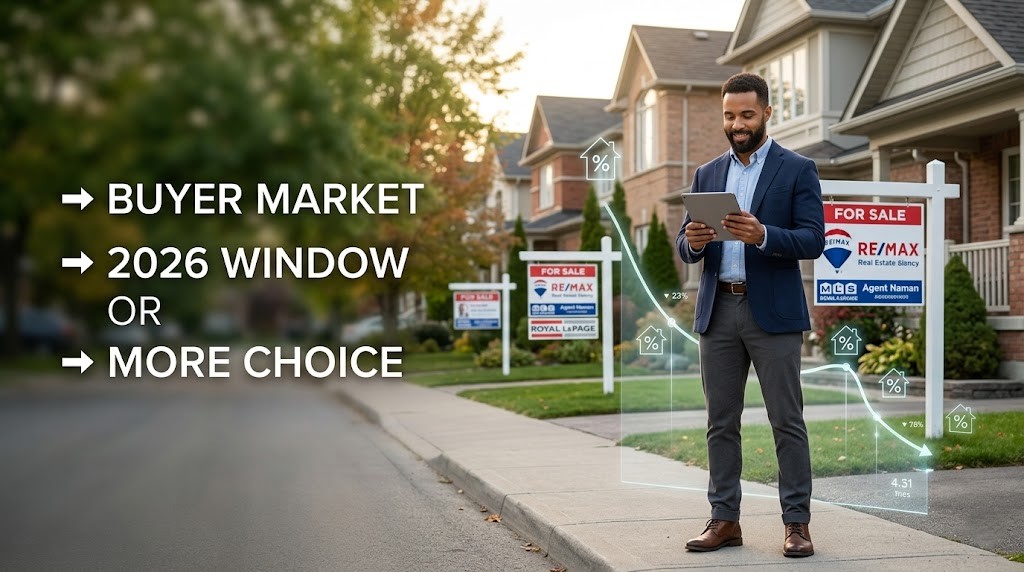
The current market represents a rare window – particularly for buyers who have been priced out or sitting on the sidelines. Here is what the data tells us about buyer strategy in spring 2026:
Is It a Buyer's Market?
Yes – by most technical measures. A balanced market requires a sales-to-new-listings ratio above 40%. The GTA’s SNLR in February 2026 was 36.1%, firmly in buyer’s market territory. That means buyers have more negotiating power, more choices, and less pressure to overbid than at any point since 2018-2019.
Will Prices Drop Further - Or Is Now the Time to Buy?
TRREB’s 2026 Market Outlook projects the GTA average price range at $1 million to $1.03 million for the full year, with prices more likely to fall in the first half of 2026 and stabilise or recover in the second half. CMHC separately projects Ontario prices to continue softening before stabilising. CREA, meanwhile, expects Ontario sales to rise more than 8% in 2026 as pent-up demand re-enters.
The honest answer: if you are buying a home to live in for five or more years, waiting for the perfect bottom is rarely a winning strategy. The window of maximum buyer leverage is likely now – before the anticipated second-half market recovery. Those who act in the spring of 2026 are likely to look back on this period as a strategic opportunity.
What About First-Time Buyers?
For first-time buyers, lower prices + declining rates = meaningfully improved affordability compared to 2021 or 2022. The government’s first-time home buyer incentives remain available and can further reduce your cost of entry. Read our complete guide: https://quantumteamrealty.com/first-time-home-buyer-incentives-ontario-2026/
Should GTA Buyers Consider Niagara?
Absolutely. With GTA prices still averaging over $1 million and Niagara offering substantially lower entry points, the value proposition of the Niagara region has never been stronger for buyers who can work remotely or are willing to commute. Property taxes in Niagara are also significantly lower than GTA municipalities – read our comparison: https://quantumteamrealty.com/property-tax-ontario-gta-vs-niagara/
What Does This Mean for Home Sellers in Ontario?
Sellers face a more challenging environment – but not an impossible one. Homes are taking longer to sell and price expectations need to be realistic. Days on market are up 30%+ year-over-year in the GTA.
- Price your home based on current comparable sales – not 2021-2022 peak values.
- Presentation matters more in a buyer’s market. Staging and professional photos are not optional extras.
- Sellers who hold back on pricing will sit longer. Sellers who price correctly are still transacting.
- If you are selling in order to buy, the buyer’s market works in your favour once you make that move.
- The second half of 2026 may bring improved conditions – but waiting carries its own risks and costs.
Why the Niagara Region Stands Out in the 2026 Ontario Market
While the GTA absorbs the deepest price corrections, the Niagara region continues to attract buyers from Toronto and Hamilton who are seeking affordability, lifestyle, and long-term value. Tourism-driven demand, infrastructure investment, and new residential development continue to support the Niagara market even as broader Ontario softens.
For investors, the rise of remote work and secondary market demand makes Niagara one of Ontario’s most compelling value propositions in 2026. Read our full analysis: https://quantumteamrealty.com/the-rise-of-secondary-markets/
Explore current properties: https://quantumteamrealty.com/properties-for-sale-in-niagara-2026/
Compare land transfer costs: https://quantumteamrealty.com/land-transfer-tax-toronto-vs-niagara/
5 Practical Steps Buyers Should Take Right Now

- Get pre-approved for a mortgage so you know exactly what you can afford at current rates – and act quickly when the right property comes up.
- Calculate your total cost of ownership, not just the purchase price. Factor in land transfer tax, CMHC insurance, property tax, and hidden costs. Read: https://quantumteamrealty.com/hidden-costs-homeownership-ontario-beyond-mortgage/
- Research the region carefully. GTA vs Niagara is not just a price comparison – it’s a lifestyle and long-term value decision. Read: https://quantumteamrealty.com/brokerage-vs-agent-niagara-real-estate-guide/
- Work with an experienced local real estate team who understands current conditions in the specific market you are targeting – not just provincial averages.
- Do not wait for the perfect bottom. If your purchase timeline is 5+ years, the spring 2026 buyer’s market window is a genuine strategic opportunity.
Thinking About Buying or Selling in Ontario This Spring?
Understanding the market is one thing. Knowing how to act on it – in your specific price range, neighbourhood, and situation – is another. At Quantum Team Realty, our agents work across the Niagara region and Ontario market every day. We provide honest, data-driven guidance that helps buyers and sellers make confident decisions – without the pressure.
Explore our 2026 market insights: https://quantumteamrealty.com/2026-insights-from-quantum-team-realty/
Find properties: https://quantumteamrealty.com/properties-for-sale-in-niagara-2026/
Connect with our team: https://quantumteamrealty.com/trusted-realtors-niagara/
Get an accurate property valuation to sell your home in Niagara.
Whether you are entering the market for the first time, relocating from the GTA, or investing in a secondary market, we are here to help you navigate 2026 with clarity.
Frequently Asked Questions
Is the Ontario housing market crashing in 2026?
No. Ontario is experiencing a market correction, not a crash. Average prices are down 6.7% year-over-year as of February 2026, following years of unsustainable price growth. TRREB, CREA, and CMHC all project stabilisation – not a collapse. Sales activity is already recovering month-over-month.
What is the average home price in Ontario in 2026?
As of February 2026, the OREA-reported average Ontario resale home price was $746,900, down 6.7% year-over-year. The WOWA estimate for the same period was $802,601. The GTA average sits at approximately $1,008,968 with a benchmark price of $938,800.
Is 2026 a good time to buy a home in Ontario?
For buyers with a long-term horizon, spring 2026 represents one of the strongest buyer’s market conditions Ontario has seen since 2019. Prices are down, inventory is elevated, and rates are declining. TRREB projects prices to stabilise in the second half of 2026 – suggesting the window of maximum buyer leverage is now.
Will Ontario home prices go up or down in 2026?
Most forecasters expect Ontario prices to continue softening in the first half of 2026 and then stabilise or modestly recover in the second half. CREA forecasts Ontario sales to rise more than 8% in 2026, which would support price stabilisation as demand returns.
What is a buyer's market and is Ontario in one?
A buyer’s market occurs when supply exceeds demand, giving buyers more negotiating power. The GTA’s sales-to-new-listings ratio was 36.1% in February 2026 – below the 40% balanced market threshold – confirming buyer’s market conditions.
Which Ontario region is the most affordable in 2026?
Northern Ontario remains the most affordable at $406,353 average – and is the only region posting year-over-year price increases (+1.9%). Western Ontario (London area) averages $564,131 and offers relative value. The Niagara region provides excellent affordability relative to the GTA while offering lifestyle and investment upside.
Is Niagara a good place to buy real estate in 2026?
Yes. Niagara offers substantially lower entry prices than the GTA, lower property taxes, and growing demand from relocators and remote workers. For investors and first-time buyers priced out of Toronto, Niagara continues to offer compelling long-term value. Explore: https://quantumteamrealty.com/niagara-real-estate-investment-guide-2025/
Should I sell my Ontario home in 2026?
Sellers face a more competitive environment in 2026 with higher inventory and longer days on market. Correct pricing is essential. The second half of 2026 may offer improved conditions. Speak with a local realtor who understands current conditions in your specific area.
What is TRREB forecasting for the GTA in 2026?
TRREB’s 2026 Market Outlook projects the GTA average price range at $1 million to $1.03 million, with elevated inventory continuing to give buyers significant negotiating power, particularly in the condo segment. Prices are expected to be lower year-over-year in H1 before stabilising in H2.
How do Ontario property taxes compare between the GTA and Niagara?
Niagara municipalities generally have significantly lower property tax rates than GTA cities. This makes Niagara properties more cost-effective on a total ownership cost basis. Read our detailed comparison: https://quantumteamrealty.com/property-tax-ontario-gta-vs-niagara/

Sunny Chadha
Sunny Chadha is the Co-Founder of Quantum Team Realty and brings over 15 years of experience in Niagara real estate. He is passionate about helping clients make informed decisions and sharing his deep knowledge of the local market.
Published by Quantum Team Realty | March 2026
Sunny Chadha & Lal Rishi – Niagara Falls & GTA Real Estate
quantumteamrealty.com
hidden costs homeownership Ontario buying a home Ontario 2026 Ontario land transfer tax CMHC insurance Ontario property tax Niagara Falls home maintenance costs Ontario Quantum Team Realty first time buyer Ontario closing costs Ontario condo fees GTA
Internal Links: First-Time Buyer Guide, Listings, Contact, Pre-Construction Page[ppl-ai-file-upload.s3.amazonaws]
External Links: MPAC.ca (property assessments), CMHC.ca (insurance premiums), Ontario.ca (land transfer tax)[ppl-ai-file-upload.s3.amazonaws]


