





Last Updated 10-09-2026
Executive Summary
- Bidding War Strategy: Learn practical ways to build a stronger offer in Ontario’s competitive market.
- Open vs Blind Bidding: Understand how different bidding formats can affect your offer strategy.
- Offer Strength: Discover how deposits, conditions, financing, and pricing can influence an offer.
- Comparable Pricing: Learn why accurate market comparisons are important before making an offer.
- Buyer Preparation: Prepare a competitive offer while protecting your budget and interests.
You found the home. You viewed it on Thursday. By Sunday, there are six offers on the table – and yours needs to stand out. Maybe you have been through this before and lost. Maybe this is your first time and the pressure feels overwhelming. Either way, you are not alone.
Bidding wars in Ontario in 2026 look different from the chaotic free-for-all of 2021-2022. The market has cooled significantly in many areas. But in specific neighbourhoods, price ranges, and property types – particularly well-maintained detached homes in desirable communities – multiple offer situations are still very much a reality. In the Durham Region alone, 64% of residential properties sold in Q1 2026 involved multiple offer scenarios. And as spring buyer activity returns across Ontario, those pockets of competition are growing.
Competing against multiple buyers for a dream property can be stressful. Under Ontario’s Trust in Real Estate Services Act (TRESA), sellers can now choose open bidding transparency. Learn how to craft winning offer packages with strategic deposit drafts, clean condition clauses, and accurate comparable pricing.
Who Is This Guide For?
- First-time buyers entering the spring market who have never faced a multiple-offer situation
- Move-up buyers who lost out on their last offer and want to approach this one differently
- GTA buyers competing in the $700K-$1.2M price range where competition is resurgent
- Niagara buyers targeting desirable Fonthill, Lincoln, or St. Catharines properties
- Anyone who has been pre-approved and is actively looking at properties this spring
- Buyers who want to understand the new TRESA open offer rules before submitting an offer
Strengthen your financial profile with first-time buyer incentives in Ontario.
Is Spring 2026 Still a Bidding War Market in Ontario?
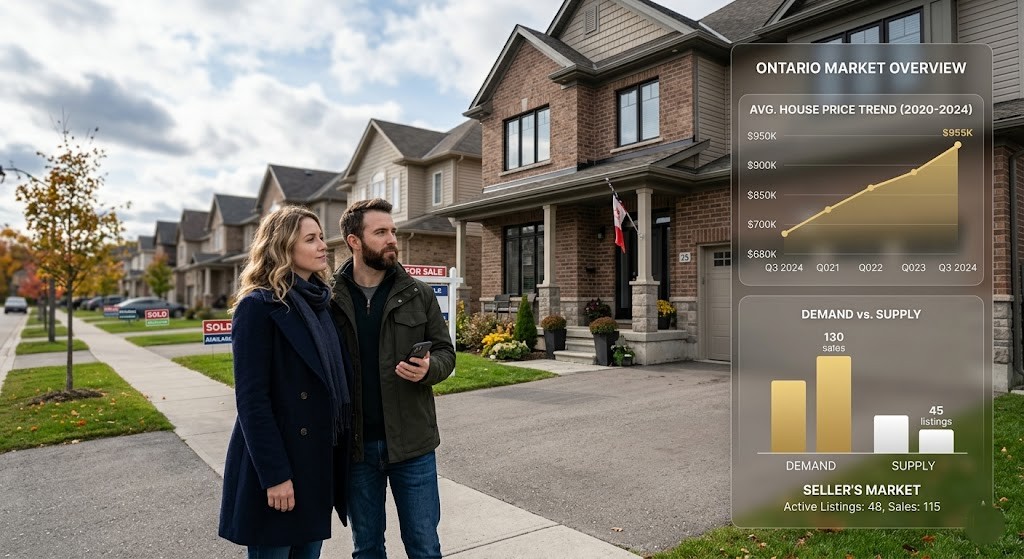
The honest answer: it depends on where you are looking and what you are buying.
The broad Ontario market has cooled considerably – prices are down 6.7% year-over-year, days on market are up, and nearly 30% of listings now require a price reduction to trigger even a single offer. This is not 2021. But it is also not a market where every buyer moves at their own pace without competition.
| Market Scenario | What to Expect | Strategy Approach |
|---|---|---|
| Well-priced detached home, desirable neighbourhood | Multiple offers likely – especially 2-bed+ family homes | Competitive – go in strong from the start |
| Overpriced or re-listed property | Single offer or low-ball offers common | Negotiate firmly – you have leverage |
| Condo / apartment segment | Softest segment – buyer’s market clearly | Negotiate conditions, price reductions, and extras |
| Move-up homes $800K-$1.2M GTA | Pockets of competition returning in spring | Escalation clause + clean offer may be needed |
| Niagara detached ($600K-$800K) | Fonthill, Lincoln moving faster; more rural slower | Know the neighbourhood – speed matters in hot pockets |
| New construction / pre-construction | Less competitive – builder sets price | Focus on terms, assignment clauses, deposit structure |
Sources: NeoHomePros Spring 2026 ; Bridge Broker Move-Up Spring ; Noble Real Estate 2026
What Changed? Understanding TRESA's Open Offer Rules in 2026

Before we get into strategy, you need to understand a fundamental change in Ontario real estate that reshapes how bidding wars work in 2026: TRESA’s Open Offer process.
Under the Trust in Real Estate Services Act (TRESA), sellers in Ontario now have the legal right to implement an “Open Offer Process” – where they can disclose the price, conditions, and deposit amounts of competing bids to other buyers in real time. This officially ends the era of fully “blind bidding” in Ontario.
Here is what this means for you as a buyer:
- In a traditional closed (blind) process: you submit your best offer with no knowledge of what others are offering. Strategy is about anticipating competition.
- In an open offer process: the seller’s agent may disclose competing bids. If you know you are $15,000 short of the leading offer, you can respond and close the gap.
- The open offer process is NOT mandatory – it is entirely the seller’s choice. They can also change the process mid-negotiation.
- If you are told the process is open, do not lead with your absolute maximum. Leave room to respond.
- If the process is closed (blind), your first offer should be your strongest competitive offer – not a test.
Ask your real estate agent upfront: “Is the seller running an open or closed offer process?” This single question changes your entire tactical approach.
12 Proven Strategies to Win a Bidding War in Ontario in Spring 2026

Option 1 - Put Down 20% or More
There is a crucial difference between mortgage pre-qualification (a rough estimate) and full mortgage pre-approval (a confirmed commitment from a lender). In a multiple-offer situation, a full pre-approval letter demonstrates you are a serious, financeable buyer – and many sellers will not even consider an offer without one.
In spring 2026, with rates at 4.04% for 5-year fixed, getting pre-approved also locks in your rate, protecting you if rates shift before you close. Read the hidden costs to factor into your budget: https://quantumteamrealty.com/cmhc-insurance-premiums-ontario-rst-hidden-costs/
Strategy 2 - Know Your Hard Ceiling Before You Walk Into Any Offer
Bidding wars are emotional. The home you are offering on will feel different when you are sitting across from your agent at 9pm with a competing offer on the table. The only defence against overpaying emotionally is a hard ceiling you set before you walk in – and commit to.
Calculate your ceiling by working backward from your maximum affordable monthly payment at current rates, factoring in CMHC insurance if applicable, land transfer tax, closing costs, and a 3-6 month emergency reserve. Your ceiling is not negotiable.
Strategy 3 - Submit a Strong Opening Offer
In a blind offer process, do not “test” with a low offer hoping to negotiate up. In a competitive situation, low offers are often dismissed without counter. Your first offer in a multiple-offer situation should reflect where you actually want to land – ideally at or slightly above asking for desirable properties.
Strategy 4 - Make a "Clean" Offer by Removing Conditions Strategically
A firm offer with no conditions – particularly no financing condition and no home inspection condition – is dramatically more attractive to a seller than a conditional offer. In a multiple-offer situation, a conditional offer can lose to a lower clean offer.
However, never waive conditions recklessly. The safe way to go firm:
- Get a pre-inspection done before the offer date – spend $500-$700 to inspect the property before submitting, then remove the inspection condition with confidence.
- Get your lender to appraise the property value before waiving the financing condition – this prevents a valuation gap where the bank won’t cover your full bid. A valuation gap impacted 14% of GTA buyers in early 2026.
Strategy 5 - Use an Escalation Clause
Strategy 6 - Maximise Your Deposit Amount
A large deposit signals seriousness and financial strength. Where many buyers put down the minimum deposit (typically 1-2% of purchase price), consider offering a larger deposit – 3-5% or more. This does not cost you more overall but tells the seller you are committed and well-funded.
Strategy 7 - Match the Seller's Ideal Closing Date
Price is not the only thing sellers care about. Closing date flexibility is often a top priority – particularly for sellers who are simultaneously purchasing another home, need time to find a rental, or are relocating on a specific timeline.
Before your agent submits the offer, find out what closing date the seller actually wants. Matching it precisely – or offering more flexibility than competing buyers – can tip the scales in your favour even when your price is similar.
Strategy 8 - Write a Personal Letter (Use With Caution)
In some situations – particularly owner-occupied family homes – a genuine, respectful personal letter explaining who you are and why this home matters to you can create emotional resonance with the seller. However, use this tactic carefully: under TRESA and human rights considerations, sellers and their agents are discouraged from factoring personal characteristics into decisions. Keep any letter focused on your genuine connection to the home and neighbourhood – not personal details.
Strategy 9 - Cover Your Own Closing Costs (And Don't Ask for Extras)
Never ask a seller to cover your closing costs, leave appliances, or throw in extras in a competitive multiple-offer situation. Every ask you put in your offer is a reason for a seller to choose the cleaner offer beside yours. Save concession negotiations for situations where you have genuine leverage – not when you are competing against five other buyers.
Strategy 10 - Act Quickly on Well-Priced New Listings
In spring 2026, well-priced properties in desirable Niagara and GTA neighbourhoods can go from new listing to offer date within 4-7 days. The buyers who win are often the ones who viewed the property within 24 hours of listing and came to their agent already prepared with pre-approval, inspection intel, and a pricing range.
Set up instant listing alerts for your target neighbourhoods, price range, and property type. Delayed viewing = missed opportunity in competitive pockets of the 2026 spring market.
Strategy 11 - Understand the Property's True Market Value
Winning a bidding war by massively overbidding is a hollow victory – especially if you paid $50,000 more than the property is worth and your mortgage lender’s appraisal comes in low. Work with your real estate agent to run a proper Comparative Market Analysis (CMA) on any property you are considering. Know the realistic market value before you set your ceiling and your opening offer.
Strategy 12 - Work With a Local Agent Who Knows the Specific Market
In Niagara’s 2026 market, what works in Fonthill is different from what works in Welland or Fort Erie. In the GTA, what works in a pocket of Mississauga is different from what works in Scarborough. Local knowledge – of seller motivations, neighbourhood dynamics, typical offer processes, and what recent comparable sales actually look like – is irreplaceable.
Meet the Quantum Team Realty agents who know Niagara inside out: https://quantumteamrealty.com/trusted-realtors-niagara/
Understand the Niagara market: https://quantumteamrealty.com/niagara-falls-real-estate-market-2026/
Bidding War Mistakes That Cost Ontario Buyers the Deal in 2026

| Mistake | Why It Loses the Deal | What to Do Instead |
|---|---|---|
| Submitting a low “testing” offer | Dismissed without counter in multiple-offer situation | Lead with your genuine competitive number |
| Waiving conditions without pre-inspection | Risk of major undiscovered defects post-purchase | Do a pre-inspection before offer date |
| Asking seller to cover closing costs | Signals financial weakness in competitive context | Cover your own closing costs – keep offer clean |
| Rigid on closing date | Seller picks the buyer who works with their timeline | Ask what closing date seller wants and match it |
| Not having pre-approval ready | Offer dismissed or delayed waiting for financing | Full pre-approval confirmed before you start offering |
| Ignoring open offer process rules | Miss opportunity to respond dynamically | Ask agent: open or closed process? Then adapt |
| Setting no hard ceiling before negotiating | Emotional overbidding; valuation gap risk | Set ceiling before viewing – not during negotiation |
| Waiting to view a well-priced new listing | Offer date passes before you have seen the property | Set instant alerts; view within 24-48 hours of listing |
Avoid costly offer mistakes by reviewing 5 real estate myths costing buyers thousands
What Does Competition Look Like in the Niagara Market This Spring?

Niagara’s spring 2026 market is more nuanced than the GTA. The broad region is in buyer’s market territory – but specific communities and property types are moving faster.
- Fonthill (Pelham) and Lincoln / Beamsville: Most desirable – well-priced detached homes attract multiple offers.
- Central St. Catharines (family detached $650K-$800K): Steady competition returning in spring.
- Niagara Falls (Drummond area): First-time buyer demand strong; well-presented homes at market value move quickly.
- Welland, Thorold, Fort Erie: More supply, less urgency – buyers have room to negotiate.
- Niagara-on-the-Lake (luxury): Unit sales up 128% in January 2026 – niche but active.
The key in Niagara is neighbourhood-level intelligence, not regional averages. Knowing the difference between a hot street and a slow one in the same city requires local expertise. See current Niagara listings: https://quantumteamrealty.com/properties-for-sale-in-niagara-2026/
Ready to Put in a Winning Offer This Spring?
The buyers who win bidding wars in Ontario’s spring 2026 market are not the ones who pay the most. They are the ones who come prepared – with financing confirmed, due diligence done, a clear ceiling in mind, and an agent who knows exactly how to structure an offer the seller cannot say no to.
At Quantum Team Realty, we have guided buyers through competitive multiple-offer situations across the Niagara region and Ontario. We know the local market, the seller dynamics, and the tactical approach that wins. Whether this is your first offer or your fifth, we are here to give you the edge.
Browse current listings: https://quantumteamrealty.com/properties-for-sale-in-niagara-2026/
Understand 2026 market conditions: https://quantumteamrealty.com/ontario-housing-market-2026/
First-time buyer resources: https://quantumteamrealty.com/first-time-home-buyer-incentives-ontario-2026/
Talk to our team: https://quantumteamrealty.com/trusted-realtors-niagara/
Frequently Asked Questions
Are there still bidding wars in Ontario in spring 2026?
Yes – in specific market segments and neighbourhoods. In the Durham Region, 64% of Q1 2026 residential sales involved multiple offer scenarios. Well-priced detached homes in desirable Niagara and GTA communities continue to attract competition, even as the broader market has cooled.
What is the most important thing to do before entering a bidding war?
Get fully pre-approved – not just pre-qualified – and set a hard ceiling you will not exceed before you begin the offer process. Buyers who set their maximum before the emotional pressure of a competing offer situation make better decisions and avoid the valuation gap risk that affected 14% of GTA buyers in early 2026.
What is the TRESA open offer process and how does it affect bidding wars?
Under TRESA, Ontario sellers can now choose to run an open offer process where competing bid amounts, conditions, and deposit sizes are disclosed to other buyers in real time. This changes buyer strategy significantly – in an open process, you do not need to lead with your maximum. In a closed (blind) process, your first offer should be your strongest competitive number.
Should I waive the home inspection condition to win a bidding war?
Only if you have done a pre-inspection before the offer date. Spend $500-$700 to have the property professionally inspected before submitting your offer, then you can waive the inspection condition with genuine confidence. Never waive conditions blindly – a major undiscovered defect can cost far more than what you gained by winning.
What is an escalation clause and when should I use it?
An escalation clause automatically increases your offer by a set amount above any competing offer, up to a ceiling you specify. It is most effective in open offer processes where competing bid prices are disclosed. Discuss with your agent whether an escalation clause fits the specific property situation before including it.
Does the closing date matter in a bidding war?
Yes – sometimes more than price. Sellers who are simultaneously buying, relocating, or coordinating a chain of transactions may prioritise a buyer who matches their ideal closing date. Finding out the seller’s preferred closing timeline – before you submit – and matching it precisely can break a tie between competitive offers.
How much deposit should I offer in a bidding war?
A larger-than-minimum deposit signals commitment and financial strength. While minimum deposits are typically 1-2% of the purchase price, offering 3-5% in a competitive situation can differentiate your offer from others at a similar price without costing you anything extra overall.
Is it still worth buying in Ontario despite potential bidding wars?
Yes – for buyers with a long-term horizon. The spring 2026 market combines declining interest rates, prices down from peak, and improving affordability. Even in competitive pockets, you are entering at better value than 2021-2022. The Ontario and Niagara markets have strong long-term fundamentals. Read: https://quantumteamrealty.com/ontario-housing-market-2026/
Is Niagara less competitive than the GTA for buyers in 2026?
Generally yes – the Niagara market is more buyer-friendly overall, with more negotiating room and fewer bidding wars than the GTA. However, specific Niagara communities like Fonthill, Lincoln, and central St. Catharines are seeing faster movement on well-priced detached homes in spring 2026. Read: https://quantumteamrealty.com/niagara-falls-real-estate-market-2026/
How can Quantum Team Realty help me win a bidding war in Niagara?
Our agents have deep local knowledge of every Niagara community – from Fonthill to Welland to Fort Erie. We know which neighbourhoods are moving fast, what terms sellers in each area care about, and how to structure an offer that wins without overpaying. Connect with our team: https://quantumteamrealty.com/trusted-realtors-niagara/

Sunny Chadha
Sunny Chadha is the Co-Founder of Quantum Team Realty and brings over 15 years of experience in Niagara real estate. He is passionate about helping clients make informed decisions and sharing his deep knowledge of the local market.


