





Last Updated 10-09-2026
Executive Summary
- 2026 Market Insights: Explore key real estate trends and opportunities shaping Niagara in 2026.
- Buyer Perspective: Understand important factors for buyers navigating the current market.
- Seller Strategy: Discover practical considerations for pricing, marketing, and selling property.
- Investment Outlook: Review opportunities and market factors that may influence investors.
- Niagara Focus: Get local insights for Niagara Falls, St. Catharines, Welland, and surrounding areas.
There is one mortgage myth that keeps more qualified Ontario buyers out of the housing market than any other – and it is surprisingly persistent despite being provably false. The belief that you need a 20% down payment to buy a home in Canada stops people from taking the first step, delays purchases by years, and often ends with buyers watching the homes they could have afforded move further out of reach while they save.
The reality is that Canada updated its minimum down payment rules, and in 2026 a buyer can purchase a home up to $1.5 million with as little as 5% down on the first $500,000 and 10% on the remainder. On a $700,000 home in Niagara Falls – typical for a detached house in many neighbourhoods – the minimum down payment is $45,000, not $140,000.
Get comprehensive, data-driven real estate guidance on 20 percent down payment mortgage myths ontario with Quantum Team Realty. Serving buyers, sellers, and investors across Niagara Falls, St. Catharines, Welland, and the Greater Toronto Area.
But the 20% myth is only one of several mortgage misconceptions that cost Ontario buyers money, delay their purchase unnecessarily, or cause them to approach the market with the wrong strategy. This guide addresses the most common ones with current numbers, real calculations, and the specific programs available to Ontario buyers in 2026.
Looking to purchase property? Explore how to buy a home in Niagara with our team.
Who Is This Guide For?
- First-time buyers in Ontario who have been waiting to save 20% before even beginning to look.
- Anyone who has been told by a parent, friend, or online source that they “are not ready” to buy because their down payment is under 20%.
- Buyers who want to understand the actual cost of buying with less than 20% down – including CMHC mortgage insurance – before making a decision.
- Young professionals in Niagara Falls, Brampton, or the GTA who have savings but are unsure whether they are sufficient to enter the market.
Get an accurate property valuation to sell your home in Niagara.

MYTH #1: "You Need 20% Down to Buy a Home in Canada"
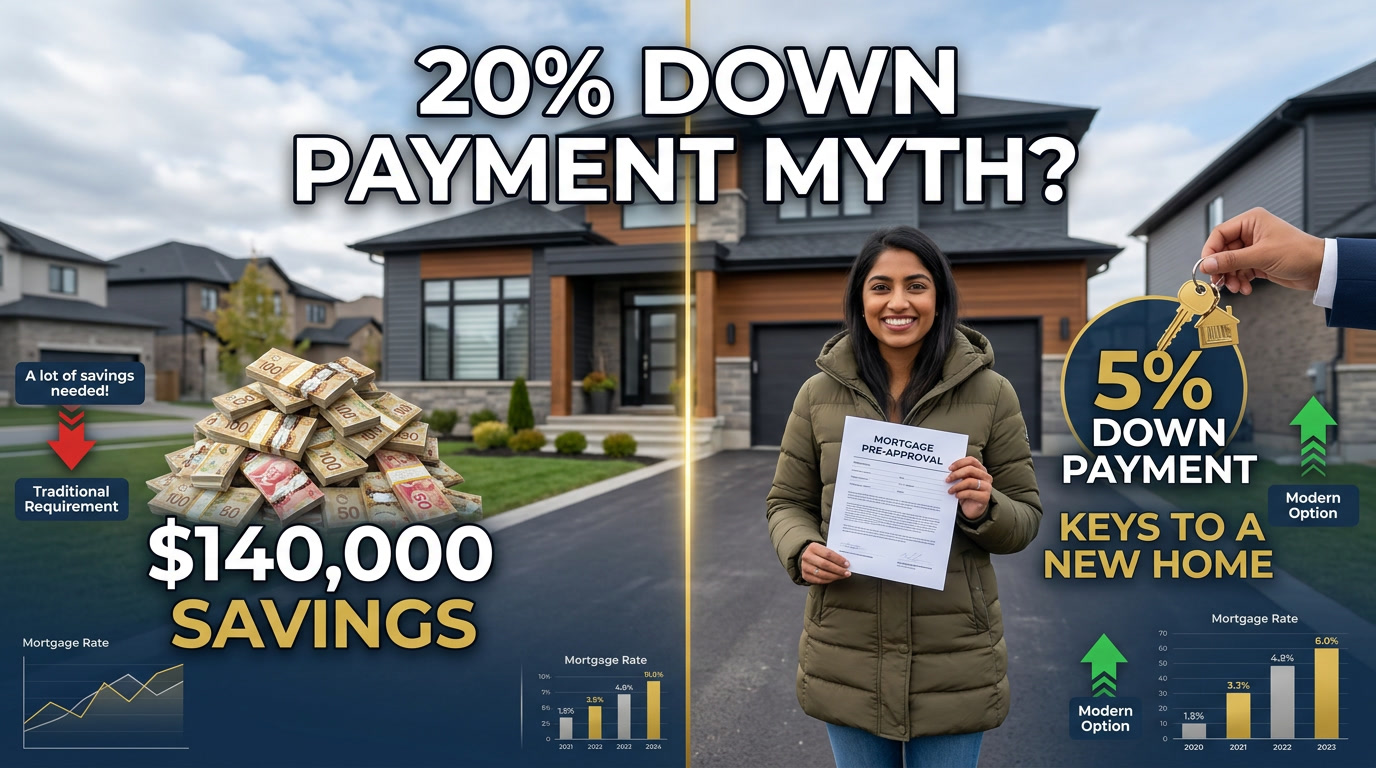
THE FACT: The Minimum Down Payment in Canada Is 5% for Homes Up to $500,000 – With Updated Rules for Higher-Priced Homes in 2026
Canada’s minimum down payment rules are set federally and apply to all buyers – not just first-timers. As of December 15, 2024 (updated rules now in full effect in 2026), the thresholds are:
| Purchase Price | Minimum Down Payment Required | Minimum Down Payment Amount (Example) |
|---|---|---|
| $500,000 or Less | 5% of the Purchase Price | $25,000 on a $500,000 Home |
| $500,001 to $1,499,999 | 5% on the First $500,000 + 10% on the Remainder | $45,000 on a $700,000 Home; $75,000 on a $1,000,000 Home |
| $1,500,000 or More | 20% of the Full Purchase Price | $300,000 on a $1,500,000 Home |
The key change in the 2024/2026 rules is the upper threshold for insured mortgages moving from $1,000,000 to $1,500,000. This means buyers in higher-priced markets can now access insured mortgage financing on homes up to $1.5 million – a significant shift from the previous rules that required 20% on any home over $1 million.
For most buyers in Niagara Falls, where average home prices are in the $500,000-$750,000 range, the required minimum down payment is between $25,000 and $50,000 – a target that many buyers can reach significantly faster than accumulating a full 20%.
MYTH #2: "CMHC Mortgage Insurance Is a Penalty for Not Saving Enough"

THE FACT: CMHC Insurance Is a Tool That Enables Homeownership Earlier – And Its True Cost Is Lower Than Most Buyers Assume
When buyers hear they will pay CMHC mortgage default insurance, many interpret it as a punishment. In reality, CMHC insurance is what makes insured mortgages possible – it protects the lender against default, which is why lenders can offer these mortgages at competitive rates with lower down payments. Without it, buyers with less than 20% down would face significantly higher interest rates or be declined entirely.
Here are the 2026 CMHC premium rates, applied to the insured mortgage amount (purchase price minus down payment):
| Down Payment Percentage | CMHC Premium Rate (2026) | Premium on a $700,000 Home (5% Down = $35K DP, $665K Insured) |
|---|---|---|
| 5.00% – 9.99% | 4.00% | $26,600 Added to Mortgage (on $665,000 Insured) |
| 10.00% – 14.99% | 3.10% | $19,530 (on $630,000 Insured with 10% = $70K Down Payment) |
| 15.00% – 19.99% | 2.80% | $16,660 (on $595,000 Insured with 15% = $105K Down Payment) |
| 20% or More | No Insurance Required | $0 |
The premium is added to the mortgage balance – not paid as cash at closing. There is one cash cost: Ontario charges 8% Provincial Sales Tax (PST) on the CMHC premium, payable at closing. On a $26,600 premium, that is $2,128 in cash – a real but manageable cost that must be budgeted for.
Now consider the comparison: a buyer who purchases a $700,000 home in Niagara Falls today with a 10% down payment ($70,000) pays a CMHC premium of approximately $19,530 added to their mortgage. A buyer who waits 3 additional years to save the full 20% ($140,000) – if the home appreciates just 4% per year – is looking at a purchase price of approximately $787,000. The $70,000 in extra savings is more than consumed by the $87,000 in price appreciation.
| Scenario | Down Payment Saved | Years of Waiting | Estimated Home Price at Purchase | CMHC Premium | Net Cost Difference |
|---|---|---|---|---|---|
| Buy Now with 10% Down | $70,000 | 0 | $700,000 | ~$19,530 (Added to Mortgage) | Baseline |
| Wait for 20% Down | $140,000 | ~3-4 Years | ~$787,000-$818,000 at 4% Growth per Year | $0 | Extra $87K-$118K in Price Appreciation; Far Exceeds CMHC Cost |
MYTH #3: "The Mortgage Stress Test Makes It Impossible to Qualify"

THE FACT: The Stress Test Is a Qualification Tool, Not a Rejection Guarantee – And Qualifying Is More Achievable Than Most Buyers Think
Canada’s mortgage stress test requires that borrowers qualify at the greater of: (1) the actual mortgage rate + 2%, or (2) 5.25% – whichever is higher. This is designed to ensure buyers can manage payments if rates rise. Many buyers hear ‘stress test’ and assume it means automatic rejection. That is not how it works.
In 2026, with the Bank of Canada overnight rate at approximately 2.75% and 5-year fixed insured mortgage rates available around 4.0-4.5%, the qualifying rate under the stress test is approximately 6.0-6.5%. Here is what that means in practice:
| Gross Household Income | Stress Test Qualifying Rate | Maximum Mortgage (Approx.) | Maximum Purchase Price (10% Down) | Affordable in Niagara? |
|---|---|---|---|---|
| $80,000/Year | 6.25% | ~$380,000 | ~$422,000 | Yes – Condos, Townhomes, Smaller Detached Homes |
| $100,000/Year | 6.25% | ~$475,000 | ~$528,000 | Yes – Broad Range of Niagara Properties |
| $120,000/Year | 6.25% | ~$570,000 | ~$633,000 | Yes – Detached Homes in Most Niagara Communities |
| $150,000/Year | 6.25% | ~$712,000 | ~$791,000 | Yes – Strong Purchasing Power Across Niagara |
| $80,000/Year | 6.25% | ~$380,000 | ~$422,000 | Toronto – Limited; Niagara – Strong Value |
These are approximations based on standard GDS/TDS ratios (39%/44%). Actual qualification depends on your specific debts, credit score, and lender. A mortgage pre-approval – which is free and takes 1-2 business days – gives you a precise number to work with.
MYTH #4: "Your Down Payment Must Come From Your Own Savings"

THE FACT: Canada Allows Down Payments From Multiple Sources – Including Gifts, RRSPs, and the First Home Savings Account
The minimum down payment in Canada can come from several sources beyond personal savings accounts. Understanding these sources is especially important for first-time buyers who may have accumulated savings in tax-advantaged accounts:
| Down Payment Source | How It Works | Key Details for Ontario Buyers 2026 |
|---|---|---|
| Personal Savings / Chequing | Standard – Must Be in Account for 90 Days | No Restrictions Beyond the 90-Day Seasoning Requirement |
| First Home Savings Account (FHSA) | Tax-Deductible Contributions up to $8,000 per Year, $40,000 Lifetime Limit, and Tax-Free Withdrawals for a Home Purchase | The Most Powerful First-Time Buyer Tool in Canada – Contributions Reduce Taxable Income and Grow Tax-Free |
| RRSP Home Buyers’ Plan (HBP) | Withdraw up to $60,000 Tax-Free for a First Home Purchase | Must Be Repaid Over 15 Years; When Combined with an FHSA, It Maximizes Tax Benefits |
| Gift from Immediate Family | Direct Gift (Not a Loan) from a Parent, Sibling, or Grandparent | Lenders Require a Signed Gift Letter Confirming No Repayment Obligation |
| Down Payment Assistance Programs | Municipal Programs Available in Some Ontario Regions, Including Toronto HOAP and Niagara Welcome Home Program | Eligibility Varies by Program; Some Offer Forgivable Loans or Financial Assistance |
For a first-time buyer who has been contributing $8,000 annually to an FHSA for 3 years, that represents $24,000 in tax-free savings (plus investment growth) available for a down payment – money that also reduced their taxable income by $8,000/year during contributions. Combined with $60,000 from an RRSP under the Home Buyers’ Plan, a buyer could access up to $84,000+ in down payment funding from these two sources alone.
MYTH #5: "You Should Wait for Lower Interest Rates Before Buying"

THE FACT: Timing the Rate Market Consistently Fails Buyers – And in a Buyer’s Market, Waiting Has a Real Price
The logic seems sound: if rates drop further, you will qualify for more and pay less. But this reasoning has two problems that consistently hurt buyers who act on it.
First, rate movements are genuinely unpredictable. Economic forecasters – including the Bank of Canada itself – have been wrong repeatedly about the direction and timing of rate changes. Buyers who waited for ‘lower rates’ in 2021 found themselves facing a rate environment that rose sharply in 2022-2023.
Second, lower rates tend to bring more buyers into the market – which increases competition and pushes prices up. The affordability improvement from a rate cut can be partially or fully absorbed by price appreciation. In Ontario’s 2026 buyer’s market, the relationship inverts: prices are soft, inventory is high, and sellers are negotiating. Waiting for rate cuts in this environment means waiting for conditions that will likely attract more competition.
| Strategy | Rate Environment | Market Condition | Net Buyer Impact |
|---|---|---|---|
| Buy Now (2026) | 4.0%-4.5% Fixed (5-Year Insured) | High Inventory, Buyer’s Market, Motivated Sellers | Strong Negotiating Power, Softer Prices, and Greater Likelihood of Conditions Being Accepted |
| Wait 12-18 Months for Lower Rates | Possibly 3.5%-4.0% | More Buyers Re-Entering the Market; Prices Likely Firming | Monthly Savings May Be Modest, While Higher Home Prices Could Offset the Benefit of Lower Rates |
| Locked In at 2022 Peak | 5.0%-5.5% | Low Inventory, Seller’s Market, Competitive Bidding Wars | Paid Peak Home Prices Alongside Higher Interest Rates – Least Favorable Combination for Buyers |
So What Do You Actually Need to Buy a Home in Ontario in 2026?
Here is a realistic summary of what a prepared buyer in Ontario – purchasing in Niagara Falls, Brampton, or the wider province – needs to have in place:

| Requirement | What You Need | Practical Target for Ontario Buyers 2026 |
|---|---|---|
| Down Payment | Minimum 5% (Under $500K); 5% + 10% Above $500K up to $1.5M | $25,000-$75,000 for Most Niagara Purchases |
| Closing Cost Cash Reserve | 3-4% of the Purchase Price in Addition to the Down Payment | $18,000-$28,000 on a $600,000 Purchase; Must Be Available as Cash (Not Mortgaged) |
| Credit Score | 620 Minimum for Insured Mortgages; 680+ for the Best Rates | Check for Free Through Equifax or Borrowell; Allow 6-12 Months for Improvement if Required |
| Stable Income | Documented Employment (T4) or Two Years of NOAs if Self-Employed | A Mortgage Pre-Approval Confirms Your Exact Qualifying Amount |
| FHSA / RRSP | Not Required but Can Significantly Increase Buying Power | Open an FHSA as Early as Possible – Every Year of Contributions Matters |
| Mortgage Pre-Approval | Not Mandatory but Strongly Recommended | Takes 1-2 Days, Establishes a Clear Budget, and Strengthens Purchase Offers |
The single most important step a prospective buyer can take in 2026 is not saving more – it is getting a mortgage pre-approval. A pre-approval gives you an exact qualifying number based on your actual income, debts, and credit profile, eliminates the guesswork, and positions you to make credible offers when the right property appears.
What Does This Look Like for Real Properties in Niagara Falls?
| Property | Est. Price | Min. Down Payment | CMHC Premium (4% at 5% DP) | Est. Closing Costs | Total Cash Needed at Minimum |
|---|---|---|---|---|---|
| 1-Bed Condo (Niagara Falls) | $420,000 | $21,000 (5%) | ~$15,960 Added to Mortgage; $1,277 PST Cash | ~$10,000-$15,000 | ~$32,000-$37,000 |
| Townhouse (Niagara Falls) | $590,000 | $34,000 (5% on First $500K + 10% on Remaining $90K) | ~$22,240 Added to Mortgage; $1,779 PST Cash | ~$13,000-$18,000 | ~$49,000-$54,000 |
| Detached Home (Welland) | $650,000 | $40,000 (5% + 10%) | ~$24,960 Added to Mortgage; $1,997 PST Cash | ~$14,000-$19,000 | ~$56,000-$61,000 |
| Detached Home (St. Catharines) | $720,000 | $47,000 | ~$26,908 Added to Mortgage; $2,153 PST Cash | ~$15,000-$20,000 | ~$64,000-$69,000 |
Note: CMHC premium is added to the mortgage – not paid as cash. Only the Ontario PST on the premium (8%) is required as cash at closing, along with your down payment and other closing costs. Total cash required is meaningfully lower than buyers typically assume.
Ready to Find Out Exactly What You Can Afford in Ontario?
At Quantum Team Realty, we help buyers across Niagara Falls, Brampton, and Ontario move from ‘I think I might be ready’ to ‘I have my pre-approval and I know my budget.’ Our team works with first-time buyers and repeat purchasers to build a clear picture of total purchase costs – down payment, CMHC, closing costs, and monthly carrying costs – before you make any commitments.
If you have been telling yourself you are not ready because you do not have 20% saved, let us show you what you can actually do with what you have today.
Book a Free Buyer Consultation → https://quantumteamrealty.com/contact/
Browse Niagara Falls Homes → https://quantumteamrealty.com/niagara-falls/
Browse Brampton Listings → https://quantumteamrealty.com/brampton/
Frequently Asked Questions
Do you need 20% down payment to buy a house in Ontario in 2026?
No. The minimum down payment in Ontario (and all of Canada) is 5% for homes priced up to $500,000, and 5% on the first $500,000 plus 10% on the remainder for homes between $500,001 and $1,499,999. A 20% down payment is only required for homes priced at $1,500,000 or more. Purchases with less than 20% down require CMHC mortgage default insurance.
What is CMHC mortgage insurance and how much does it cost in 2026?
CMHC mortgage default insurance protects the lender if you default on your mortgage, allowing them to offer insured mortgages at competitive rates with lower down payments. The 2026 premium rates are 4.00% (5-9.99% down), 3.10% (10-14.99% down), and 2.80% (15-19.99% down) of the insured mortgage amount. The premium is added to your mortgage – not paid as cash – though Ontario charges 8% PST on the premium amount, which is due as cash at closing.
What is the minimum down payment on a $700,000 home in Ontario?
On a $700,000 home in Ontario, the minimum down payment is $45,000 – calculated as 5% of the first $500,000 ($25,000) plus 10% of the remaining $200,000 ($20,000). You also need to budget approximately $15,000-$20,000 in cash for closing costs, including land transfer tax, legal fees, and Ontario PST on the CMHC premium.
What is the First Home Savings Account (FHSA) and how does it help with a down payment?
The First Home Savings Account (FHSA) is a registered account that allows first-time buyers to contribute up to $8,000 per year (lifetime limit of $40,000), deduct contributions from income tax, and withdraw funds tax-free for a qualifying home purchase. It combines the tax benefits of an RRSP (tax deduction on contributions) and a TFSA (tax-free withdrawals), making it the most powerful down payment savings tool for Canadian first-time buyers.
Can a gift from parents count as a down payment in Canada?
Yes. Gifted funds from an immediate family member (parent, grandparent, or sibling) are an acceptable source of down payment in Canada. The lender will require a signed gift letter confirming the funds are a true gift with no repayment obligation – not a loan. The letter must specify the donor’s name, relationship, amount gifted, and that no repayment is expected.
What is the mortgage stress test in Canada and how does it affect buyers?
The mortgage stress test requires buyers to qualify for a mortgage at the greater of the actual mortgage rate plus 2%, or 5.25% – whichever is higher. In 2026, with rates around 4.0-4.5%, the qualifying rate is approximately 6.0-6.5%. This is not a rejection tool – it is a qualification benchmark. Most buyers with stable employment income and reasonable debt levels can qualify; a mortgage pre-approval will show your exact qualifying amount.
Is it better to wait and save a larger down payment or buy now in Ontario?
In most cases, buying sooner with a smaller down payment (and CMHC insurance) is more financially advantageous than waiting to save 20%. If Ontario home prices rise 4% annually, a $700,000 home costs ~$787,000 in 3 years – an increase of $87,000 that far exceeds the CMHC premium cost. In 2026’s buyer-leaning market with high inventory and motivated sellers, the conditions for purchasing are also more favourable than they have been in years.
What is the RRSP Home Buyers' Plan (HBP) and how much can I withdraw?
The RRSP Home Buyers‘ Plan allows first-time buyers to withdraw up to $60,000 from their RRSP tax-free for a qualifying home purchase (the limit was raised from $35,000 in the 2024 federal budget). The withdrawal must be repaid to your RRSP over 15 years beginning the second year after the withdrawal. Used alongside the FHSA, the HBP can provide substantial additional down payment funding.
What credit score do I need to get a mortgage in Ontario?
Most lenders require a minimum credit score of 620 for an insured mortgage (less than 20% down). To qualify for the best insured rates, a score of 680 or above is preferred. For uninsured mortgages (20%+ down), many lenders prefer 700+. Your credit score can be improved within 6-12 months by paying down revolving debt, maintaining on-time payments, and avoiding new credit applications before applying.
Are there down payment assistance programs for buyers in Niagara Region?
Yes. Ontario’s Land Transfer Tax Rebate (up to $4,000) reduces your closing cost cash requirement. The Niagara Region’s Welcome Home Niagara Homeownership Program (pending 2026 budget confirmation) offers interest-free down payment assistance to eligible buyers. The City of Toronto’s Home Ownership Assistance Program (HOAP) serves Toronto-area buyers. The federal FHSA and RRSP Home Buyers’ Plan are available to all Ontario first-time buyers. A local realtor and mortgage broker can identify which programs you qualify for.

Sunny Chadha
Sunny Chadha is the Co-Founder of Quantum Team Realty and brings over 15 years of experience in Niagara real estate. He is passionate about helping clients make informed decisions and sharing his deep knowledge of the local market.


