




Last Updated 10-09-2026
Executive Summary
- Pre-Construction Condos: Understand how pre-construction condo purchases work in Ontario.
- Facts vs Fiction: Separate common myths from the realities of buying before construction.
- Costs & Fees: Learn about deposits, closing costs, development charges, and other potential expenses.
- Risks & Benefits: Understand both the opportunities and risks before committing to a pre-construction property.
Pre-construction condos have been sold to Ontario buyers for decades on the promise of locked-in pricing, guaranteed appreciation, and a path to ownership in markets where resale inventory is too expensive or too competitive. For a period – roughly 2012 through 2022 – much of that promise delivered. Buyers who signed pre-construction agreements and held through closing frequently closed on properties worth more than they had paid.
That era is over. In 2026, Ontario’s pre-construction market is operating under conditions that are fundamentally different from anything buyers experienced during the last decade of growth. Toronto pre-construction condo sales are at 35-year lows. Over 32 projects – representing more than 6,981 units – have been cancelled since 2024 alone. Buyers who signed 4-5 years ago at peak prices are closing on units now worth less than their contracted purchase price, with appraisal gaps forcing them to inject tens of thousands of dollars in cash or walk away from their deposits entirely.
Looking to purchase property? Explore how to buy a home in Niagara with our team.
This does not mean pre-construction is never the right choice. But it does mean that the fictions circulating about pre-construction condos – inherited from a decade of rising prices – are now actively costing Ontario buyers money. This guide separates what is true from what is not, with current data and real numbers.
Get comprehensive, data-driven real estate guidance on pre construction condos separating facts from fiction with Quantum Team Realty. Serving buyers, sellers, and investors across Niagara Falls, St. Catharines, Welland, and the Greater Toronto Area.
Who Should Read This?
- Anyone attending a pre-construction sales centre or considering signing an Agreement of Purchase and Sale in Ontario.
- Investors evaluating pre-construction condos in Niagara Falls, Toronto, Brampton, or anywhere in the GTA.
- First-time buyers who have been told pre-construction is “more affordable” than resale.
- Buyers who signed a pre-construction agreement 2-5 years ago and are approaching their closing date.
- Anyone who wants to understand how pre-construction actually works before committing a deposit.

How Does Buying Pre-Construction Actually Work in Ontario?
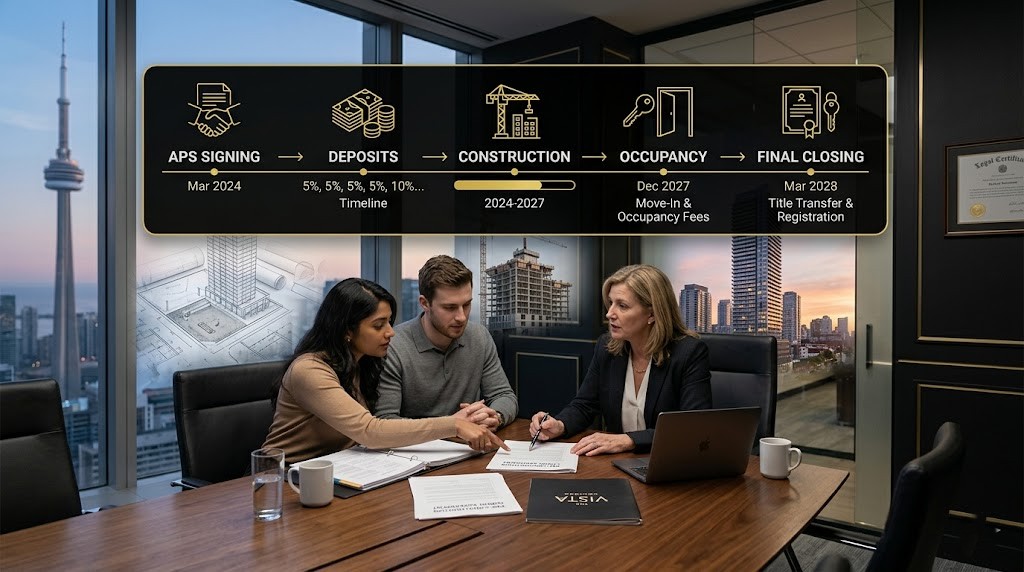
Before addressing the fiction, it helps to understand the mechanics clearly. When you buy a pre-construction condo in Ontario, you are not buying a completed unit – you are signing an Agreement of Purchase and Sale (APS) for a unit that does not yet exist. Here is what that process looks like:
| Stage | What Happens | Timeline |
|---|---|---|
| Signing the APS | You agree to purchase a specific unit at a fixed price. A cooling-off period of 10 calendar days begins immediately under Ontario law. | Day 0 – lawyer review strongly recommended before or during this period |
| Deposit Structure | Deposits are typically paid in installments of 5-20% over 12-24 months after signing. | First installment often due immediately; subsequent payments over 12-24 months |
| Construction Period | The builder constructs the building. This typically takes 3-5+ years. Delays are common and legally permitted under Tarion occupancy date rules. | 3-5+ years, often longer – Tarion allows multiple permitted delay extensions |
| Interim Occupancy | You move into the unit and begin paying occupancy fees to the builder – but you do not hold title yet. This phase can last months to over a year. | 6-18+ months in many projects |
| Final Closing | Title transfers to you. Mortgage is activated. All remaining closing costs – including HST, development levies, and adjustments – are due. | Final closing date is set by the builder |
Get an accurate property valuation to sell your home in Niagara.
FICTION #1: "The Purchase Price Is What You Actually Pay"
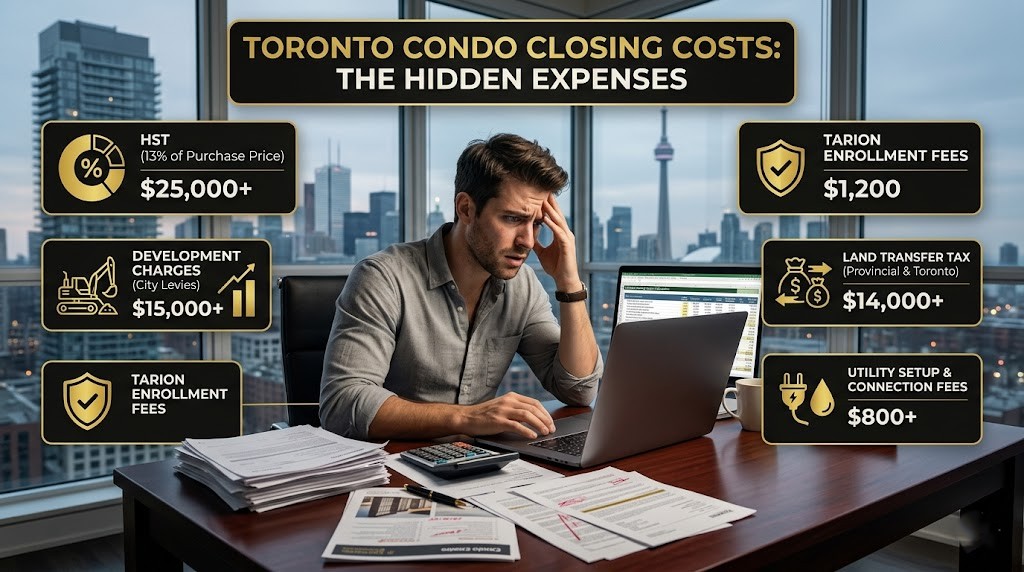
THE FACT: Closing Costs on Pre-Construction Can Add 7-10% on Top of the Purchase Price
This is the single most financially damaging misconception in pre-construction real estate. The price displayed in the sales centre brochure is the base contract price. It does not include the substantial costs payable on closing day – many of which are unique to new construction and do not apply to resale purchases.
| Closing Cost | Pre-Construction Estimate | Resale Equivalent |
|---|---|---|
| Ontario + Toronto Land Transfer Tax (City of Toronto) | ~$15,000 on a $700K unit | ~$13,000 on a $650K resale |
| Development Charges & Levies | $20,000-$30,000 (city-imposed, builder passes to buyer) | $0 – not applicable to resale |
| HST on New Construction (net of rebate, if owner-occupied) | ~$2,000-$8,000 depending on price and use | $0 – no HST on resale residential |
| Legal fees, title insurance, admin | $2,500-$3,500 | $2,000-$3,000 |
| Tarion enrolment fee | Several hundred dollars + HST (effective Sept 2025) | $0 |
| Utility connection fees, hydro setup | $500-$2,000+ | Minimal |
| Estimated Total Closing Costs | $40,000-$50,000+ (7-10% of purchase price) | $20,000-$25,000 (3-4%) |
A buyer who budgets only the purchase price and minimum down payment for a pre-construction condo can arrive at closing facing a $20,000-$30,000 cash shortfall beyond what they prepared for. Development charges alone – which are municipal fees that vary by city and are almost always passed through to the buyer in the APS – regularly reach $25,000+ on new condo units in the GTA and are rising.
FICTION #2: "Your Deposit Is Fully Protected No Matter What"

THE FACT: Deposit Protection Has Limits – Know What Tarion Actually Covers
Tarion’s warranty program provides important protections for Ontario pre-construction buyers, but it is not an unlimited guarantee. For condominiums, deposit protection under Tarion (for agreements of purchase and sale signed on or after July 1, 2023) is capped at a maximum of $300,000 per unit. For freehold homes, the cap is $400,000.
This matters because many pre-construction condos in Toronto and the GTA are contracted at prices above $700,000-$900,000, with deposits of 15-20% representing $105,000-$180,000. On a $900,000 unit with a $180,000 deposit, the full deposit is covered by Tarion. But on a $1.5M unit with a $300,000 deposit, only $300,000 is protected – which in this case is still the full amount, but buyers at higher price points need to verify this explicitly.
More practically: Tarion protection covers your deposit if the builder goes bankrupt, fails to build, or cancels the project. It does not protect you from:
- Signing a contract and then choosing not to proceed (deposit forfeited)
- The unit appraising below the purchase price at closing (appraisal gap – your problem)
- Being unable to secure mortgage financing at closing (your problem)
- Changes in unit specifications, delays, or floor plan modifications that fall within what the APS permits the builder to make
FICTION #3: "Pre-Construction Will Always Be Worth More by the Time It Closes"

THE FACT: In 2026, Buyers Are Closing on Units Worth Less Than What They Contracted to Pay
This fiction was widely true between 2012 and 2022. It is no longer a reliable assumption. In February 2026, CityNews Toronto reported that falling GTA condo appraisals are leaving pre-construction buyers facing massive losses. A Vaughan man who committed $675,000 to a pre-construction unit five years ago – putting down approximately $135,000 (20%) – found at closing that the unit’s current market value was significantly below the contracted price, and his lender’s appraisal would not support the full mortgage amount needed to close.
This is called an appraisal gap – the difference between what you contracted to pay and what the unit is worth at the time of closing. It is not theoretical. Urbanation has documented significant gaps between pre-sale price per square foot and resale values in newly completed Toronto condo buildings. When an appraisal gap exists:
| Scenario | What Happens | Your Options |
|---|---|---|
| Appraisal matches or exceeds purchase price | Mortgage approved at contracted amount | Close as planned |
| Appraisal is 5% below purchase price on $700K unit | Lender provides mortgage on $665K appraised value | Inject an extra $35,000 cash at closing OR… |
| You cannot cover the gap | Cannot close as contracted | Walk away (forfeit deposit) OR attempt assignment |
| Assignment sale not permitted or no buyer found | Default on closing | Legal and financial consequences; deposit lost |
In Toronto, pre-construction condo prices are forecast to decline approximately 2.5% in 2026 – meaning buyers closing this year on contracts signed at 2021-2022 peak prices may face appraisal gaps of 15-25% or more on the value difference between then and now.
FICTION #4: "You Can Easily Exit a Pre-Construction Deal If Your Plans Change"
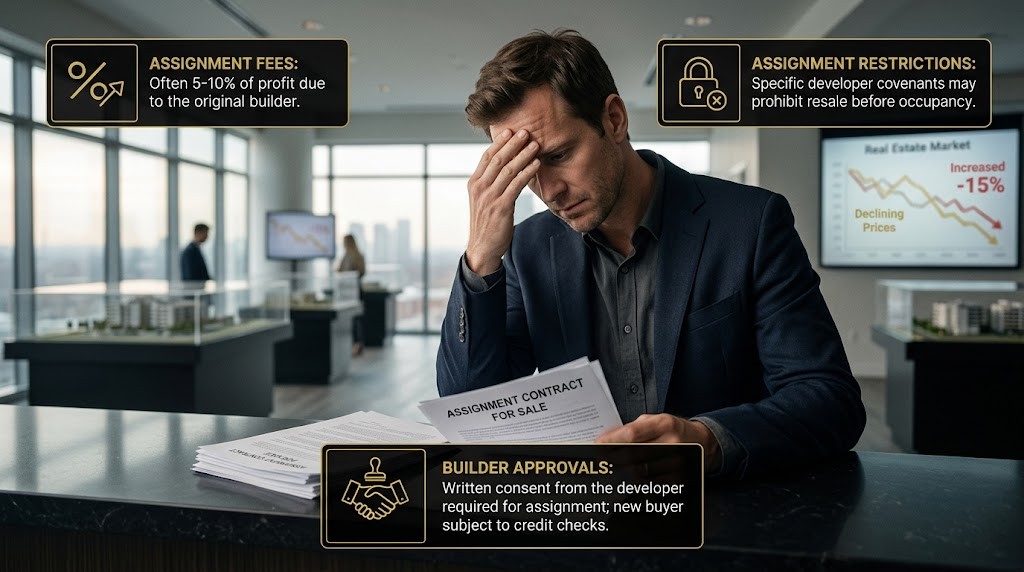
THE FACT: Assignment Sales Are Complex, Restricted, and Not Always Available
One of the features often cited to reassure pre-construction buyers is the ability to ‘assign’ the contract – sell your Agreement of Purchase and Sale to another buyer before the building closes. In theory, this allows you to exit the position without closing, ideally at a profit if prices have risen.
In practice, assignment is far more complicated than the sales centre may suggest:
- Builder consent is required in most pre-construction contracts, and it is not always granted. Builders may charge assignment fees of $1,000-$5,000 or more.
- In a down market like 2026, finding an assignment buyer willing to pay more than your contracted price is genuinely difficult – and finding one willing to pay even your contracted price is not guaranteed.
- HST implications differ on assignment sales depending on whether the assignor is considered a builder for tax purposes – a legal and tax question that requires a real estate lawyer to assess.
- Some APS contracts explicitly prohibit assignment entirely, giving you no exit option short of forfeiting your deposit.
- The 10-day cooling-off period – your only automatic exit right under Ontario law – begins immediately when you sign. If you miss it, your only contractual exit is assignment or deposit forfeiture.
FICTION #5: "Pre-Construction Is Always Cheaper Than Resale"
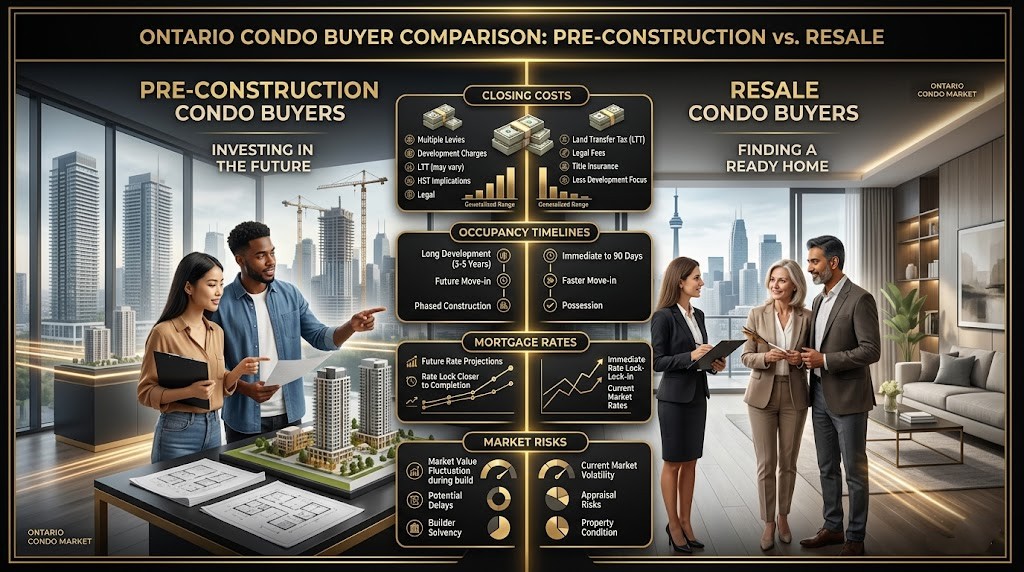
THE FACT: In Ontario 2026, Resale Condos Often Represent Better Value Than Pre-Construction
The argument that pre-construction is cheaper is based on the idea that you lock in today’s price before the market rises. In a flat or declining market, this logic inverts entirely.
| Factor | Pre-Construction | Resale |
|---|---|---|
| Purchase Price | Locked at today’s price; market may fall before closing | Current market price – what the unit is worth now |
| Total Closing Costs | 7-10% of purchase price | 3-4% of purchase price |
| Time to Occupancy | 3-5+ years | 30-90 days typically |
| What You See Before Buying | Floor plans, brochures, model suites | The actual unit – inspect it yourself |
| Mortgage Rate Certainty | Unknown – rates in 3-5 years are not guaranteed | Can lock in a rate for your actual closing date |
| Market Risk | Significant – contract price may exceed market value at closing | Minimal – you buy at current market value |
| Development Charges | Buyer absorbs (often $20K-$30K) | Already embedded in any previous purchase; N/A to buyer |
| HST | Buyer pays on new unit (net of rebate) | No HST on resale residential property |
In Niagara Falls specifically, the average resale condo price is approximately $415,000 – while pre-construction condos in the region start from the $460,000s (Zebra Condos, Delta Builders, 2026 occupancy) to $849,000 (Le Falls, M5V Developments). When development charges and HST adjustments are added to pre-construction pricing, the total cost of a new unit frequently exceeds comparable resale options, sometimes by a significant margin.
So When Does Pre-Construction Make Sense in Ontario in 2026?

Pre-construction is not automatically wrong. It can make sense when:
- You are buying a specific unit type, floor, or layout that does not exist in the resale market – and you are willing to wait.
- The builder has a strong track record, a high pre-sale absorption rate (70%+ of units sold), and demonstrable financial backing. In 2026, with 32+ Toronto pre-construction cancellations since 2024, builder vetting is not optional.
- You have fully budgeted the total closing costs – including development charges, HST, Tarion fees, and all adjustments – and can absorb them without financial stress.
- You have stress-tested an appraisal gap scenario: if the unit appraises 10-15% below your contracted price at closing, can you still close?
- You have a clear purpose: owner-occupation or long-term hold as a rental – not a short-term flip in a declining market.
- Your real estate lawyer has reviewed the full APS, including amendment clauses that allow the builder to modify specifications, and you understand what you are agreeing to.
The Ontario government’s 2026 Budget introduced an expanded HST relief framework for new homes where construction begins on or after April 1, 2026 and agreements are signed between April 1, 2026 and March 31, 2027 – which may improve the economics of some new construction purchases in specific situations. A real estate lawyer and tax professional can clarify how this applies to a specific APS.
Considering a Pre-Construction Condo in Niagara or the GTA?
Pre-construction decisions in 2026 require a different level of due diligence than in previous years. At Quantum Team Realty, we help buyers evaluate pre-construction opportunities across Niagara Falls, Brampton, and the broader Ontario market – with independent analysis, real closing cost calculations, and honest guidance on whether a specific project and price point makes sense for your situation.
We also work with buyers exploring resale alternatives where stronger value exists right now – including condos and townhouses in Niagara Falls from the low $400,000s, and in the GTA where motivated sellers are offering pricing not seen since 2019.
Book a Free Pre-Construction Consultation → https://quantumteamrealty.com/contact/
Browse Niagara Falls Listings → https://quantumteamrealty.com/niagara-falls/
Browse Pre-Construction Projects → https://quantumteamrealty.com/pre-construction/
Frequently Asked Questions
Is buying a pre-construction condo in Ontario safe in 2026?
It depends heavily on the specific project, builder, and your financial position. With 32+ pre-construction project cancellations in Toronto since 2024 and appraisal gaps emerging at closing, the risk profile is meaningfully higher than in previous years. Buyers should vet the builder rigorously (Tarion Directory), verify pre-sale absorption rates, budget 7-10% for total closing costs, and have a lawyer review the full APS before signing.
What closing costs do I pay on a pre-construction condo in Ontario?
Pre-construction closing costs typically include land transfer tax, development charges ($20,000-$30,000 in most GTA municipalities), HST (net of applicable rebates), Tarion enrolment fees, legal fees, title insurance, utility connection fees, and various builder administrative adjustments. Total closing costs on a pre-construction condo typically range from 7-10% of the purchase price – significantly more than the 3-4% typical for resale properties.
What is an appraisal gap and how does it affect pre-construction buyers?
An appraisal gap occurs when the market value of a unit at the time of closing is lower than the price you contracted to pay years earlier. Your lender will only provide a mortgage based on the appraised value – not the contracted price. If there is a gap, you must inject additional cash to close. In 2026, buyers who purchased at 2021-2022 peak prices and are closing now may face appraisal gaps of 15-25%.
How much deposit is required for a pre-construction condo in Ontario?
Pre-construction deposits in Ontario are typically structured as 15-20% of the purchase price, paid in installments over 12-24 months after signing. For a $700,000 unit, this means $105,000-$140,000 in deposits before construction even completes. These funds are held in trust and are protected under Tarion up to a maximum of $300,000 per condominium unit.
What does the Ontario 10-day cooling-off period mean for pre-construction buyers?
Under Ontario’s Condominium Act, pre-construction condo buyers have a 10-calendar-day cooling-off period from the date they sign the Agreement of Purchase and Sale. During this time, you can rescind the agreement without penalty and receive your deposit back. After the 10-day period expires, you are legally bound to the agreement and the only exit options are assignment (if permitted) or deposit forfeiture.
Can I sell my pre-construction condo contract before closing?
You can potentially sell your Agreement of Purchase and Sale through an assignment sale – but only if the builder permits assignments (check your APS), the builder provides written consent, and you can find a buyer willing to pay at least your contracted price in the current market. Assignment sales also have HST and legal complexity that requires professional advice. In a down market, assignment buyers are difficult to find.
Is there HST on a new condo in Ontario?
Yes. New construction condos are subject to 13% HST in Ontario. However, a partial HST rebate is available. For owner-occupied units, the federal portion rebate phases out on units priced above $450,000; the Ontario portion rebate is up to $24,000. For investor-owned units rented out as long-term residential rentals, the New Residential Rental Property (NRRP) rebate can recover the full rebate regardless of price. Buyers must understand their specific rebate eligibility before closing.
Are pre-construction condos in Niagara Falls a good investment in 2026?
Niagara Falls has 7+ active pre-construction projects in 2026, with pricing from approximately $460,000 to $850,000+. Compared to Toronto, Niagara pre-construction carries lower development charge exposure and no municipal land transfer tax. However, the same due diligence principles apply – vet the builder, budget fully for closing costs, and compare against resale condos (average $415,000 in Niagara) before committing. Quantum Team Realty can provide a specific project-by-project analysis.
What does the 2026 Ontario Budget HST relief mean for pre-construction buyers?
Ontario’s 2026 Budget introduced an expanded HST relief framework for new residential construction. For homes where construction begins on or after April 1, 2026, and agreements are signed between April 1, 2026 and March 31, 2027, enhanced provincial HST relief may be available. This primarily benefits buyers of new builds completed by December 31, 2029. The specific impact depends on whether you are buying as an owner-occupant or investor. Consult a real estate lawyer and tax professional for your situation.
How do I verify a pre-construction builder's reliability in Ontario?
Check the builder’s registration and history on the Tarion Builder Directory (tarion.com). Look for the percentage of units already sold (pre-sale absorption) – projects with less than 70% of units sold have difficulty securing construction financing and are higher cancellation risk. Research the builder’s track record of completed projects. Ask for construction financing confirmation. Review online community forums and past buyer experiences. Never rely solely on the sales centre for this information.

Sunny Chadha
Sunny Chadha is the Co-Founder of Quantum Team Realty and brings over 15 years of experience in Niagara real estate. He is passionate about helping clients make informed decisions and sharing his deep knowledge of the local market.


