




Last Updated 10-09-2026
Executive Summary
- Myth Busting: Uncover five common real estate myths that can cost Ontario buyers thousands.
- Real Costs: Understand the true costs of buying a home beyond the purchase price.
- Smart Decisions: Learn how accurate information can help buyers avoid costly mistakes.
- Buyer Protection: Understand important factors to consider before making an offer.
5 Real Estate Myths That Cost Ontario Buyers Thousands
Real estate advice travels fast in Ontario – through family dinners, social media threads, and well-meaning friends who bought a home years ago. Some of it is useful. A surprising amount of it is wrong. And in a market where a single transaction can represent five, ten, or twenty years of savings, believing the wrong thing at the wrong moment can cost a buyer tens of thousands of dollars.
In 2026, the Ontario housing market is entering a period of adjustment. Prices in many markets have softened, inventory is at 15-year highs, interest rates are stabilising, and buyers have more negotiating power than they have had in years. This is exactly the kind of market where separating myth from reality gives buyers a genuine financial advantage – and where acting on outdated assumptions causes the most damage.
Get comprehensive, data-driven real estate guidance on 5 real estate myths cost ontario buyers thousands with Quantum Team Realty. Serving buyers, sellers, and investors across Niagara Falls, St. Catharines, Welland, and the Greater Toronto Area.
Looking to purchase property? Explore how to buy a home in Niagara with our team.
Who Should Read This?
- First-time buyers in Ontario who are doing their own research and want to test what they have heard against what is actually true.
- Repeat buyers who last purchased years ago and may be operating on assumptions that no longer reflect the 2026 market.
- Anyone who has been told they are “not ready” to buy – and wants to understand whether that is true or just a myth.
- Investors evaluating Ontario properties who want to avoid strategy decisions based on bad data.

Myth #1: "You Need a 20% Down Payment to Buy a Home in Ontario"

This is the most financially damaging myth in Canadian real estate – because it causes qualified buyers to wait years longer than necessary, often watching home prices move beyond their reach in the meantime.
The truth is that Canada’s minimum down payment rules allow significantly lower down payments for most buyers:
| Purchase Price | Minimum Down Payment Required | Minimum Down Payment Amount |
|---|---|---|
| Under $500,000 | 5% of the full purchase price | $25,000 on a $500,000 home |
| $500,000 to $999,999 | 5% on first $500,000 + 10% on the remainder | $50,000 on a $750,000 home |
| $1,000,000 and above | 20% (no CMHC insurance available) | $200,000 on a $1M home |
A buyer purchasing a $700,000 home in Niagara Falls needs a minimum down payment of $45,000 – not $140,000. The trade-off is that purchases with less than 20% down require CMHC mortgage default insurance, which adds a premium to the mortgage. On $655,000 insured at the 3.10% rate, that premium is approximately $20,305 – added to the mortgage, not paid in cash at closing. That is a real cost, but it is spread across the life of the mortgage and is not an upfront barrier to purchase.
What is the true cost of waiting? If a buyer waits three additional years to save the full 20% on a $700,000 home, and prices rise even modestly – say 4% per year – the home costs approximately $787,000 by the time they are ready. The extra down payment saved is more than offset by the price increase.
What the Myth Costs You
| Scenario | Down Payment Saved | Time Waiting | Home Price at Purchase | Approx. Extra Cost of Waiting |
|---|---|---|---|---|
| Buy now at 5% down | $45,000 | 0 years | $700,000 | – |
| Wait for 20% down | $140,000 | ~4 years | ~$818,000 (at 4% annual growth) | $118,000 more – far exceeds CMHC premium |
Myth #2: "Spring Is Always the Best Time to Buy in Ontario"
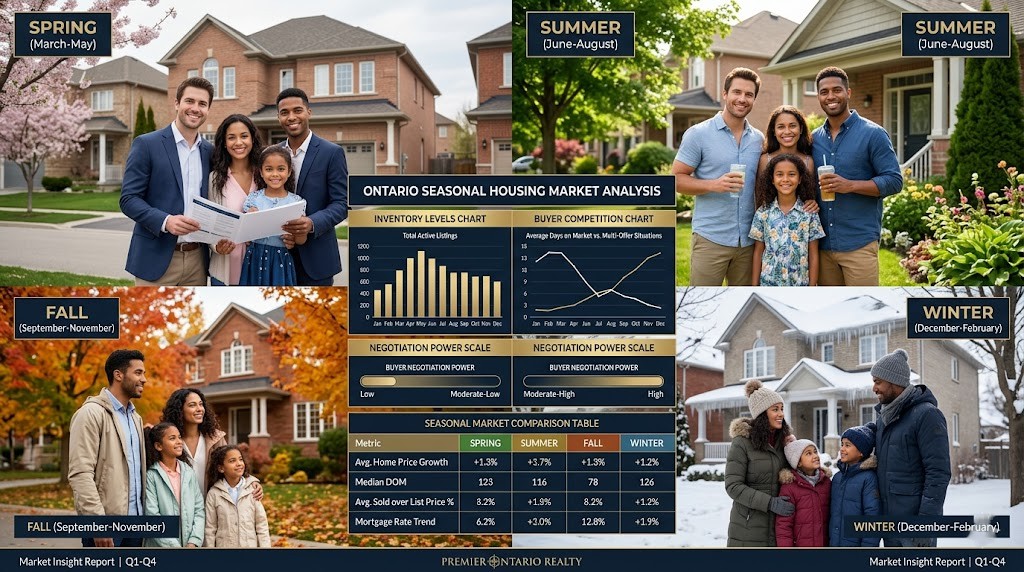
The spring market – March through June – is when the most properties list in Ontario. More choice is real. But “more choice” is not the same as “best price.” Spring is also when buyer competition peaks, multiple-offer situations are most common, and sellers have maximum negotiating leverage.
In 2026, Ontario’s buyer-leaning market makes this myth more misleading than usual. Inventory is at 15-year highs across the province. Homes in Niagara Region are sitting on the market an average of 67 days. Days on market in the GTA have extended significantly from the frenzied 2021-2022 peak. In this environment, the advantage of a “busy” spring market almost entirely evaporates.
| Season | Typical Inventory | Buyer Competition | Average Negotiating Power | Best For |
|---|---|---|---|---|
| Spring (Mar-Jun) | Highest | Highest – multiple offers common | Lowest | Sellers |
| Summer (Jul-Aug) | Moderate, declining | Moderate | Moderate | Neutral |
| Fall (Sep-Nov) | Second highest | Moderate | Good | Buyers – motivated sellers |
| Winter (Dec-Feb) | Lowest | Lowest | Highest | Serious buyers – least competition |
The buyers who consistently get the best prices in Ontario are not the ones who time the calendar correctly – they are the ones who are financially prepared, move quickly when the right property appears, and do not wait for artificial “seasons.” In a high-inventory market like 2026, motivated sellers exist in every month of the year.
What the Myth Costs You
Waiting for spring in a buyer’s market means competing against more buyers for the same properties – paying closer to asking price and losing negotiating leverage that is available right now. In markets with significant price corrections, waiting for “the right season” often means paying more than necessary or losing the property to a less seasonally-minded buyer.
Get an accurate property valuation to sell your home in Niagara.
Myth #3: "Pre-Construction Condos Are Guaranteed to Go Up in Value"

Pre-construction investing became enormously popular in Ontario during the 2015-2022 bull market. Assignment flips were common. Appreciation between signing and closing was treated as a given. The myth that pre-construction condos are a reliable, low-risk appreciation play took root – and has been painfully dispelled in 2023, 2024, and into 2026.
The reality is that pre-construction condos carry a specific set of risks that are distinct from resale properties:
- Closing costs are not fully transparent at signing: HST on new builds (13%), development levies, utility connection fees, and occupancy fees during the interim occupancy period are frequently underestimated by buyers.
- The market may move against you between signing and closing: In Toronto, condo prices are forecast to decline approximately 2.5% in 2026. Buyers who signed pre-construction agreements at 2021-2022 prices and are closing in 2025-2026 are in some cases closing on properties worth less than what they contracted to pay.
- Builder delays are common and are protected by Tarion warranty timelines: Projects regularly close 1-2 years later than the original scheduled date, during which your deposit is tied up.
- Assignment sales are complex and not always permitted: If your circumstances change and you need to exit before closing, selling your contract (assignment) requires builder consent and may attract assignment fees.
This does not mean pre-construction investing is always wrong. In the right project, with the right price and timeline, it can still make sense. But it is not passive, guaranteed appreciation – and treating it as such has cost Ontario buyers and investors significant amounts of money in the current cycle.
What the Myth Costs You
Underestimating closing costs on a pre-construction condo in Ontario can easily add $30,000-$60,000 in unexpected expenses beyond the contract price. Failing to account for market timing risk has left some investors closing on properties with negative equity compared to the contracted purchase price.
Myth #4: "You Don't Need a Real Estate Agent - It Saves Money to Go Direct"

With online listing platforms providing access to almost every MLS listing in Ontario, some buyers conclude that using a buyer’s agent is unnecessary – and that going directly to the listing agent saves money. This reasoning is understandable but almost always wrong, and it is worth understanding exactly why.
| Factor | With a Buyer’s Agent | Going Directly to Listing Agent |
|---|---|---|
| Who pays the buyer’s agent | Traditionally the seller, through commission structure | No buyer’s agent – listing agent may offer reduced total commission to seller |
| Whose interests are represented | Yours – fiduciary duty to the buyer | Listing agent represents the seller, not you |
| Access to off-market and pre-list properties | Yes – network access | No |
| Offer strategy and pricing advice | Yes – comparative market analysis, offer preparation | No – listing agent cannot advise you while representing the seller |
| Due diligence and condition guidance | Yes – home inspection, status certificate review | No |
| Negotiating leverage | Full advocacy on your behalf | Listing agent cannot negotiate against their own client |
| Cost to buyer in most Ontario transactions | $0 – commission paid by seller | Often $0 in cash but significant loss in negotiating and advisory support |
The misconception is that the listing agent’s commission is “saved” when you go direct. In most transactions, the listing agent simply retains a larger share of the total commission – the seller’s discount is not automatically passed to the buyer as a price reduction. Meanwhile, the buyer enters the most significant financial transaction of their life without independent representation, market analysis, or negotiating advocacy.
What the Myth Costs You
Buyers who purchase without independent representation routinely overpay – not because they are careless, but because they lack the comparative market data, offer strategy experience, and negotiating positioning that a buyer’s agent provides. On a $700,000 purchase, a 2% overpayment from poor negotiating is $14,000. The buyer’s agent, in most Ontario transactions, costs you nothing.
Myth #5: "The Asking Price Is the Market Value"

Asking price is a marketing number. It is set by the seller – or more precisely, by the listing agent’s recommendation to the seller – to position the property in the current market. It reflects what the seller hopes to receive. It does not reflect what the property is worth, what comparable properties have actually sold for, or what a reasonable buyer should pay.
In a hot market, asking prices are routinely set below true market value to attract multiple offers and drive prices above asking. In a slow market – like much of Ontario in 2026 – asking prices are frequently set above where the market will actually transact, requiring downward negotiation. Understanding this distinction is fundamental to making an informed offer.
The metric that matters is not asking price but sold price on comparable properties – and specifically the ratio of sold price to asking price in the current market. In Niagara Region in early 2026, the sale-to-list price ratio on many property types is below 100%, meaning properties are selling below asking. Buyers who treat the asking price as the floor – rather than the starting point for a data-informed offer – are leaving money on the table.
What the Myth Costs You
| Market Condition | Sale-to-List Price Ratio | What It Means for Your Offer |
|---|---|---|
| Hot/Seller’s Market (2021-2022) | 105-115%+ | Bidding wars – offers significantly above asking |
| Balanced Market | 98-102% | Offers near asking; minor negotiation typical |
| Buyer’s Market (Niagara/GTA 2026) | 94-99% in many segments | Legitimate offers below asking; data-backed negotiation expected |
In a buyer’s market, a well-researched offer 3-6% below asking on a fairly priced $800,000 property could save $24,000-$48,000. Buyers who do not understand the difference between asking price and market value – and do not have a comparative market analysis in hand – are negotiating blind.
The Cost of Acting on Bad Information

| Myth | Typical Cost to Ontario Buyers |
|---|---|
| Myth #1 – Waiting for 20% down | $50,000-$150,000+ in missed price appreciation over a 3-5 year wait |
| Myth #2 – Timing the spring market | $5,000-$25,000 in above-ask pricing due to peak competition |
| Myth #3 – Pre-construction always appreciates | $30,000-$80,000 in unexpected closing costs or negative equity at closing |
| Myth #4 – Going direct saves money | $10,000-$30,000+ in overpayment from absence of buyer representation |
| Myth #5 – Asking price equals market value | $15,000-$50,000 in overpayment by not negotiating from a data position |
These are not hypothetical losses. They are the real financial consequences of buying on assumption rather than information – and they happen to well-intentioned, financially responsible buyers across Ontario every year.
Buying in Ontario in 2026? Start with the Right Information.
At Quantum Team Realty, we help buyers across Niagara Falls, Brampton, and the broader Ontario market make decisions based on current market data – not outdated assumptions. Whether you are buying your first home or building a property portfolio, understanding the real numbers is where every successful transaction begins.
Our team serves buyers across Niagara Region and the GTA with local market expertise, independent buyer representation, and straight-forward advice – including honest guidance on timing, financing, and the actual costs involved at every stage of a purchase.
Book a Free Buyer Consultation → https://quantumteamrealty.com/contact/
Browse Ontario Listings → https://quantumteamrealty.com/listings/
Get a Free Home Evaluation → https://quantumteamrealty.com/evaluation/
Frequently Asked Questions
Do you really need 20% down payment to buy a home in Ontario?
No. In Canada, the minimum down payment is 5% on homes under $500,000, and 5% on the first $500,000 plus 10% on the remainder for homes between $500,000 and $999,999. The 20% minimum only applies to homes priced at $1,000,000 or more. Purchases with less than 20% down require CMHC mortgage default insurance, which adds a premium to the mortgage.
Is spring really the best time to buy a home in Ontario?
Spring has the most listings but also the most buyer competition – which means higher prices and fewer negotiating opportunities. In a buyer’s market like Ontario in 2026, fall and winter often provide better pricing conditions because fewer competing buyers are active. The best time to buy is when you are financially ready and a suitable property is available, not a specific calendar season.
Are pre-construction condos a safe investment in Ontario?
Pre-construction condos carry risks that resale properties do not – including HST on new builds, development levies, builder delays, occupancy fees, and market timing risk between signing and closing. They are not guaranteed to appreciate. In 2026, some Toronto pre-construction buyers are closing on properties worth less than the contracted price. Due diligence is essential before signing any pre-construction agreement.
Does using a buyer's agent in Ontario cost the buyer money?
In most Ontario real estate transactions, the buyer’s agent commission is paid by the seller as part of the total commission structure. In the post-CREA rule changes that took effect in 2024, some variation exists – but in the majority of transactions, using a buyer’s agent does not add a direct cost to the buyer and provides independent representation, comparative market data, and negotiating advocacy that going direct to the listing agent does not.
Should I offer the asking price on a home in Ontario?
Not without checking the comparable sales data first. In buyer-leaning markets – which describes much of Ontario in 2026 – properties regularly sell below asking price. Your offer should be based on a comparative market analysis of recently sold properties, not the asking price the seller has set. A buyer’s agent can provide this analysis before you make any offer.
What is the biggest financial mistake first-time buyers make in Ontario?
Underestimating closing costs is the most consistent and costly mistake. Beyond the purchase price, buyers must budget for land transfer tax (up to $32,950 in Toronto on a $1M home), legal fees ($1,500-$3,000), home inspection ($500-$700), title insurance, CMHC insurance (if applicable), and Ontario RST on the insurance premium. Not budgeting for these costs can create a serious cash shortfall on closing day.
Is it true that Ontario real estate always goes up in value?
No. Ontario real estate has experienced meaningful price corrections – including in 2017 (after the foreign buyer tax), 2019, and again in 2022-2026 following peak pricing. While long-term appreciation across Ontario has historically been positive, individual properties in specific markets and time periods have experienced significant value declines. Buying at peak pricing in any market carries real downside risk.
Should I skip the home inspection to win a bidding war in Ontario?
In most of Ontario’s 2026 market, waiving a home inspection is not necessary to win offers. With inventory at 15-year highs and seller competition for buyers, inspection conditions are increasingly accepted again. Even in competitive situations, a pre-offer inspection (arranged before submitting the offer) is often possible. Waiving an inspection to save $500-$700 and missing a $30,000 structural issue is one of the most financially damaging decisions a buyer can make.
What does "buyer's market" mean for Ontario home buyers in 2026?
A buyer’s market means there are more properties available than there are active buyers – giving purchasers more negotiating power, more time to make decisions, more ability to include conditions (like home inspections and financing), and more opportunity to negotiate below asking price. In 2026, much of Ontario – including Niagara Region and parts of the GTA – is in a buyer’s market, meaning buyers have advantages they have not had since before 2017.
How do I know if I am ready to buy a home in Ontario?
The key indicators of readiness are: a stable income that can support mortgage payments and carrying costs; a credit score of 650+ (680+ preferred by most lenders); a saved down payment of at least 5% plus closing costs (budget 3-4% of purchase price for closing); and a clear picture of your total budget including all homeownership costs. A free consultation with a local realtor and a mortgage pre-approval are the two most useful first steps for anyone evaluating their readiness.

Sunny Chadha
Sunny Chadha is the Co-Founder of Quantum Team Realty and brings over 15 years of experience in Niagara real estate. He is passionate about helping clients make informed decisions and sharing his deep knowledge of the local market.


